• HOME
  • NEWS
  • EXPLORE
    • CAREER
      • Companies
      • Jobs
    • EVENTS
    • iGEM
      • News
      • Team
    • PHOTOS
    • VIDEO
    • WIKI
  • BLOG
  • COMMUNITY
    • FACEBOOK
    • INSTAGRAM
    • TWITTER
Monday, October 5, 2026
BIOENGINEER.ORG
No Result
View All Result
  • Login
  • HOME
  • NEWS
  • EXPLORE
    • CAREER
      • Companies
      • Jobs
        • Lecturer
        • PhD Studentship
        • Postdoc
        • Research Assistant
    • EVENTS
    • iGEM
      • News
      • Team
    • PHOTOS
    • VIDEO
    • WIKI
  • BLOG
  • COMMUNITY
    • FACEBOOK
    • INSTAGRAM
    • TWITTER
  • HOME
  • NEWS
  • EXPLORE
    • CAREER
      • Companies
      • Jobs
        • Lecturer
        • PhD Studentship
        • Postdoc
        • Research Assistant
    • EVENTS
    • iGEM
      • News
      • Team
    • PHOTOS
    • VIDEO
    • WIKI
  • BLOG
  • COMMUNITY
    • FACEBOOK
    • INSTAGRAM
    • TWITTER
No Result
View All Result
Bioengineer.org
No Result
View All Result
Home NEWS Science News Chemistry

Human contact plays big role in spread of some hospital infections, but not others

Bioengineer by Bioengineer
May 30, 2019
in Chemistry
Reading Time: 3 mins read
0
IMAGE
Share on FacebookShare on TwitterShare on LinkedinShare on RedditShare on Telegram

Findings suggest hand hygiene is key, but more methods needed to fight multidrug-resistant infection
IMAGE

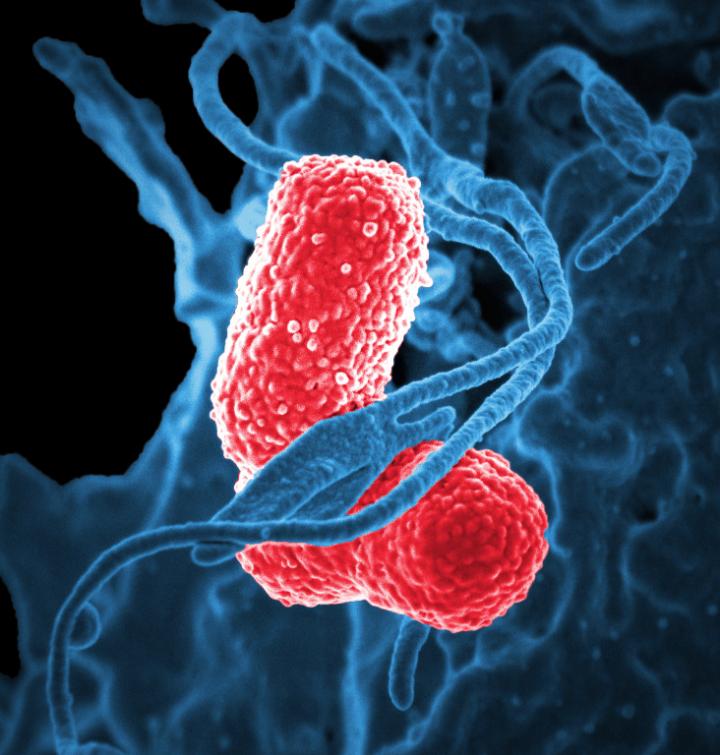
Credit: David Dorward; Ph.D.; National Institute of Allergy and Infectious Diseases.

An observational study conducted in a French hospital showed that human contact was responsible for 90 percent of the spread of one species of antibiotic-resistant bacteria to new patients, but less than 60 percent of the spread of a different species. Audrey Duval of the Versailles Saint Quentin University and Institut Pasteur in Paris, France, and colleagues present these findings in PLOS Computational Biology.

People treated in hospitals and other health care settings are increasingly at risk of infection with multidrug-resistant bacteria. Many of these microbes produce enzymes called extended-spectrum β-lactamases (ESBLs), which make them resistant to antibiotics. Understanding how ESBL bacteria spread from person to person is key to developing effective prevention strategies.

In the new study, Duval and colleagues distributed wearable sensors to hundreds of patients and health care workers in a French hospital. Equipped with RFID tags, the sensors allowed the researchers to track patterns of human contact between patients over an eight-week period. Meanwhile, they systematically screened patients for ESBL-producing Escherichia coli and Klebsiella pneumonia.

The scientists found that 90 percent of the spread of ESBL K. pneumonia to new patients could be explained by direct or indirect contact with patients who had the same bacteria within the previous eight weeks; this figure was less than 60 percent for ESBL E. Coli. The findings suggest that contact-prevention strategies–primarily hand hygiene–can be very efficient in limiting transmission of ESBL K. pneumonia. However, additional measures, such as environmental decontamination or using antibiotics more appropriately, may be necessary to prevent spread of ESBL E. Coli.

The researchers suggest that the same kind of wearable-sensor analysis could be extended to other multidrug-resistant species. Investigation of more detailed genomic data could further illuminate how ESBL-producing bacteria spread.

“By combining digital epidemiology and rapid microbiological diagnostic tools, we may be entering a new era to understand and control the risk of hospital-acquired infection with multidrug-resistant bacteria,” Duval says.

###

Peer-reviewed / Observational study / People

In your coverage please use this URL to provide access to the freely available article in PLOS Computational Biology:
https://journals.plos.org/ploscompbiol/article?id=10.1371/journal.pcbi.1006496

Citation: Duval A, Obadia T, Boëlle P-Y, Fleury E, Herrmann J-L, Guillemot D, et al. (2019) Close proximity interactions support transmission of ESBL-K. pneumoniae but not ESBL-E. coli in healthcare settings. PLoS Comput Biol 15(5): e1006496. https://doi.org/10.1371/journal.pcbi.1006496

Funding: This study was supported by the European Commission under the Life Science Health Priority of the 6th Framework Program (MOSAR network contract LSHP-CT-2007-037941), funding was also received from the French Government through the National Clinical Research Program and the Investissement d’Avenir program, Laboratoire d’Excellence “Integrative Biology of Emerging Infectious Diseases” (grant no. ANR-10-LABX-62-IBEID, http://www.agencenationale-recherche.fr/ProjetIA-10-LABX-0062) to DG and from the Ecole des Hautes Etudes en Santé Publique (EHESP, https://www.ehesp.fr/) to AD. The funders had no role in study design, data collection and analysis, decision to publish, or preparation of the manuscript.

Competing Interests: The authors have declared that no competing interests exist.

Media Contact
Didier Guillemot
[email protected]

Related Journal Article

http://dx.doi.org/10.1371/journal.pcbi.1006496

Tags: BacteriologyBiochemistryBiologyBiotechnologyEpidemiologyHealth Care Systems/ServicesInfectious/Emerging DiseasesMedicine/HealthMicrobiologyTechnology/Engineering/Computer Science
Share12Tweet8Share2ShareShareShare2

Related Posts

Pineapple Core Extract and Aloe Vera Gel Team Up to Keep Fresh-Cut Mangoes Golden

Pineapple Core Extract and Aloe Vera Gel Team Up to Keep Fresh-Cut Mangoes Golden

October 5, 2026
Mulberry Compounds Outdock a Clinical Cancer Drug in CDK1 Simulation Study

Mulberry Compounds Outdock a Clinical Cancer Drug in CDK1 Simulation Study

October 5, 2026

Nanoclay-Boosted Polymer Additive Slashes Waxy Crude Oil Pour Points by 30 Degrees

October 5, 2026

Amino Acid Nanoparticles Turn Indigo Dye Into Biocompatible Memory Devices

October 5, 2026
Please login to join discussion

POPULAR NEWS

  • Alloys That Shrink Their Own Grains: New PIX Mechanism Refines Metals With Heat Alone

    Alloys That Shrink Their Own Grains: New PIX Mechanism Refines Metals With Heat Alone

    29 shares
    Share 12 Tweet 7
  • Endurance Exercise Reshapes the Liver in Males and Females Through Distinct Molecular Routes

    29 shares
    Share 12 Tweet 7
  • Single Transcription Factor PU.1 Rapidly Converts Fibroblasts into Macrophage-Lineage Cells

    29 shares
    Share 12 Tweet 7
  • New Scale Measures How Ready Nurse Educators Really Are for the AI Era

    29 shares
    Share 12 Tweet 7

About

We bring you the latest biotechnology news from best research centers and universities around the world. Check our website.

Follow us

Recent News

Alloys That Shrink Their Own Grains: New PIX Mechanism Refines Metals With Heat Alone

Endurance Exercise Reshapes the Liver in Males and Females Through Distinct Molecular Routes

Single Transcription Factor PU.1 Rapidly Converts Fibroblasts into Macrophage-Lineage Cells

Subscribe to Blog via Email

Success! An email was just sent to confirm your subscription. Please find the email now and click 'Confirm' to start subscribing.

Join 85 other subscribers
  • Contact Us

Bioengineer.org © Copyright 2023 All Rights Reserved.

Welcome Back!

Login to your account below

Forgotten Password?

Retrieve your password

Please enter your username or email address to reset your password.

Log In
No Result
View All Result
  • Homepages
    • Home Page 1
    • Home Page 2
  • News
  • National
  • Business
  • Health
  • Lifestyle
  • Science

Bioengineer.org © Copyright 2023 All Rights Reserved.