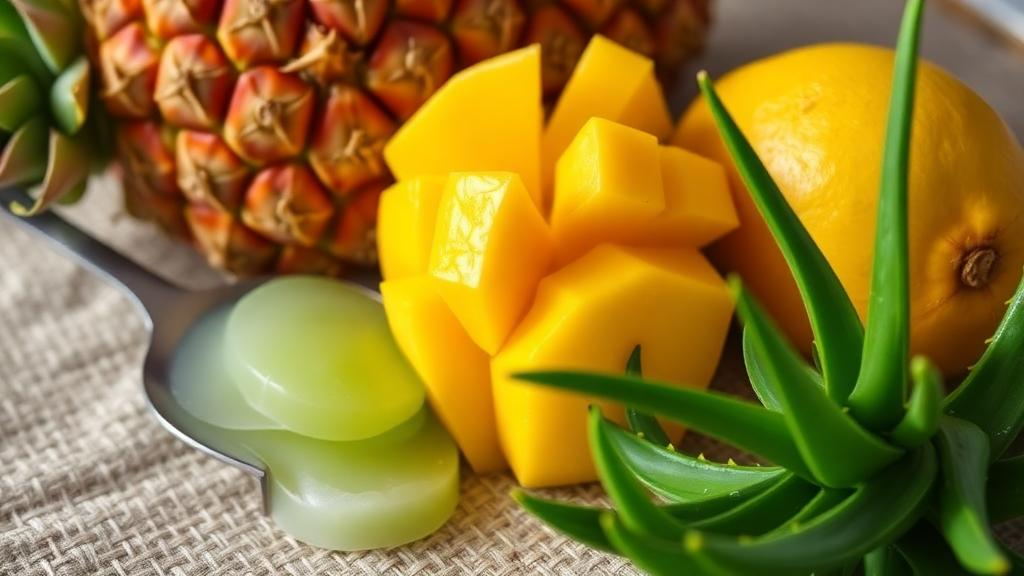
The humble slice of mango has a stubborn enemy: time. Within hours of the knife touching the fruit, the golden flesh of Thailand’s beloved Nam Dok Mai mango begins to turn an unappetizing brown, and within roughly two days of refrigerated storage, the product is usually no longer marketable. That short window has long frustrated producers of fresh-cut fruit, a market that has expanded rapidly as urban consumers demand convenient, ready-to-eat produce. Now, a team of Thai researchers has reported that a simple, entirely plant-based dip, combining pineapple core extract with Aloe vera gel, can dramatically slow that decline, keeping cut mangoes visually appealing, firm, and microbiologically safe for six days at 4 degrees Celsius.
The study, published in Food Chemistry: X, focused on Nam Dok Mai, one of Thailand’s most important commercial mango cultivars and a significant export to Singapore, China, Malaysia, and Japan. Fresh-cut mango deteriorates through three intertwined processes: enzymatic browning, tissue softening, and microbial growth, with yeasts being a particular problem. Browning arises when the enzyme polyphenol oxidase, or PPO, oxidizes phenolic compounds in the damaged tissue, generating brown pigments on the cut surface. The researchers set out to test whether two natural agents with complementary modes of action could tackle these problems simultaneously, offering an eco-friendly alternative to synthetic antibrowning chemicals such as sulfites.
The first ingredient, pineapple core extract, was prepared from Smooth Cayenne pineapple fruit selected at 16 to 18 percent total soluble solids. The cores were blended, squeezed, filtered, and pasteurized at 70 degrees Celsius for 10 seconds before being diluted to a 50 percent solution. Notably, previous work by the same research group had shown that the core of the pineapple, often discarded as waste, is actually more effective at inhibiting browning than the pulp, likely because of its higher bromelain activity. Bromelain is a sulfhydryl protease, a protein-digesting enzyme that has been shown to suppress enzymatic browning, and pineapple also contains organic acids, chiefly citric and malic acids, along with sulfur-containing amino acids and phenolic compounds, all of which contribute to antibrowning and antioxidant activity.
The second ingredient, fresh Aloe vera gel from one-year-old Barbadensis leaves, was similarly blended, filtered, and pasteurized. Aloe vera has earned a reputation in postharvest science as an edible coating: when applied to cut produce, its polysaccharides form a semi-permeable film that limits oxygen diffusion to the surface, reduces moisture loss, and modulates oxidative metabolism. The gel also carries bioactive compounds, including anthraquinones and saponins, with documented antibacterial and antifungal properties. Ripe mangoes, harvested 85 days after anthesis and ripened uniformly with calcium carbide fumigation, were peeled, cut into six-centimeter pieces, and immersed for two minutes in one of three treatment solutions: 50 percent pineapple core extract, 50 percent Aloe vera gel, or a 1:1 mixture of the two. Untreated slices served as the control, and all samples were stored in clear PET trays at 4 degrees Celsius for six days.
The visual results were striking. After just two days of storage, obvious browning had developed on the untreated control slices, while the Aloe vera-treated samples showed slight discoloration. In contrast, the slices dipped in pineapple core extract or the combined treatment showed no visible browning at all. By day six, the control and Aloe vera-only samples were extensively browned, whereas the pineapple-treated and combined-treatment slices displayed only slight browning. Quantitative measurements backed up what the photographs showed: browning intensity, measured as absorbance of ethanol extracts at 420 nanometers, rose steadily in all samples but remained lowest in the pineapple-containing treatments. A panel of fifty tasters scored browning severity on a nine-point scale, and by day six the control and Aloe vera samples had crossed the acceptability threshold of a score above five, while the pineapple core extract and combined treatments remained at approximately 2.8, comfortably within the acceptable range.
Colorimetry told a consistent story. Surface lightness, the L* value, dropped sharply in the control during the first two days, while the treated slices stayed significantly brighter. On day four, the combined treatment achieved the highest L* value of all groups, and by the end of storage the pineapple-containing samples retained significantly better lightness than the control or Aloe vera alone. Hue angles stayed within the range of 88 to 95 degrees, confirming that the slices kept their characteristic yellow color, and the combined treatment held chroma, a measure of color saturation, significantly higher than the control in later storage while maintaining the smallest overall color difference from the initial sample. The researchers attribute the dominant antibrowning effect to the pineapple extract, whose organic acids lower tissue pH and directly suppress PPO activity, while bromelain and sulfur-containing compounds add further inhibition; the Aloe vera layer contributes by physically restricting oxygen delivery to the cut surface.
Texture proved to be where the combination genuinely outperformed either ingredient alone. Firmness declined in all samples over the six days, as expected, since softening in mango is driven by the enzymatic degradation of pectic polysaccharides in the cell wall and by the loss of cell membrane integrity. But from day two onward, the combined treatment consistently maintained significantly higher firmness than every other group, including the individual treatments, while the control was the softest. The authors propose two mechanisms for this synergy. Both pineapple and Aloe vera are rich in calcium, which can cross-link demethylated pectin chains into calcium pectate, strengthening cell-to-cell adhesion and stabilizing the wall. Meanwhile, the Aloe vera coating restricts oxygen diffusion, reducing oxidative stress and membrane lipid peroxidation, which was reflected in lower accumulation of malondialdehyde, a standard marker of membrane damage, in all treated samples compared with the control. Importantly, neither total soluble solids nor titratable acidity changed significantly in any treatment, meaning the dips preserved the fruit’s balance of sweetness and acidity untouched.
On the microbiological front, the roles reversed. Aloe vera immersion proved more effective than pineapple core extract at suppressing total aerobic bacteria, coliform bacteria, and yeasts and moulds, an effect credited to its anthraquinones, saponins, and barrier-forming polysaccharides. Coliform bacteria appeared in the control, pineapple, and combined treatments after four days but were not detected in the Aloe vera samples until day six, and Aloe vera consistently maintained the lowest yeast and mould counts. Throughout the entire storage period, all samples stayed within the microbiological guideline limits for ready-to-eat foods set by the Thai Food and Drug Administration and the Department of Medical Sciences, with total aerobic bacteria below 6 log10 colony-forming units per gram and yeasts and moulds below 4. The combined treatment delayed bacterial proliferation effectively, though the data showed no synergistic antimicrobial interaction beyond what Aloe vera achieved on its own.
To integrate all these threads, the researchers applied principal component analysis to the full dataset of quality attributes. The first two principal components captured 62.2 percent of the total variance, and the resulting biplot cleanly separated the untreated control, which clustered with microbial growth, browning enzymes, lipid peroxidation, and color loss, from all treated samples. The combined treatment sat closest to the desirable attributes of hue angle, chroma, and acidity, and farthest from the deterioration-related variables, confirming its status as the strongest overall preservative strategy. The authors are candid about the study’s limits: sensory attributes such as flavor and aroma, respiration rate, weight loss, and the precise chemical composition of the extracts were not measured, and future work should characterize the bioactive compounds involved. Even so, the message is compelling. Two agricultural byproducts and garden plants, one usually thrown away and the other grown in backyard pots, together kept one of the world’s favorite tropical fruits fresh, firm, golden, and safe for twice its usual shelf life, pointing toward a future where the freshest-cut fruit on the shelf owes its glow to nothing more exotic than pineapple and aloe.
Subject of Research: Natural antibrowning and antimicrobial preservation of fresh-cut mango using pineapple core extract and Aloe vera gel
Article Title: Combined application of pineapple core extract and Aloe vera gel for browning inhibition and quality preservation of fresh-cut ‘Nam Dok Mai’ mangoes
Article References: Keawmanee, N., Techavuthiporn, C., Suo, X., Boonyaritthongchai, P., & Supapvanich, S. (2026). Combined application of pineapple core extract and Aloe vera gel for browning inhibition and quality preservation of fresh-cut ‘Nam Dok Mai’ mangoes. Food Chemistry: X, Article 104571. https://doi.org/10.1016/j.fochx.2026.104571
Image Credits: AI Generated
DOI: 10.1016/j.fochx.2026.104571
Keywords: fresh-cut mango, pineapple core extract, Aloe vera gel, enzymatic browning, polyphenol oxidase, bromelain, edible coating, food preservation, postharvest quality, Nam Dok Mai, food microbiology, natural preservatives
News Source: Morgan Morrow. (October 5, 2026). Pineapple Core Extract and Aloe Vera Gel Team Up to Keep Fresh-Cut Mangoes Golden. Scienmag.