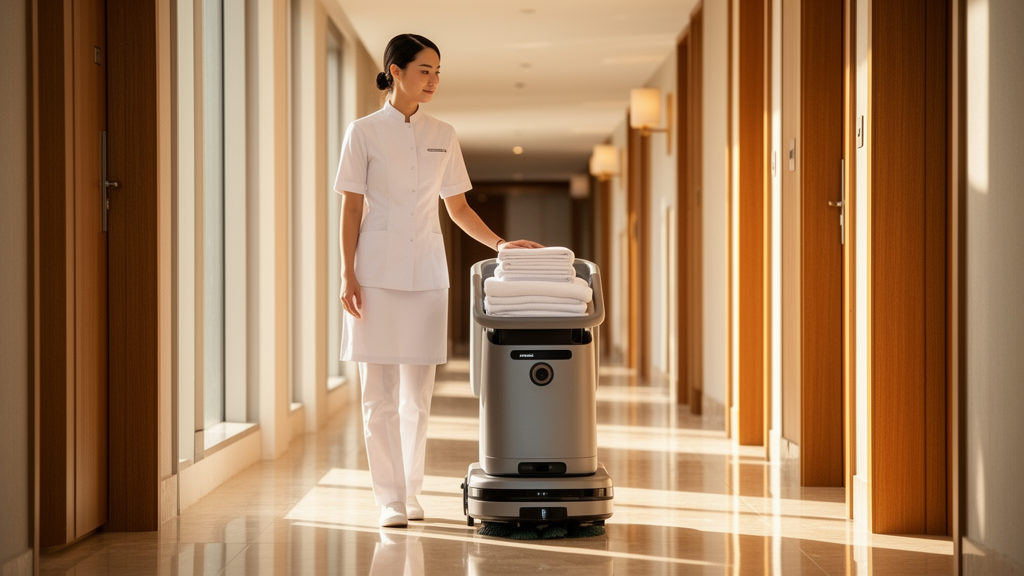
Hotel employees in Jaipur, India, are most willing to accept robotic process automation when they believe it will genuinely improve their work performance, according to a new study that applied an extended technology acceptance framework to the hospitality workplace. The research, published in Discover Analytics, surveyed 170 hotel workers across different hotel categories and departments and analyzed their responses using partial least squares structural equation modeling to test which factors drive acceptance of software robots that automate routine, rule-based tasks.
The study used the extended Unified Theory of Acceptance and Use of Technology, known as UTAUT-3, which measures nine constructs including performance expectancy, effort expectancy, social influence, facilitating conditions, hedonic motivation, price value, habit, behavioral intention, and use behavior. Each construct was assessed with six items on a five-point Likert scale, and the questionnaire was back-translated between English and Hindi to maintain semantic consistency. Data collection took place between December 2024 and February 2025, with participants ranging in age from 20 to 50 years and varying levels of RPA experience.
Results confirmed all hypothesized relationships in the model. Performance expectancy emerged as the strongest predictor of behavioral intention, with a path coefficient of 0.325, followed by effort expectancy at 0.248. The relationship between behavioral intention and use behavior showed the highest path coefficient at 0.342, indicating strong intention-behavior consistency. The model explained 68.5 percent of the variance in behavioral intention and 59.2 percent in use behavior, with fit indices including an SRMR of 0.062 and an NFI of 0.912. Hedonic motivation showed the weakest, though still significant, influence on behavioral intention at 0.162, suggesting that enjoyment matters less than utilitarian factors in this professional context.
Facilitating conditions, which capture organizational support and enablement, influenced both behavioral intention and use behavior directly, with coefficients of 0.228 and 0.195 respectively. The authors interpret this dual pathway as evidence that organizational infrastructure operates at two distinct adoption stages: it signals commitment during intention formation and removes practical barriers during actual implementation. Social influence also contributed moderately to behavioral intention at 0.185, reflecting the hierarchical structures and interdependent service delivery that characterize hotel operations.
Moderation analysis revealed that demographic factors reshape how these acceptance drivers operate. Age negatively moderated the relationship between performance expectancy and behavioral intention, with a coefficient of -0.142, meaning the influence of perceived performance benefits weakens among older employees. Conversely, age positively moderated the effort expectancy to behavioral intention link at 0.156, indicating that ease of use becomes more important for older workers. Experience showed the strongest moderating effect on the habit to use behavior relationship at 0.182, confirming that RPA usage patterns become more habitual with greater exposure. Gender effects were also significant but relatively weaker.
The demographic profile of the sample showed a predominantly young workforce, with 38.2 percent aged 20 to 30 years and 35.3 percent aged 31 to 40. Most respondents, 44.1 percent, had one to two years of RPA experience, while 32.4 percent had less than one year. Five-star hotels represented the largest segment at 41.2 percent of respondents, and front office staff made up the largest departmental group at 26.5 percent. The authors report higher acceptance of RPA among front office employees and luxury hotel category workers, with front office showing a performance expectancy score of 4.32 and a behavioral intention score of 4.28.
The study’s context matters for interpreting these findings. RPA refers to software robots configured to execute routine, rule-based processes by mimicking human interactions with digital systems, operating with minimal intervention after initial deployment. In hotel operations, such systems have been applied to reservation management, automated check-in and check-out procedures, inventory management, financial reconciliation, and compliance reporting. The authors note that technology adoption failures in hotels predominantly stem from human and organizational factors rather than technical limitations, and that the hospitality workforce is characterized by high demographic diversity, significant skill heterogeneity, and lower average technological sophistication compared to technology or professional service sectors.
The weak hedonic motivation effect contrasts with consumer technology research where enjoyment often rivals performance considerations. The authors attribute this to the mandatory workplace context: hotel employees encounter RPA systems not as discretionary entertainment choices but as tools imposed by organizational management, and the value proposition of RPA involves removing unpleasant administrative obligations rather than introducing engaging new activities. This distinction, they argue, suggests that professional contexts fundamentally reshape the psychological drivers of technology acceptance, and that frameworks developed primarily through consumer technology studies may underweight how hedonic considerations recede in specialized automation settings.
The authors caution that the study examined a specific geographic and cultural context using a cross-sectional design, so findings may not generalize uniformly to other regions, hotel types, or operating models. They also relied on self-reported measures of acceptance and use behavior, and recommend future research incorporating objective usage metrics, qualitative investigation, and longitudinal designs tracking employees through implementation processes. The sample size of 170 exceeded a minimum requirement of 156 determined through a priori power analysis, and post-hoc analysis confirmed statistical power of 0.96.
For hotel managers, the findings suggest that implementation strategies should emphasize performance benefits for younger employees, ease of use for older employees, and robust support infrastructure across all segments. The authors recommend tailoring change management communications and training to demographic subgroups rather than applying a uniform approach, noting that the dominant young workforce with moderate RPA exposure provides a conducive atmosphere for technology innovation, but that continued variation in acceptance across departments and hotel categories calls for customized approaches.
Subject of Research: Factors influencing hotel employees' acceptance of robotic process automation in Jaipur, India, using the UTAUT-3 framework
Article Title: Performance expectancy and facilitating conditions drive robotic process automation acceptance among hotel employees while demographic factors reshape adoption pathways
Article References: Tailor, R. K., & Tailor, D. (2026). Performance expectancy and facilitating conditions drive robotic process automation acceptance among hotel employees while demographic factors reshape adoption pathways. Discover Analytics, 4(1), Article 27. https://doi.org/10.1007/s44257-025-00049-y
Image Credits: AI Generated
DOI: 10.1007/s44257-025-00049-y
Keywords: robotic process automation, hotel employees, UTAUT-3, technology acceptance, hospitality industry, PLS-SEM, performance expectancy, facilitating conditions, behavioral intention, demographic moderation, Jaipur India, organizational support
News Source: Denise Maddox. (October 30, 2026). Hotel workers embrace automation when it promises performance gains, study finds. Scienmag.