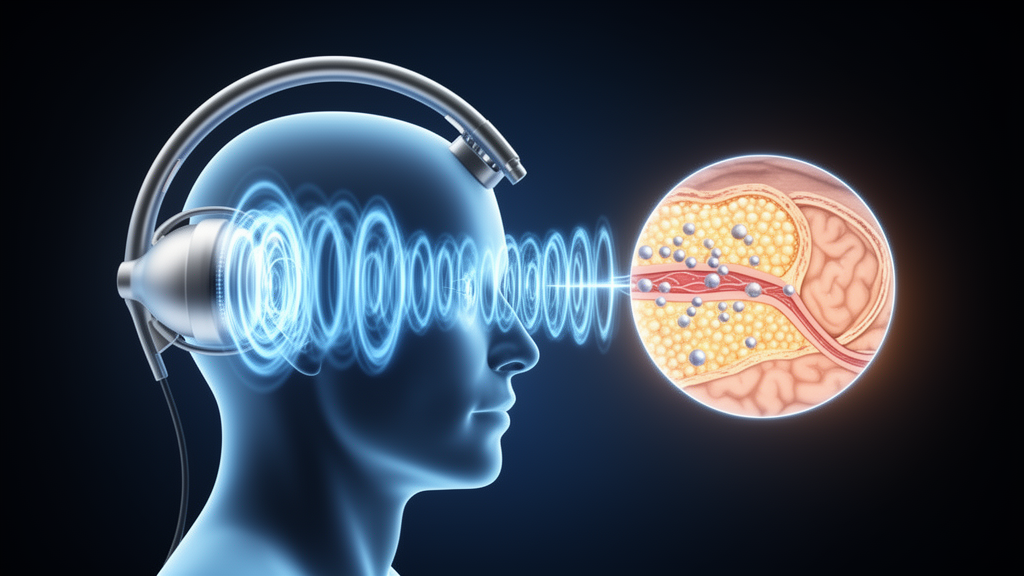
A low-cost platform that pairs 3D-printed holograms with a single ultrasound transducer can noninvasively open the blood-brain barrier at multiple targeted sites around stroke-damaged tissue, according to a study published in Nature Communications. The technique, called hologram-assisted multitarget blood-brain barrier opening, or HaMBO, was tested in male mice with transient focal cerebral ischemia, where a single two-minute treatment enhanced delivery of both extracellular vesicles and mesenchymal stromal cells to the peri-infarct zone, the border region surrounding the dead tissue. The central obstacle the researchers set out to address is twofold.
The blood-brain barrier blocks most circulating therapeutics from entering the brain, and infarcts vary widely in shape and location, making uniform delivery across the damaged region difficult. HaMBO tackles both problems with acoustics: a 3D-printed hologram shapes the output of a single-element transducer into spatially tailored acoustic fields, creating localized barrier opening along the borders of the infarct rather than at one fixed focal point. In the mouse model, the single HaMBO treatment was reported as safe and produced measurable structural and regenerative effects.
Brain atrophy was reduced by approximately 56 percent, angiogenesis increased roughly two-fold, and neural progenitor proliferation rose about four-fold compared with controls. The animals also showed improved long-term behavioral recovery. The delivered therapeutics span an unusually wide size range, from nanoscale extracellular vesicles to whole mesenchymal stromal cells, so a delivery method that accommodates both could apply to a broad set of potential stroke therapies.
To probe the biological mechanism, the team performed spatial transcriptomic analysis, which maps gene expression across intact tissue sections. The analysis associated HaMBO-assisted extracellular vesicle therapy with reduced macrophage infiltration and enhanced pro-angiogenic and neurogenic signaling, suggesting the treatment shifted the inflammatory and repair environment around the infarct toward regeneration. The authors note these transcriptomic findings are associations observed in the treated tissue rather than a demonstrated causal chain.
The study also addressed clinical translation. Simulations based on human skulls demonstrated that the platform could adapt its acoustic fields across diverse stroke scenarios, an early indication that the approach may be adaptable beyond the mouse model. The researchers position HaMBO as a safe, low-cost, and customizable route to noninvasive multitarget delivery for ischemic stroke and potentially other neurological disorders.
As with all preclinical work, the findings come from a male mouse model of transient focal ischemia, and safety, dosing, and efficacy in human patients remain to be established through future studies.
Subject of Research: Hologram-assisted focused ultrasound for noninvasive multitarget brain delivery after ischemic stroke
Article Title: Holographic focused ultrasound enables multitarget EV and MSC delivery for neurovascular repair after ischemic stroke
Article References: Pan, J.-J., Li, C., Yao, X., Wei, Y., Shen, L., Piao, X., Wang, M., Hu, J., Yang, G.-Y., Pei, Y., & Cheng, B. (2026). Holographic focused ultrasound enables multitarget EV and MSC delivery for neurovascular repair after ischemic stroke. Nature Communications. https://doi.org/10.1038/s41467-026-78847-5
Image Credits: AI Generated
DOI: 10.1038/s41467-026-78847-5
Keywords: focused ultrasound, blood-brain barrier, ischemic stroke, extracellular vesicles, mesenchymal stromal cells, holography, neurorepair, angiogenesis, Holographic, focused, ultrasound, enables
News Source: Cassandra Pierce. (October 25, 2026). Holographic ultrasound opens the blood-brain barrier to deliver stroke therapies. Scienmag.