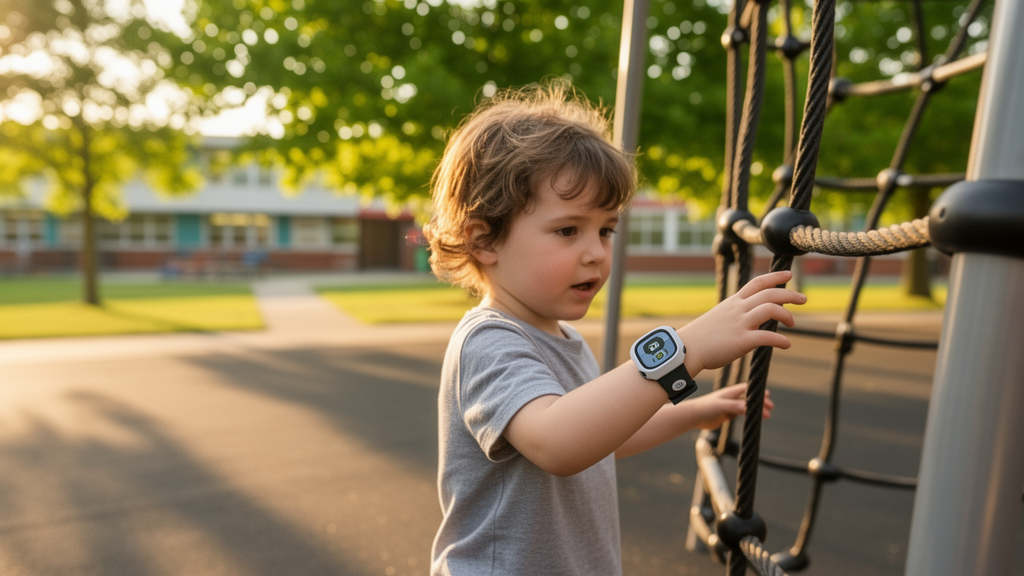
Time spent outdoors is one of the few modifiable factors known to lower the risk of myopia onset in children, but measuring how much bright light a child actually receives each day has long been a logistical headache for researchers. A pilot field study conducted in Kaohsiung, Taiwan, and published in BMC Public Health, tested whether a solar-powered wristwatch could stand in for the chest-mounted light loggers that are considered more accurate but are cumbersome to deploy at scale. The answer, according to the data, is a qualified yes: the watch performed well when describing average exposure across a group, yet it fell short when the goal was tracking a single child's daily bright-light time.
Two children failed to complete the monitoring, leaving 43 child-days of paired measurements from eight children. The two devices produced remarkably similar averages. The mean difference between the HOBO logger and the watch was just −6.3 minutes per day, with a 95% confidence interval spanning −28.6 to 16.1 minutes, meaning the watch neither systematically overestimated nor underestimated bright-light time at the group level.
Spearman's correlation coefficient reached 0.82 and the intraclass correlation coefficient 0.74, both indicating strong agreement between the instruments when daily values were pooled across participants. Agreement on any individual day, however, was far less convincing. The 95% limits of agreement, adjusted for repeated measurements per subject, stretched from −153.3 to 140.8 minutes per day, meaning that on a given day the watch could plausibly differ from the chest logger by roughly two and a half hours in either direction.
Within-child correlation was correspondingly weak, at r = 0.30. When the investigators removed the single child showing the largest measurement discrepancy, the limits of agreement tightened dramatically to between −46.5 and 51.8 minutes per day, suggesting that a substantial share of the observed scatter was driven by one outlier participant rather than by the technology itself. The automated program misread the hour hand in 3 of 54 photographs, a small but nontrivial failure rate for a workflow intended to support large-scale cohorts without trained personnel.
The study's authors conclude that the wrist-worn TT120 correlated strongly with the chest-mounted HOBO and showed a minimal mean difference, making it a plausible tool for describing average bright-light exposure in groups of children. They are equally clear that it cannot substitute for the HOBO in daily individual tracking, given the wide limits of agreement for single days. Time outdoors is an established protective factor against myopia onset, and objective quantification across large cohorts remains challenging, which is precisely the gap this pilot was designed to probe.
Several caveats frame the findings. The sample was small, involving only eight children with complete data over a single week in one city, and the study lacked a calibrated co-located reference standard that could adjudicate which device was closer to the truth when the two disagreed. Even so, the pilot offers an early signal for myopia prevention research.
The results establish a concrete performance profile for the TT120: strong group-level agreement with the chest-mounted logger, weak day-to-day agreement for individual children, and a dial-reading workflow that misread a small share of photographs.
Subject of Research: Agreement between a solar-powered wristwatch and a chest-mounted light logger in quantifying children's daily bright-light exposure
Article Title: Agreement between a wrist-worn solar-powered watch and a chest-mounted light logger in quantifying daily time above 1500 lx in children: a pilot field comparison study
Article References: Huang, T.-J., & Wu, P.-C. (2026). Agreement between a wrist-worn solar-powered watch and a chest-mounted light logger in quantifying daily time above 1500 lx in children: a pilot field comparison study. BMC Public Health. https://doi.org/10.1186/s12889-026-30036-1
Image Credits: AI Generated
DOI: 10.1186/s12889-026-30036-1
Keywords: myopia, light exposure, pediatrics, wearable devices, public health, lux, outdoor time, pilot study, Agreement, between, wrist-worn, solar-powered
News Source: Ophelia Keating. (October 25, 2026). Solar-Powered Watch Tracks Children’s Outdoor Light Exposure in Pilot Study. Scienmag.