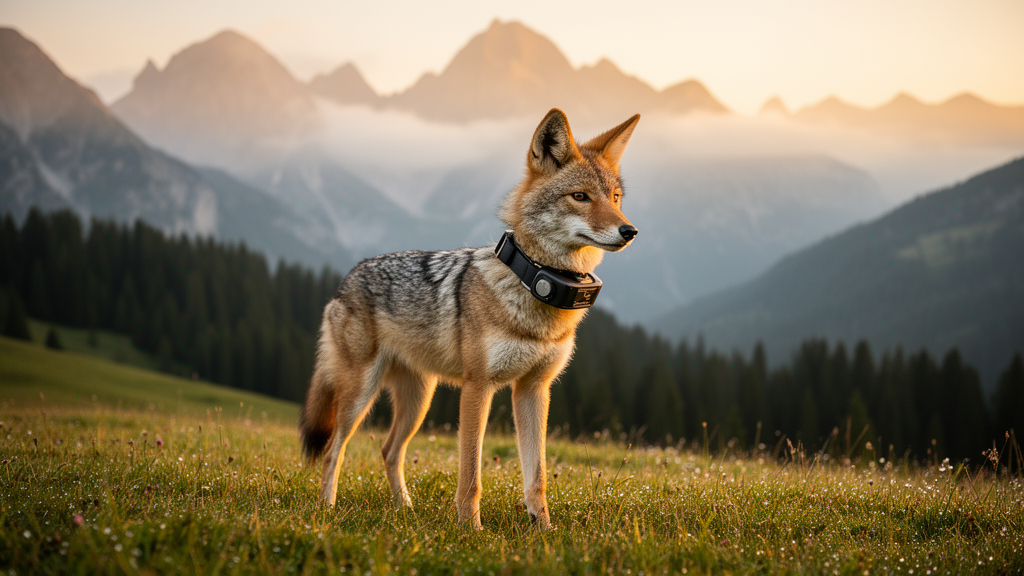
Deep in the Julian Alps of Slovenia, a young male golden jackal woke up one June morning in 2023 with a GPS collar around his neck and no idea that he was about to make scientific history. Researchers had trapped him on the Pokljuka plateau while monitoring wolves, chemically immobilised him with ketamine and medetomidine, and fitted him with a Vectronic GPS-GSM collar weighing just 2.3 percent of his body mass. They named him Maj. Over the following months, the collar silently recorded his every move at intervals of roughly two to four hours, with a validated positional accuracy of 8.3 metres and a fix success rate of 97.9 percent. What those recordings captured, in unprecedented detail, was the first fully documented case of a golden jackal dispersing through a subalpine environment, crossing international borders and major highways, and settling down to found a family above 1000 metres in altitude.
Golden jackals are expanding rapidly across Europe, pushing into northern and western regions where the species was once unknown. Climate change is creating new suitable habitats as temperatures rise, and the animals have proven remarkably adaptable, even relying on anthropogenic food sources during harsh winters in Subarctic and Arctic regions. To the west, jackals have reached the Iberian Peninsula by crossing the Pyrenees. Yet the traditional assumption has been that lowland and semi-open landscapes define the species’ ecological limits. Records from the Alps and Dinaric Mountains have hinted otherwise: a territorial group was documented at approximately 1800 metres in the Italian Alps, and in April 2019 an individual was photographed in the snow at 2350 metres. In the Himalayas, jackals have been reported as high as 5365 metres in Ladakh. But high-altitude sightings of dispersing individuals are one thing; a complete, GPS-tracked dispersal event ending in verified reproduction in subalpine terrain is quite another.
For the first five months after his capture, Maj behaved like a typical resident. He established a transient home range on the pre-Alpine Pokljuka plateau, moving in short relocations and clustering around particular spots in what the researchers interpreted as exploratory behaviour. Then, in November 2023, his movement pattern changed dramatically. The hull elongation values calculated from his GPS data, a metric reflecting the eccentricity of each movement hull, spiked during this period, indicating a strong directional bias. The jackal had entered the dispersal phase, the process by which young carnivores leave their natal range after reaching sexual maturity at around 11 months of age to establish a new family group elsewhere.
The numbers behind Maj’s journey are striking. Analysed at interpolated four-hour intervals, his cumulative minimum distance travelled during dispersal came to 170 kilometres, a conservative figure that does not capture fine-scale tortuosity. His net straight-line displacement between origin and final settlement area was approximately 75 kilometres. Along the way he crossed at least 20 highways and climbed to elevations of up to 1950 metres, briefly reaching a maximum straight-line distance of 96 kilometres from his pre-dispersal home range at the Katschberg ski resort in Austria. He temporarily moved beyond his eventual settlement location before backtracking to establish a territory on the northern slopes at the entrance to the Malta Valley in Carinthia.
To disentangle the phases of this journey, the researchers applied the Time Local Convex Hull framework, optimising the space-time scaling parameter and hull count based on the stability of isopleth area curves. They then computed net squared displacement, the squared Haversine distance from Maj’s first recorded location, and fitted the trajectory with a logistic sigmoid model. Using a two percent threshold of the asymptotic displacement to define dispersal onset, the analysis pinpointed the start of dispersal at 154 days post-capture, on 14 November 2023, and its end at 165 days, on 3 December 2023. The NSD-based dispersal phase itself lasted approximately 11 days, a remarkably tight window. The fitted model estimated an asymptotic net squared displacement of 4.91 × 10⁹ square metres, a half-displacement time of 156 days, and a steepness parameter of 0.54 per day, reflecting a fast increase in net displacement around the trajectory’s midpoint.
The behavioural models revealed two considerable effects on step length during dispersal. Night as time of day carried a posterior estimate of 1.15 on the log scale, with a 95 percent highest posterior density interval of 0.52 to 1.77, confirming that Maj covered greater distances between consecutive GPS locations after dark. The mean aggregation index also showed a considerable positive effect of 0.39, indicating that the jackal moved more extensively in homogeneous, aggregated landscapes than in fragmented ones. These patterns suggest a temporal avoidance of human activity during daylight hours and rapid, uninterrupted transit through uniform terrain, consistent with findings in GPS-collared wolves and previous golden jackal telemetry studies.
More surprising was what the models failed to show. None of the eight environmental covariates tested, including tree cover density, human settlement density, slope, distances to roads, rivers, vegetation and buildings, had considerable effects on resting-site selection, defined as locations where Maj remained within overlapping 250-metre buffers for at least six consecutive hours. Turning angle, modelled with gamma regression, was likewise unaffected by any covariate. Crucially, altitude and slope showed no evidence of constraining the intensity or directionality of Maj’s movements. The mountainous terrain that researchers predicted might impede dispersal simply did not register in the data. Roads, rivers and even human settlements failed to act as barriers, echoing previous demonstrations that jackals can traverse motorways and heterogeneous landscapes during dispersal.
Then came the confirmation that transformed a movement study into a colonisation record. In spring 2024, camera traps at a mid-elevation montane site at 1230 metres captured a second individual and, most likely in late April, the birth of two pups. Photographic evidence of the family interacting at multiple sites suggested the establishment of a stable family group. Because the collared male remained resident in the territory before and after these observations, the most parsimonious explanation is successful settlement followed by local reproduction. Maj had not merely passed through the subalpine environment; he had founded a family in it, the first documented golden jackal settlement in this region.
The findings carry weight beyond a single animal’s biography. Previous GPS-tracked jackal dispersals have shown transience durations ranging from 8 to 97 days, with recorded dispersal distances of up to 3400 kilometres, and Maj’s 11-day event fits neatly within this spectrum. Notably, while neither genetic nor telemetry data show conclusive evidence that male jackals disperse farther than females, the first recorded individuals in new areas have so far always been males, and Maj continues that pattern. The researchers caution that their inferences describe individual-level patterns rather than population-level effects, and that interpolation of irregular GPS fixes means cumulative distances are minimum estimates. Still, the case demonstrates that suitable golden jackal habitat exists even in regions traditionally considered marginal for the species. As jackals multiply in transboundary regions of Central Europe, the study underscores the need for international collaboration in monitoring, for genetic analyses of newly established subalpine populations, and for long-term observation of population dynamics, potential human-wildlife conflicts and ecological interactions with native fauna.
Subject of Research: First GPS-documented dispersal and settlement of a golden jackal in a subalpine environment
Article Title: Overcoming Alpine Barriers: The First Documented Case of Golden Jackal (Canis aureus) Settlement in a Subalpine Environment
Article References: Custers, J., Hatlauf, J., de Bergeyck, A., Črtalič, J., Pokorny, B., & Potočnik, H. (2026). Overcoming Alpine Barriers: The First Documented Case of Golden Jackal ( Canis aureus ) Settlement in a Subalpine Environment. Ecology and Evolution, 16(10), Article e74511. https://doi.org/10.1002/ece3.74511
Image Credits: AI Generated
DOI: 10.1002/ece3.74511
Keywords: golden jackal, Canis aureus, dispersal, GPS telemetry, Alps, subalpine settlement, range expansion, camera traps, movement ecology, Slovenia, Austria, wildlife monitoring
News Source: Gavin Prescott. (October 25, 2026). GPS-Collared Golden Jackal Crosses Alps to Settle and Breed in Austria. Scienmag.