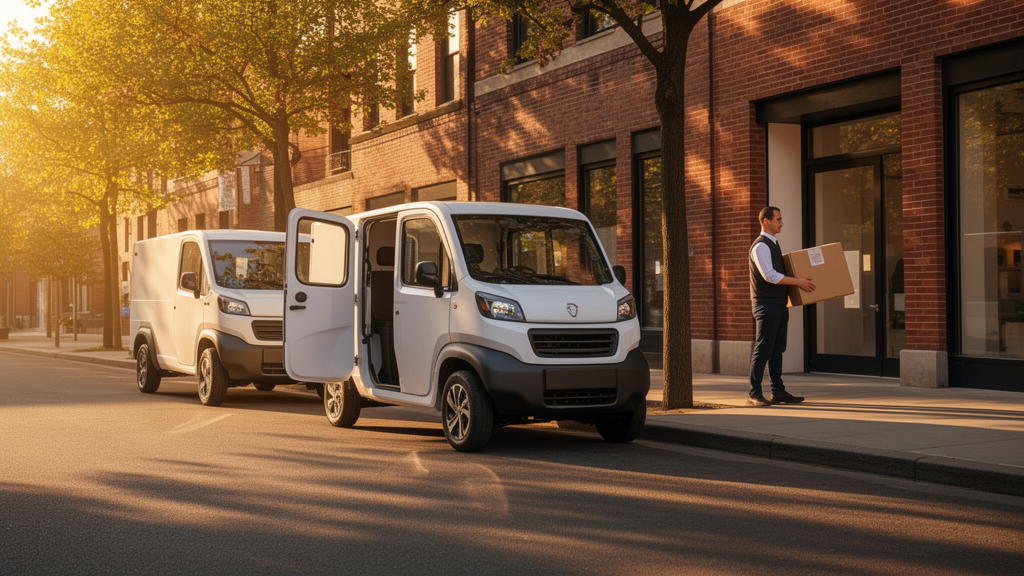
Electrifying delivery fleets combined with route integration offers the largest simulated energy and emissions savings for e-commerce last-mile logistics, according to a comparative evaluation published in Scientific Reports. The study, led by Pengcheng Xie and colleagues, tested five energy-efficiency strategies across 120 calibrated simulated operating scenarios spread over five metropolitan regions and three delivery-density classes, benchmarking each against a conventional internal-combustion baseline.
The team compared route optimization, shipment consolidation, fleet electrification, and an integrated strategy that combined these measures. Route optimization alone reduced mean final energy use by 11.07 percent and route-operational CO₂e emissions by 11.06 percent relative to the baseline, while consolidation achieved reductions of 14.58 percent and 14.56 percent respectively. These operational measures delivered consistent but comparatively modest gains in the simulations.
Electrification produced a far larger effect. After accounting for 90 percent charging efficiency, switching to electric vehicles cut grid-purchased final energy use by 66.43 percent and route-operational CO₂e emissions by 61.15 percent. The integrated strategy, which layered electrification on top of route optimization and consolidation, performed best overall: grid-purchased final energy fell by 74.13 percent, route-operational CO₂e dropped by 70.05 percent, and productivity rose from 29.34 to 33.81 deliveries per vehicle-hour.
The analysis went beyond simple averages. The researchers applied paired scenario-level comparisons, controlled-response analysis, factorial decomposition, grid-carbon break-even analysis, Monte Carlo simulation, and robustness tests. Factorial and alternative-combination analyses showed that the integrated strategy kept its first-place ranking even after removal of the 0.99 integration multiplier and under the examined alternative combination rules, suggesting the result was not an artifact of a single modeling choice.
Grid carbon intensity emerged as a decisive boundary condition. Both electrified strategies remained lower-carbon than the combustion baseline under average grid emission factors, but the advantage was fragile under nonbaseload factors: fleet electrification retained its carbon benefit in only 91 of the 120 scenarios when nonbaseload grid factors were applied. This indicates that the climate case for electric last-mile fleets depends on when and how vehicles draw power from the grid, not merely on the average emission factor.
Uncertainty testing reinforced a condition-dependent picture. The ordering of the five strategies remained unchanged across all ordinary-uncertainty simulations, but rankings frequently reversed under deliberately severe implementation stress. The authors conclude that the findings support condition-dependent strategy selection rather than a one-size-fits-all prescription.
The study’s scope carries important limitations. All results derive from calibrated simulated operations rather than measured field deployments, and the analysis covers route-level energy use and emissions only. The findings are therefore best read as a comparative modeling exercise that identifies which levers offer the greatest simulated headroom for cutting last-mile logistics energy and carbon under varying metropolitan conditions and grid characteristics.
For logistics operators and policymakers watching the decarbonization of urban freight, the message from this modeling work is that integration pays: combining operational measures with powertrain switching yielded the strongest central performance across the simulated scenarios. But the same work cautions that the size of the prize depends on local delivery density, grid carbon characteristics, and how robust each strategy remains when real-world conditions depart from model assumptions.
Subject of Research: Comparative evaluation of energy-efficiency and low-carbon strategies for e-commerce last-mile logistics using 120 calibrated simulated scenarios
Article Title: Comparative evaluation of energy efficiency strategies for green and low-carbon e-commerce logistics operations
Article References: Xie, P., Hu, L., Lu, C., Huang, J.-C., & Alizadeh, M. (2026). Comparative evaluation of energy efficiency strategies for green and low-carbon e-commerce logistics operations. Scientific Reports. https://doi.org/10.1038/s41598-026-76431-x
Image Credits: AI Generated
DOI: 10.1038/s41598-026-76431-x
Keywords: e-commerce logistics, last-mile delivery, energy efficiency, fleet electrification, carbon emissions, route optimization, shipment consolidation, simulation, grid carbon intensity, Scientific Reports, Comparative, evaluation
News Source: Denise Maddox. (October 25, 2026). Integrated Electrification Cuts Simulated Last-Mile Delivery Emissions Most. Scienmag.