Body mass appears to shape one of the most widely used measurements in animal tracking research. A new study of free-ranging black-tailed prairie dogs (Cynomys ludovicianus) reports that dynamic body acceleration, a summary of movement intensity derived from animal-borne accelerometers, declines as body mass increases within a single species. The finding, published in the journal Animal Biotelemetry, offers rare field-based evidence that body size can complicate how researchers interpret accelerometer data in comparative and energetic studies.
Dynamic body acceleration, or DBA, is widely used to infer behaviour and movement-related energy expenditure in wild animals. Biomechanical scaling theory predicts that smaller animals should generate higher mass-specific accelerations during locomotion, but the authors note that this expectation has rarely been tested within a free-ranging species. The new study set out to address that gap using a standardised measurement protocol across dozens of individuals.
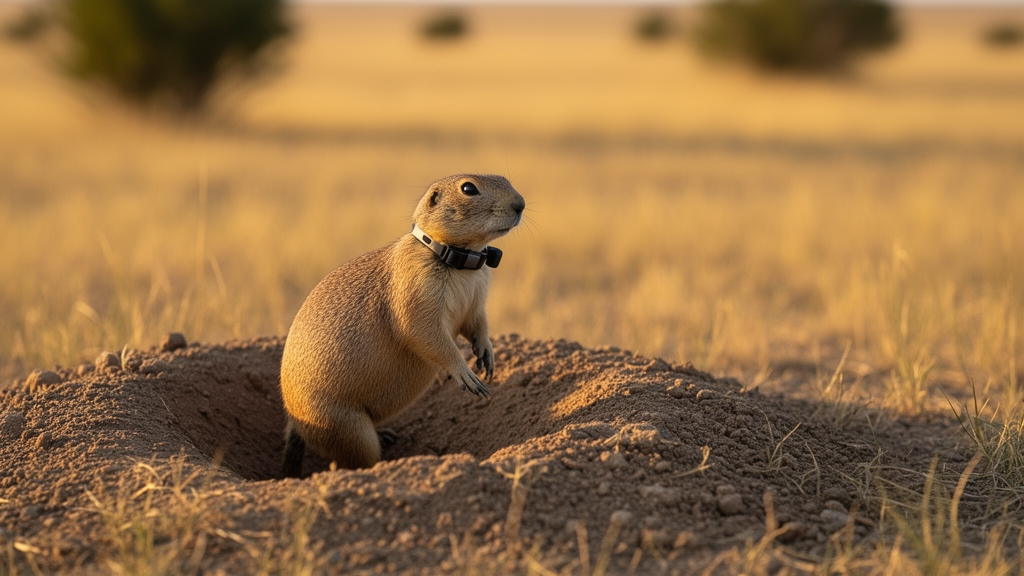
The team deployed collar-mounted tri-axial accelerometers recording at 40 Hz on 41 free-ranging prairie dogs. Movement intensity was quantified using smoothed vectorial dynamic body acceleration, abbreviated sVeDBA, a commonly used derivative of the raw accelerometer signal. To test for scaling, the researchers carried out a log-log analysis in which sVeDBA values were natural-log transformed at the record level before being averaged within individuals.
The results showed a clear negative relationship. Mean log-sVeDBA declined with increasing body mass, with an estimated scaling exponent of −1.37 and a 95% confidence interval spanning −2.33 to −0.41. The model’s R-squared value was 0.175, indicating that body mass explained a modest but detectable share of the variation in movement intensity among individuals.
The magnitude of the effect was substantial, though imprecise. Across the observed body-mass range of 0.82 to 1.31 kilograms, the fitted geometric mean sVeDBA was 47.3% lower at the maximum body mass than at the minimum. The authors emphasise that uncertainty around this estimate was considerable, with a 95% confidence interval ranging from 17.3% to 66.4% lower.
Behaviour may partly explain the pattern. Using behavioural classification informed by video-synchronised observations of captive animals, the researchers found that the proportion of daytime spent resting increased with body mass. Estimated changes in the allocation of time to walking and foraging, and to running, were negative but uncertain. In other words, heavier prairie dogs in the study tended to rest more during the day, which could contribute to lower overall acceleration summaries.
To test this, the team accounted for daytime walking/foraging and running allocation in their analysis. Doing so attenuated the estimated mass coefficient by approximately 24%, yet the negative mass–sVeDBA relationship remained evident. This suggests that differences in activity budgets account for only part of the scaling pattern, and that acceleration itself may vary with mass even within comparable behaviours.
Indeed, the behaviour-specific relationships differed among resting, walking/foraging and running, indicating that the whole-deployment pattern did not reflect a uniform scaling of locomotor acceleration. The overall decline in acceleration with body mass therefore emerges from a combination of behavioural and biomechanical influences rather than a single simple mechanism.
The authors say their results provide field-based evidence that body mass can influence accelerometer-derived movement summaries within a species. They highlight the importance of interpreting DBA alongside behaviour, morphology and attachment context when the metric is used in comparative or energetic applications. For researchers using accelerometers to estimate energy expenditure across animals of different sizes, the study is a reminder that a seemingly straightforward movement metric may carry a body-mass signature of its own.
Subject of Research: How body mass influences accelerometer-derived movement measurements in free-ranging black-tailed prairie dogs
Article Title: The scaling of motion: dynamic body acceleration declines with body mass in black-tailed prairie dogs
Article References: Redcliffe, J., Boulerice, J. T., Namir, I., Shamon, H., Haley, E.-J., Koziol, M., Tretten, T., McShea, W. J., & Wilson, R. P. (2026). The scaling of motion: dynamic body acceleration declines with body mass in black-tailed prairie dogs. Animal Biotelemetry. https://doi.org/10.1186/s40317-026-00497-7
Image Credits: AI Generated
DOI: 10.1186/s40317-026-00497-7
Keywords: black-tailed prairie dogs, dynamic body acceleration, accelerometers, biotelemetry, body mass scaling, animal movement, energy expenditure, behavioural classification, sVeDBA, wildlife tracking, biomechanics, ecophysiology
News Source: Drew Townsend. (October 29, 2026). Heavier prairie dogs move with lower acceleration, collar data reveal. Scienmag.