Cassava is one of the most quietly important crops on Earth. Across sub-Saharan Africa, Latin America and tropical Asia, this starchy root sustains hundreds of millions of people, thriving in drought, poor soils and erratic rainfall where other staples falter. Yet behind its resilience lies a stubborn bottleneck: cassava is painfully slow to breed. Its highly heterozygous genome, asynchronous flowering and long breeding cycles mean that developing an improved variety can take many years, while the traditional phenotyping methods used to evaluate each generation—measuring yields, digging roots, scoring plant architecture by hand—are laborious, expensive and difficult to scale. A new study published in BMC Agriculture now shows that a handheld sensor costing a fraction of high-end remote sensing platforms could help break this logjam, turning a simple measure of canopy greenness into a powerful predictor of root yield.
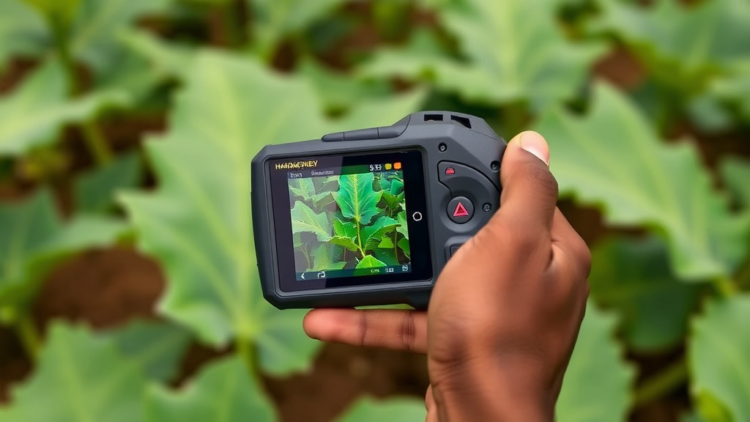
The research, led by Abiodun Fatai Olayinka of the West Africa Centre for Crop Improvement at the University of Ghana and the International Institute of Tropical Agriculture in Ibadan, Nigeria, set out to develop a rapid phenotyping protocol for cassava using the Normalized Difference Vegetation Index, or NDVI. NDVI is calculated from the difference between near-infrared and red light reflectance divided by their sum, a formula that exploits the way healthy plant canopies strongly absorb red light for photosynthesis while reflecting near-infrared radiation from their internal leaf structure. Because NDVI rises with vegetative vigour, it has long been used from satellites and drones to monitor crop growth. But those platforms are costly and technically demanding for many resource-constrained breeding programs, so the team turned to the Trimble GreenSeeker, an affordable handheld meter that emits red light at 660 nanometres and near-infrared light at 780 nanometres and reads back the reflectance in real time.
The scale of the trial was substantial. The researchers evaluated 453 cassava accessions, including clonal evaluation lines and commercial checks, across two contrasting agroecological zones in Nigeria during the 2021/2022 planting season. The first site, Mokwa, lies in the Southern Guinea Savannah at 180 metres above sea level, with sandy loam soils, bimodal rainfall of roughly 1200 millimetres per year and temperatures ranging from 28 to 35 degrees Celsius. The second, Onne, sits in the Humid Forest zone just 6.8 metres above sea level, with clay loam soils, abundant rainfall near 2700 millimetres per year and cooler temperatures of 24 to 32 degrees. Using an augmented block design with two replications per location, the team collected NDVI readings at three, six and nine months after planting, holding the sensor one metre above the canopy at a 45-degree angle and averaging three readings per plot, alongside ground-truth measurements of 26 agronomic traits covering yield, plant architecture and root quality.
The genetic parameters that emerged from the trial were encouraging for breeders. Broad-sense heritability estimates—the proportion of observed variation attributable to genetics—were moderate to high for the traits that matter most: 0.56 for fresh root yield, 0.61 for dry matter content, 0.61 for starch content and 0.66 for harvest index. These figures indicate that selection should deliver real genetic gains. Heritability ranged from zero for NDVI at three months up to 0.87 for height at first branch at the same stage. Genotypic coefficients of variation reached nearly 49 percent for the number of lodged plants per plot, and the highest genetic advance as a percentage of the mean, 71.57 percent, was recorded for that same lodging trait, meaning the trait would respond dramatically to selection pressure applied to the top five percent of the population.
Perhaps the most striking biological finding concerned plant architecture. Genotypic correlations revealed strong negative relationships between lodging—the tendency of plants to lean or collapse—and key yield components: fresh root yield correlated at minus 0.56 and harvest index at minus 0.72. At Mokwa, the correlation between harvest index and the number of lodged plants per plot reached minus 0.73, while lodging showed strong positive correlations with plant height at six and nine months, at 0.87 and 0.79 respectively. In other words, tall plants tend to fall over, and falling over costs yield. Path coefficient analysis reinforced the picture: at Mokwa, root weight exerted a direct positive effect of 1.0 on fresh root yield, harvest index boosted root weight by 0.69, and plant height at nine months contributed positively through root weight, while the number of lodged plants and plant height at six months dragged root weight down.
The predictive heart of the study lay in the regression models linking NDVI to agronomic traits. In the Mokwa trial, NDVI measured at six months after planting predicted fresh root yield, dry yield and root weight with a coefficient of determination of 0.90—an exceptionally strong result for a single handheld reading. Plant height was predicted with even greater precision at early stages, with NDVI at three months explaining 94 percent of the variation in plant height at three months. Harvest index was moderately predicted at around 0.7 using NDVI at six and nine months, and quality traits such as dry matter content showed low error margins, with root mean squared errors between 1.2 and 1.6 percent. For cassava breeders who currently must wait until harvest, often nine to twelve months after planting, to know what a genotype can deliver, a mid-season spectral reading that forecasts yield this accurately is transformative.
But the story was not uniformly rosy. At Onne, the humid forest site, prediction accuracy dropped to moderate levels, with R-squared values around 0.50 for fresh root yield, dry yield and root weight predicted from NDVI at nine months, and error terms nearly doubled—root mean squared error rose to 15.3 tonnes per hectare and mean absolute error to 13 tonnes, compared with 8.3 and 7.4 tonnes per hectare at Mokwa, roughly a 50 percent error reduction in the savanna site. The explanation lies in the atmosphere and the soil. Mokwa enjoys higher solar irradiance and lower atmospheric humidity, conditions that favour stable spectral reflectance, while Onne’s persistent cloud cover and heavy rainfall introduce noise and interference that degrade the consistency of NDVI data. Similar patterns have been reported elsewhere, with prediction accuracy declining under wet, saturated field conditions.
An intriguing paradox also surfaced in the genetic analysis. Despite NDVI’s superb predictive performance, its broad-sense heritability across all timepoints was essentially zero, driven by very low genotypic variance—peaking at just 0.00029—and high error variance. The observed variation in NDVI, the authors conclude, was largely non-genetic, reflecting the sensor’s sensitivity to micro-environmental noise such as light variability, soil exposure and inconsistent canopy closure. This positions NDVI not as a heritable trait in its own right but as an environmentally responsive estimator of phenotypic performance, valuable precisely because it integrates the crop’s response to its growing conditions. The practical implication is clear: handheld NDVI readings are excellent for rapid phenotyping and mid-season selection decisions, but their reliability depends heavily on site conditions, and breeders should treat predictions from different environments with appropriate caution.
The broader significance of the study extends well beyond cassava. Strong genotype-by-environment interaction was evident for most traits, echoing earlier Nigerian and South African trials, and the authors argue that genetic improvement remains achievable through multi-environment testing, selection for broad or specific adaptation, and predictive models that explicitly incorporate these interactions. Because dry matter content is highly correlated with starch content, selection for one can drive gains in the other, and the moderate heritability combined with a genetic advance of roughly 20 percent for starch content suggests meaningful improvement is within reach for industrial-quality roots. With error reductions of this magnitude available from a sensor that costs a tiny fraction of drone or satellite systems, and with data and code openly archived on Zenodo, the study offers breeding programs across the tropics a practical, low-cost route to faster variety development—provided they respect the environmental limits of what a single greenness reading can tell them.
Subject of Research: NDVI-based high-throughput phenotyping for accelerating cassava genetic improvement
Article Title: Accelerating cassava genetic improvement through NDVI-based high-throughput phenotyping
Article References: Accelerating cassava genetic improvement through NDVI-based high-throughput phenotyping. (n.d.). https://doi.org/10.1186/s44399-026-00037-x
Image Credits: AI Generated
DOI: 10.1186/s44399-026-00037-x
Keywords: cassava, NDVI, high-throughput phenotyping, plant breeding, genotype-by-environment interaction, heritability, yield prediction, remote sensing, plant architecture, Nigeria, food security, GreenSeeker
Cite Scienmag News
APA MLA Chicago
Alan Morgan. (September 21, 2026). Handheld NDVI Sensor Accelerates Cassava Breeding in Nigeria. Scienmag. https://scienmag.com/handheld-ndvi-sensor-accelerates-cassava-breeding-in-nigeria/
Alan Morgan. “Handheld NDVI Sensor Accelerates Cassava Breeding in Nigeria.” Scienmag, 21 September 2026, https://scienmag.com/handheld-ndvi-sensor-accelerates-cassava-breeding-in-nigeria/. Accessed 21 September 2026.
Alan Morgan. “Handheld NDVI Sensor Accelerates Cassava Breeding in Nigeria.” Scienmag. September 21, 2026. https://scienmag.com/handheld-ndvi-sensor-accelerates-cassava-breeding-in-nigeria/
Copy citation Download RIS
Tags: accelerated plant breeding techniquescassavacassava breedingcassava crop improvementcost-effective agricultural sensorscrop yield prediction toolsFood securitygenotype by environment interactionGreenSeekerhandheld NDVI sensorheritabilityhigh-throughput phenotypingNDVINigeriaNigeria cassava researchphenotyping technology in tropical cropsplant architectureplant breedingplant canopy greenness measurementrapid phenotyping in agricultureremote sensingremote sensing for crop yield predictiontropical crop resilience and breedingyield prediction