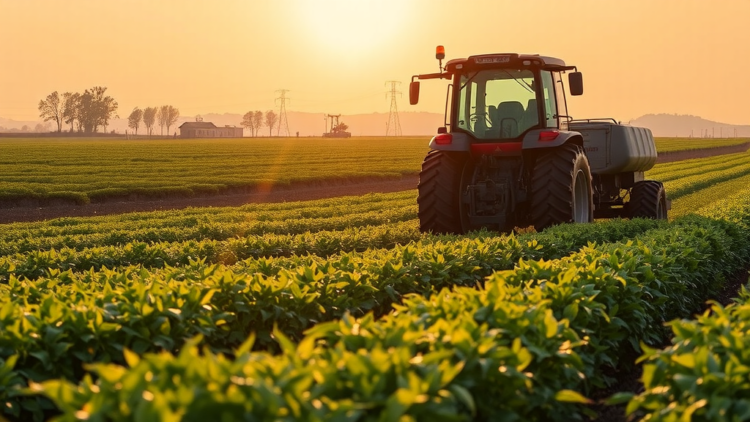
A sweeping new survey published in the International Journal of Data Science and Analytics argues that machine vision, the branch of artificial intelligence that lets computers and robots perceive and interpret visual information, has moved from laboratory curiosity to a working backbone of precision agriculture. The review, led by Shirun Gu, Xinyuan Fan, Lihui Zhu, Caixia Song and colleagues at Qingdao Agricultural University in Shandong, China, pulls together decades of research on how cameras, image processing algorithms and machine learning models are being deployed across nearly every stage of crop production, from the seed in the soil to the fruit on the supermarket shelf. Its central message is striking: the farm of the near future will not merely be mechanized, it will be able to see.
Machine vision systems combine image acquisition hardware, such as RGB cameras, multispectral and hyperspectral sensors, infrared thermography and even X-ray imaging, with software pipelines that clean, enhance and analyze the resulting images. The survey traces the classical workflow in detail. Raw images are first converted between color spaces or reduced to grayscale, then enhanced through techniques such as histogram equalization and its many adaptive variants, which stretch contrast while preserving brightness and structural detail. Noise introduced by dust, vibration and inconsistent field lighting is suppressed with Gaussian, median and Wiener-style filters, some of them optimized for real-time performance on embedded processors. Only after this preprocessing can the harder tasks begin: segmenting plants from soil, extracting features such as color, texture and shape, and classifying what the camera has actually seen.
Those downstream tasks have been transformed by the deep learning revolution. The survey documents the field’s migration from hand-engineered classifiers such as k-nearest neighbors, support vector machines, logistic regression and random forests toward convolutional neural networks, including landmark architectures such as AlexNet and the YOLO family of real-time object detectors, and more recently toward transformer-based and hybrid convolutional-transformer models. In plant disease detection alone, the authors cite systematic reviews showing that deep learning approaches now dominate the literature, with models trained on leaf imagery achieving rapid, automated diagnosis across crops as varied as tomato, grape, citrus, papaya and blueberry. Explainable deep vision frameworks have even been applied to plant stress phenotyping, giving breeders not just a prediction but a spatial map of where stress manifests on the plant.
Pest identification and monitoring emerges as one of the most mature application areas. Early systems relied on color cues to distinguish weeds from crops, while large-scale investigations demonstrated that machine vision could identify weed seeds with high accuracy. More recent work combines k-means clustering with convolutional neural networks for weed identification, enabling precision sprayers that apply herbicide only where weeds are detected rather than across entire fields. Smartphone-based systems now allow aphid identification and counting in the field, and light-attracted pest traps fitted with vision modules can automatically recognize and tally insect catches at high altitude in orchards. The practical payoff is a reduction in chemical inputs, lower costs and less environmental burden, all of which align with the sustainability goals that motivate precision agriculture in the first place.
The survey also charts how vision systems track crop growth and estimate yield, a problem with direct economic consequences. Researchers have measured seedling growth rates from images as early as the 1990s, and subsequent systems have monitored greenhouse vegetables, mushrooms and chrysanthemums non-destructively over time. Yield mapping began with citrus, where cameras counted fruit on the tree, and has since expanded to tomato yield estimation and fruit maturity detection using machine vision pipelines. Crop-load estimation with YOLOv8 illustrates the current state of the art: a single neural network counts fruit in real time from imagery captured on the move, giving growers a data-driven forecast of harvest volume before a single crate is filled. Systematic reviews of machine learning for crop yield prediction confirm that such vision-derived features are increasingly central to these forecasting models.
Perhaps the most visually dramatic applications involve harvesting robots, which must find fruit, localize it in three dimensions and guide a manipulator to pick it without damaging the crop. The review covers recognition and localization methods for fruit-picking robots across cucumber, apple, cotton, strawberry and citrus systems, including approaches that distinguish fruit from branch in cluttered natural scenes using support vector machines, and methods that reconstruct 3D models of fruit for precise grasping. Hyperspectral imaging paired with deep learning can even spot early bruises on apples that are invisible to the human eye, while X-ray and machine vision combinations probe internal fruit quality non-destructively. These capabilities matter because a robot that cannot reliably see ripe, undamaged fruit in variable lighting is a robot that cannot harvest at all.
Beyond the field, machine vision governs the quality grading and sorting lines that decide which products reach consumers. The survey documents multispectral real-time inspection of citrus dating back to the early 2000s, defect segmentation on apples, quality evaluation of soybeans, maturity prediction for harvested mangoes, and automatic grading of eggs, hairy crabs, walnuts, dragon fruit and litchi. Classical statistical tools such as principal component analysis and Gabor features once powered these systems; today, weighted k-means clustering, AlexNet-derived networks and automated machine learning pipelines sort produce by size, color, shape and surface defects at production-line speeds. Seed quality inspection has followed the same arc, with spectral detection of maize seed vigor and machine vision classification of seed defects enabling pre-planting screening that was previously impossible at scale.
Visual navigation for agricultural robots rounds out the survey’s application landscape. By extracting crop rows, navigation baselines and linear targets from camera imagery, machines can drive themselves through fields, orchards and paddy fields, often fusing vision with GPS for robustness. Stereo vision provides obstacle detection for off-road vehicles, and autonomous robotic mowers have demonstrated navigation and obstacle avoidance in orchards using purely visual cues. The authors note that this capability is converging with broader cyber-physical and Internet of Things architectures, in which vision-equipped machines, cloud analytics and renewable-energy-powered sensor networks form integrated cyber-agricultural systems capable of closing the loop from perception to action across entire farms.
The survey is candid about the obstacles that remain. Field lighting is notoriously inconsistent, motivating engineering fixes such as overcurrent-driven LEDs that guarantee stable image color and brightness. Datasets are often imbalanced or too small for the deep models being applied, and occlusion, clutter and the sheer biological variability of living crops continue to challenge even state-of-the-art detectors. The authors also flag the computational cost of running heavy neural networks on the embedded hardware that agricultural machinery can realistically carry, and the need for interpretable models that farmers can trust. Their forward-looking section points toward transformer architectures, multimodal sensor fusion combining hyperspectral and multispectral imagery, and tighter integration of vision with the cyber-physical systems that will define the next generation of autonomous agriculture.
What emerges from the full sweep of the review is a discipline in transition. The foundational image processing techniques of the 1990s and 2000s, from thresholding and edge detection to early neural classifiers, laid the groundwork; the deep learning era supplied the accuracy and generality that made commercial deployment plausible; and the current wave of transformers, explainable AI and cyber-physical integration is pushing machine vision toward farms that monitor, decide and act with minimal human intervention. For a world that must produce more food with fewer inputs on less land under a changing climate, the authors argue, teaching machines to see may prove one of the most consequential technologies agriculture has ever adopted.
Subject of Research: Machine vision applications in precision agriculture, including crop disease detection, yield estimation, robotic harvesting, quality grading and visual navigation
Article Title: A comprehensive survey on machine vision applications in precision agriculture: current trends and future perspectives
Article References: A comprehensive survey on machine vision applications in precision agriculture: current trends and future perspectives. (n.d.). https://doi.org/10.1007/s41060-026-01278-4
Image Credits: AI Generated
DOI: 10.1007/s41060-026-01278-4
Keywords: machine vision, precision agriculture, deep learning, computer vision, crop disease detection, yield estimation, harvesting robots, agricultural robotics, image processing, hyperspectral imaging, smart farming, artificial intelligence
Cite Scienmag News
APA MLA Chicago
Elena Sutton. (September 21, 2026). Machine Vision Is Quietly Rewriting the Rules of Modern Farming. Scienmag. https://scienmag.com/machine-vision-is-quietly-rewriting-the-rules-of-modern-farming/
Elena Sutton. “Machine Vision Is Quietly Rewriting the Rules of Modern Farming.” Scienmag, 21 September 2026, https://scienmag.com/machine-vision-is-quietly-rewriting-the-rules-of-modern-farming/. Accessed 21 September 2026.
Elena Sutton. “Machine Vision Is Quietly Rewriting the Rules of Modern Farming.” Scienmag. September 21, 2026. https://scienmag.com/machine-vision-is-quietly-rewriting-the-rules-of-modern-farming/
Copy citation Download RIS
Tags: agricultural roboticsAI for crop monitoringAI-driven farm managementArtificial Intelligenceautomated pest detectioncomputer visioncrop disease detectioncrop health assessmentdeep learningfuture of smart farmingharvesting robotshyperspectral imaginghyperspectral sensors in farmingimage processingimage processing in agricultureinfrared thermography in agriculturemachine visionmachine vision in farmingmultispectral and hyperspectral imagingprecision agricultureSmart farmingyield estimation