


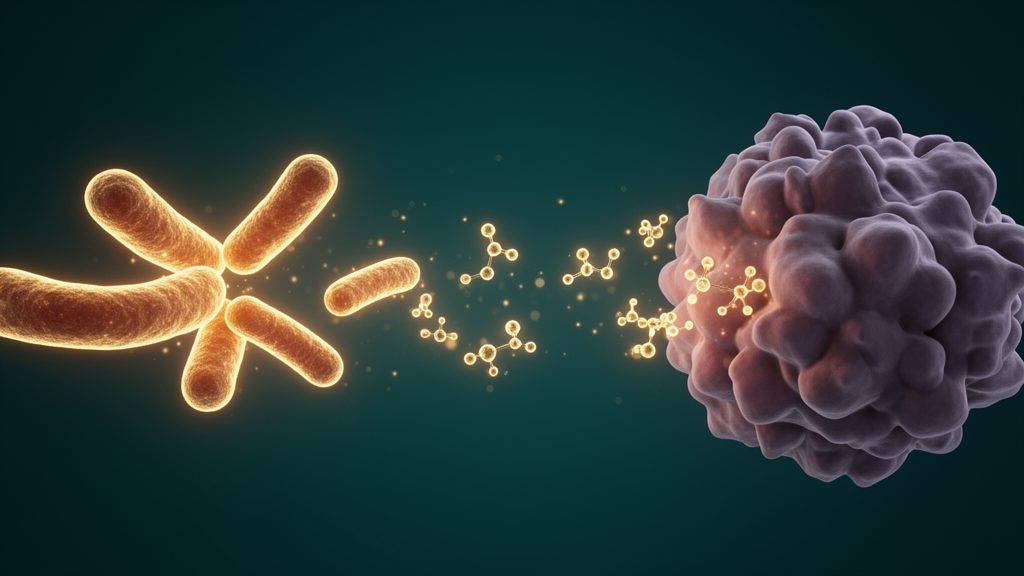
Gut bacteria do far more than digest dinner. The small molecules they produce—short-chain fatty acids, tryptophan-derived indoles, secondary bile acids, and polyamines—circulate through the bloodstream and reach deep into tumors, where they can decide whether immune checkpoint inhibitors work or fail. A new open-access review published in Discover Immunity argues that these microbial metabolites should no longer be treated as passive biomarkers of immunotherapy response, but as programmable bioactive drugs that can be engineered, dosed, and personalized like any other medicine.
The clinical problem the review addresses is stark. Immune checkpoint inhibitors targeting CTLA-4, PD-1, and PD-L1 have transformed treatment of melanoma, non-small cell lung cancer, and renal cell carcinoma, yet only 15 to 30 percent of patients experience durable benefit, and the mechanisms behind this variability remain incompletely understood. Growing evidence points to the intestinal microbiome as a previously underappreciated modulator of that response. In melanoma patients, responders to PD-1 blockade carried higher abundances of bacteria such as Akkermansia muciniphila and Bifidobacterium longum than non-responders, and fecal microbiota transplantation from responders into germ-free or antibiotic-treated mice improved tumor control and enhanced anti-PD-1 activity—causal evidence, the review notes, that specific commensal communities can augment antitumor immunity.
The mechanistic star of this field is butyrate, a short-chain fatty acid produced by Firmicutes bacteria including Faecalibacterium and Roseburia. Butyrate signals through histone deacetylase inhibition and G-protein-coupled receptors such as GPR43 and GPR109A, promoting regulatory T cell differentiation while simultaneously supporting long-lived memory CD8-positive T cell formation. In murine melanoma models, oral butyrate or high-fiber diets increased CD8-positive T cell infiltration into tumors and enhanced responses to anti-PD-1 therapy. Clinically, elevated serum butyrate—often associated with Faecalibacterium and Bifidobacterium enrichment—has correlated with improved responsiveness to PD-1 inhibitors. But the effect is sharply dose- and context-dependent: excessive butyrate within the tumor microenvironment can skew immunity toward suppression, dampening cytotoxic T cell function, and in colorectal cancer, high intratumoral lactate and altered transporter expression can shift butyrate’s action toward regulatory T cell induction instead of immune activation.
That context dependence runs through every metabolite class the review examines. Indole derivatives from tryptophan metabolism activate the aryl hydrocarbon receptor, and their effects hinge on ligand identity and site of production. In the colorectum, aryl hydrocarbon receptor activation promotes IL-22 production from group 3 innate lymphoid cells, enhancing mucosal repair and potentially reducing inflammation-driven tumorigenesis. In melanoma, select indole-derived ligands produced intratumorally have been shown to bias signaling toward CD8-positive T cell stemness and improved checkpoint blockade responsiveness. A 2024 Cell study highlighted in the review found that a dietary tryptophan metabolite produced by intratumoral Lactobacillus johnsonii acts as a high-affinity aryl hydrocarbon receptor ligand that enhances effector CD8-positive T cell stemness and sensitizes tumors to checkpoint blockade—reframing the tryptophan axis as an engineering node rather than a purely immunosuppressive pathway, though the authors of the review caution that cohort sizes and tumor-type diversity in that work were limited.
Secondary bile acids illustrate the same duality from the opposite direction. Deoxycholic acid, generated by 7-alpha-dehydroxylating Clostridia, engages receptors including FXR and TGR5, and in mouse studies colonization with bile-acid-transforming bacteria suppressed natural killer T cell accumulation in the liver and increased hepatocellular carcinoma burden. In the colon, perturbed bile acid composition impaired epithelial barrier function and promoted IL-6-driven tumorigenic inflammation. Polyamines tell a similarly two-sided story: spermidine supplementation enhanced CD8-positive T cell longevity and antitumor cytotoxicity when combined with checkpoint inhibitors in melanoma and lung cancer models, yet elevated polyamine concentrations in certain colorectal and breast tumor microenvironments correlated with impaired antigen presentation and increased myeloid suppression—a narrow therapeutic window, the review concludes, that must account for each tumor’s metabolic phenotype.
These metabolite signatures are already being tested as predictive biomarkers. Melanoma patients with gut microbiomes enriched in SCFA-producing taxa showed increased serum butyrate and acetate and better progression-free survival under PD-1 blockade, while elevated kynurenine-to-tryptophan ratios in serum were consistently associated with T cell anergy and predicted poor checkpoint inhibitor response across glioblastoma, non-small cell lung cancer, and melanoma. A prospective study using mass spectrometry-based metabolomics in plasma from NSCLC patients receiving anti-PD-1 therapy found that responders exhibited distinct profiles—low kynurenine, high short-chain fatty acids, and elevated indole-propionic acid—suggesting blood-based metabolite panels could eventually predict clinical response before treatment begins. The review stresses, however, that such clinical evidence remains largely associative, with metabolomic endpoints inconsistently reported and mechanistic confirmation still lacking.
The engineering toolkit the review maps out spans four main strategies. Probiotics and prebiotics modulate microbial communities and their metabolite output, though clinical data are mixed: in an observational study of over 100 melanoma patients, spontaneous use of over-the-counter probiotics was paradoxically associated with poorer response to PD-1 therapy and reduced microbiome diversity, underscoring that strain specificity matters. Fecal microbiota transplantation has produced the most striking results: in a phase I trial, 15 patients with advanced melanoma refractory to anti-PD-1 therapy received FMT from robust responders, and six patients—40 percent—showed renewed response to pembrolizumab, accompanied by increased Akkermansia muciniphila and SCFA-producing Faecalibacterium, enhanced CD8-positive T cell infiltration in tumor biopsies, and metabolomic shifts including elevated butyrate and indoles with decreased kynurenine. Similar proof-of-concept results have been reported in small single-center trials of non-small cell lung cancer and renal cell carcinoma.
Synthetic biology pushes the approach furthest. Engineered live biotherapeutics such as Synlogic’s SYNB1891—described in the review as an engineered strain delivering STING agonists intratumorally—is in phase I trials for advanced solid tumors, and first-in-human studies reported no systemic infection or horizontal gene transfer after dosing. Engineered E. coli Nissle 1917 expressing checkpoint inhibitors or IL-2 within the gut lumen has shown superior tumor control compared with systemic therapy in preclinical work, with minimal toxicity. Postbiotic strategies bypass live microbes altogether, delivering purified metabolites or analogs—oral butyrate adjuvants, indole-based aryl hydrocarbon receptor modulators, IDO1 inhibitors—with the advantages of precise dosing and standardized production. Yet the review is candid about the translational gap: as of late 2025, no completed phase III randomized trial has confirmed a reproducible survival benefit of microbiome-based interventions in oncology, and a pooled analysis of eleven interventional or prospective studies encompassing more than 800 patients found an increased objective response rate (pooled risk ratio roughly 1.40, 95 percent confidence interval 1.15 to 1.70) with moderate heterogeneity across tumor types.
Safety and regulation form the final frontier. Early FMT studies showed mostly mild gastrointestinal adverse events and no treatment-related deaths, with donor strains declining over six to twelve months to partial engraftment—but the U.S. Food and Drug Administration has issued safety alerts documenting transmission of multidrug-resistant organisms through inadequately screened FMT material, making molecular pathogen testing and resistance-gene surveillance non-negotiable. Engineered strains require containment circuits such as auxotrophy or kill switches, whole-genome sequencing to exclude virulence and resistance determinants, and structured post-market surveillance. The review proposes a roadmap of harmonized endpoints, randomized placebo-controlled trial designs stratified by baseline microbiome and diet, standardized LC-MS/MS metabolite assays validated for clinical matrices, and AI-guided platforms—neural network models have reportedly forecast PD-1 response with over 85 percent accuracy using combined gut microbiota and plasma metabolite profiles—to match patients to interventions. Most preclinical findings, it warns, come from murine systems with simplified microbiota and metabolite concentrations exceeding physiological levels. The field, the authors conclude, sits at the inflection point between experimental discovery and clinical reality, and its success will depend on rigorous standardization rather than enthusiasm alone.
Subject of Research: Engineering microbial metabolites to modulate tumor immunity and improve cancer immunotherapy
Article Title: Engineering microbial metabolites to modulate tumor immunity and advance cancer immunotherapy
Article References: Chigozie, V. U., & Esimone, C. O. (2026). Engineering microbial metabolites to modulate tumor immunity and advance cancer immunotherapy. Discover Immunity, 3(1), Article 3. https://doi.org/10.1007/s44368-026-00019-w
Image Credits: AI Generated
DOI: 10.1007/s44368-026-00019-w
Keywords: gut microbiome, microbial metabolites, cancer immunotherapy, immune checkpoint inhibitors, short-chain fatty acids, fecal microbiota transplantation, synthetic biology, butyrate, biomarkers, live biotherapeutics, tumor microenvironment, personalized medicine
News Source: Nathaniel Bowman. (October 30, 2026). Gut Microbe Metabolites Engineered as Programmable Drugs Against Cancer. Scienmag.



