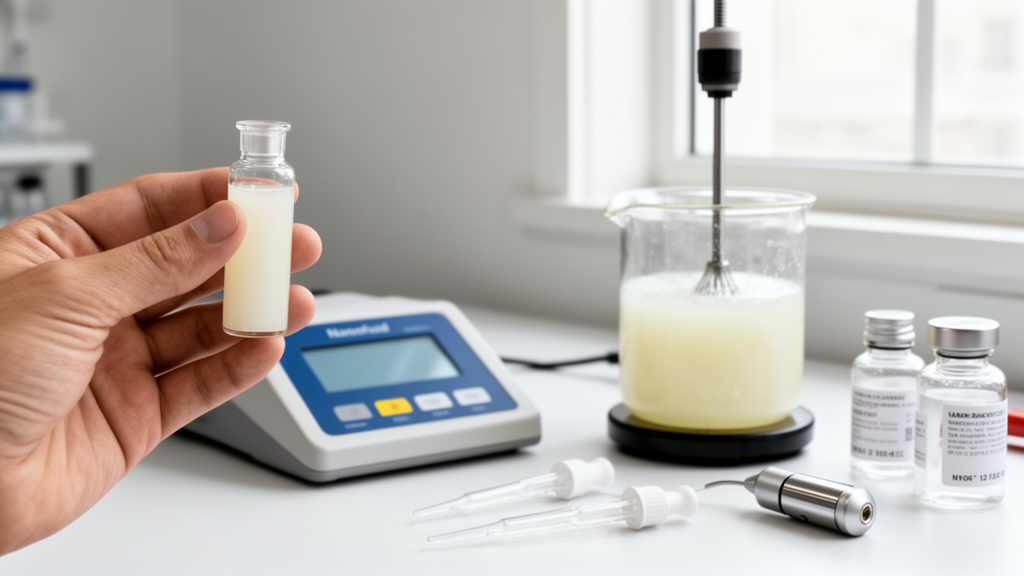
Heat transfer fluids that carry engineered nanoparticles promise better thermal performance than plain water, yet most have never left the laboratory. A new study in Results in Engineering takes a detailed look at one candidate, a hybrid nanofluid made of silicon dioxide and zinc oxide nanoparticles dispersed together in water, and reports that the key to making it work lies not only in the particles themselves but in how they are stabilized and how they cluster.
The central problem the team set out to solve is electrostatic in origin. When the two particle types were dispersed in deionised water without any additives, the silica particles carried a negative zeta potential of about −29.2 millivolts while the zinc oxide particles were positively charged at about +15.4 millivolts. Opposite charges attract, and the hybrid dispersion aggregated within seconds. Silica alone formed a stable dispersion in water, but the mixed system collapsed immediately. To fix this, the researchers screened six different surfactants, including hexadecyltrimethylammonium bromide, Triton X-100, sodium carboxymethyl cellulose, Tween 80 and sodium dodecylbenzenesulfonate, and selected gum arabic, a natural emulsifier from acacia trees already common in the food and pharmaceutical industries, as the most effective by visual observation.
Gum arabic works through a combination of electrostatic and steric mechanisms. Its glycoprotein components, such as arabinogalactan, form van der Waals interactions with particle surfaces, and the polysaccharide fraction builds a protective hydrated layer around each particle that prevents aggregation on collision. In the measurements, gum arabic flipped the surface charge of the zinc oxide particles to strongly negative, giving both particle types high negative zeta potentials of −31.5 and −23.1 millivolts respectively, which produced acceptable stability in the hybrid dispersion. The authors caution, however, that because gum arabic stabilizes electrosterically, zeta potential alone cannot fully characterize the stability of these dispersions, since the macromolecular layer contributes protection that zeta potential measurements do not capture.
The stabilization came at a measurable rheological price. All the nanofluids behaved as Newtonian fluids, and their viscosities exceeded that of water by 15 to 40 percent across the tested range. Strikingly, the gum arabic solution by itself, at the concentration used in the 1.5 percent hybrid nanofluid, raised viscosity by 28 percent, accounting for roughly 74 percent of that nanofluid’s total viscosity increase over water. Within the hybrid series, each additional 0.5 volume percent of nanoparticles increased viscosity by approximately 13 percent. The 1.5 percent zinc oxide and hybrid nanofluids both increased viscosity by about 38 percent on average, while silica at the same loading caused a 33 percent increase. No significant temperature dependence of the relative viscosity appeared between 20 and 60 degrees Celsius.
Thermal conductivity told a different story. Measured with a modified transient plane source instrument between roughly 11 and 61 degrees Celsius, the nanofluids tracked the temperature dependence of water closely, so the relative thermal conductivity showed no measurable temperature dependence. At 1.5 volume percent loading, silica nanoparticles enhanced thermal conductivity by 3.5 percent, zinc oxide by 6.1 percent and the hybrid system by 5.1 percent. Particle material mattered more than concentration: higher loadings produced only slow gains in thermal conductivity, while switching to the higher-conductivity zinc oxide produced a clearly larger effect, consistent with the expectation that particles with higher intrinsic thermal conductivity, about 50 watts per meter-kelvin for zinc oxide versus roughly 1.3 for silica, deliver greater enhancement.
To probe whether the persistent large clusters in the dispersions were simply undispersed starting material or newly formed mixed aggregates, the team turned to scanning electron microscopy with energy-dispersive X-ray analysis on dried samples. The elemental distribution of silica and zinc oxide was uniform across the examined regions, but the detected zinc oxide content was approximately 40 weight percent, notably lower than the 69 percent expected from the initial 1:1 volume mixing ratio. Because EDX overestimates material near the surface, the authors interpret this as silica particles preferentially located near the aggregate surface with zinc oxide buried deeper inside. The relatively uniform composition across the sample suggests the original single-particle aggregates were effectively broken apart during ultrasonic homogenization and then re-agglomerated into mixed clusters a few hundred nanometers in size.
Those clusters were substantial. Dynamic light scattering showed the average hydrodynamic size of the hybrid dispersion falling from about 338 nanometers after 5 minutes of ultrasonication to about 237 nanometers after 40 minutes, an exponential decay that never brought the aggregates below roughly ten times the diameter of the primary particles, which measured about 21 nanometers for silica and 31 nanometers for zinc oxide by transmission electron microscopy. Even after the longest treatment, agglomerates persisted. Long-term stability, however, was strong: in seven-day sedimentation tests on the 1.5 percent hybrid nanofluid, less than 10 percent of the nanoparticles had settled after a week, with a sampling design that kept at least one bottle undisturbed until each measurement day to control for sampling errors.
To weigh the viscosity penalty against the thermal gain, the researchers calculated the Property Enhancement Ratio, which combines the relative increases in viscosity and thermal conductivity, with lower values indicating better heat transfer suitability; values below 4 generally indicate a fluid no worse than its base fluid. Within the tested range, lower nanoparticle concentrations performed better. The 0.5 volume percent hybrid nanofluid achieved a PER of 3.77, meaning it performed no worse than water as a heat transfer fluid. Among the 1.5 percent fluids, silica produced the highest PER while the zinc oxide-containing sample scored lowest, reflecting the strong influence of thermal conductivity on overall performance. Perhaps the most notable comparison came when the 1.5 percent hybrid nanofluid was referenced against the gum arabic solution itself: its PER dropped substantially, showing it is a significantly more effective heat transfer fluid than a solution carrying the same surfactant concentration without particles.
The study also benchmarked its results against earlier work by Yalçın and colleagues, who used the same gum arabic concentration, 10 weight percent relative to the nanoparticles, on similar hybrid systems. The viscosities diverged sharply: the earlier 1.0 volume percent fluid exceeded water by roughly 100 percent, while the corresponding increase here was only about 23 percent. Conversely, the new hybrid fluids showed thermal conductivity enhancements of roughly 4.0 to 4.5 percent at 0.5 and 1.0 volume percent, considerably higher than the approximately 1.1 and 1.7 percent reported previously. The authors attribute the discrepancies primarily to colloidal stability differences, noting that an ultrasonic bath delivers far lower energy density than the ultrasonic homogenizer used here, and that the earlier study reported no particle size data that could confirm or exclude large aggregates that might have distorted capillary viscometry and thermal conductivity measurements.
The practical conclusions are concrete. Because surfactant concentration alone drives a large share of the viscosity increase, optimizing the gum arabic dose to the minimum needed for stability could preserve the thermal benefit while cutting the hydraulic penalty. Alternatively, the authors suggest that the optimum operating point for this hybrid system likely lies at or below 0.5 volume percent nanoparticle loading. The work also delivers a methodological message for the field: connecting aggregate structure, measured here by light scattering and EDX, to macroscopic thermophysical properties is essential for judging whether a nanofluid is genuinely viable, since the same nominal formulation can perform very differently depending on how well it was dispersed and stabilized.
Subject of Research: Water-based SiO2-ZnO hybrid nanofluids stabilized with gum arabic and characterized for stability, viscosity, thermal conductivity and aggregate composition
Article Title: Characterisation of SiO 2 -ZnO hybrid nanofluids
Article References: Várady, Z. I., Szücs, P., Mesterné Kurovics, E., Karacs, G., Balogh-Weiser, D., Gyarmati, B., & Szilágyi, I. M. (2026). Characterisation of SiO2-ZnO hybrid nanofluids. Results in Engineering, 32, Article 113613. https://doi.org/10.1016/j.rineng.2026.113613
Image Credits: AI Generated
DOI: 10.1016/j.rineng.2026.113613
Keywords: nanofluids, SiO2-ZnO hybrid nanofluids, gum arabic, thermal conductivity, viscosity, zeta potential, colloidal stability, SEM-EDX, ultrasonication, Property Enhancement Ratio, heat transfer, nanoparticle aggregation
News Source: Denise Maddox. (October 30, 2026). Gum Arabic Stabilized Silica-Zinc Oxide Hybrid Nanofluids Characterized in New Study. Scienmag.