

• HOME
  • NEWS
  • EXPLORE
    • CAREER
      • Companies
      • Jobs
    • EVENTS
    • iGEM
      • News
      • Team
    • PHOTOS
    • VIDEO
    • WIKI
  • BLOG
  • COMMUNITY
    • FACEBOOK
    • INSTAGRAM
    • TWITTER
Wednesday, October 28, 2026
BIOENGINEER.ORG
No Result
View All Result
  • Login
  • HOME
  • NEWS
  • EXPLORE
    • CAREER
      • Companies
      • Jobs
        • Lecturer
        • PhD Studentship
        • Postdoc
        • Research Assistant
    • EVENTS
    • iGEM
      • News
      • Team
    • PHOTOS
    • VIDEO
    • WIKI
  • BLOG
  • COMMUNITY
    • FACEBOOK
    • INSTAGRAM
    • TWITTER
No Result
View All Result
Bioengineer.org
No Result
View All Result
Home NEWS Science News Biology

Glue-on accelerometers decode Eurasian otter behaviour in zoo trial

by
October 28, 2026
in Biology, Technology
Reading Time: 2 mins read
0
Glue-on accelerometers decode Eurasian otter behaviour in zoo trial

Glue-on accelerometers decode Eurasian otter behaviour in zoo trial

Share on FacebookShare on TwitterShare on LinkedinShare on RedditShare on Telegram

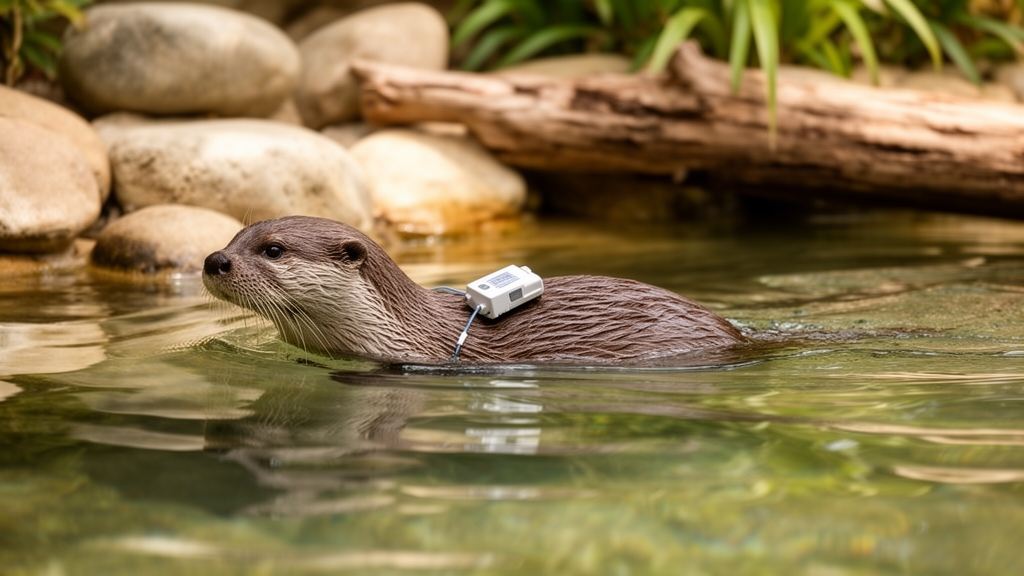
A new methodological study now shows that a small tri-axial accelerometer glued temporarily to an otter’s fur can be used to recognise a range of behaviours from acceleration patterns alone, offering a potential route into the private lives of this vulnerable species.

Researchers tagged three adult male Eurasian otters (Lutra lutra) living under human care in zoos. Each tagged otter was observed for four to five days, with behaviours recorded simultaneously by video cameras and direct visual observation, creating a labelled dataset linking specific activities to their acceleration signatures.

The team combined these visual observations with the acceleration data to train an extreme gradient boosting model, a machine-learning approach, to classify 13 different behaviours during the tracking period based solely on the accelerometer output. When the trained model was applied to behavioural events that were new to it, it predicted the correct activity with an overall accuracy of 53.6%, with an F1 score of 0.506, a recall rate of 0.536 and a precision of 0.538.

Performance, however, varied considerably between behaviours. In particular, stationary behaviours were often not clearly distinguished from one another by the model. When the researchers grouped the stationary behaviours together — with the exception of latrine behaviour — accuracy rose to 68.2%, with an F1 score of 0.66.

Accelerometers of this kind measure body posture and movement-based proxies for energy expenditure, so refining the classification could eventually allow researchers to estimate not only what a free-ranging otter is doing but also how much energy different activities cost. The authors note that improving the attachment method with more glue to keep the tag on for longer would strengthen the approach, and they argue the method has great potential to reveal the ecological significance of behaviours and energetics in wild Eurasian otters.

Combined with spatial location data, the researchers expect such accelerometry to answer what, where, when and how wild otters allocate their activities. Understanding wild Eurasian otter behaviour, spatial movements and habitat use is expected to have great significance for the conservation and management of this vulnerable species. Because the current results come from three adult males in zoos, the findings represent a validated methodological step rather than a direct measurement of wild otter behaviour, and further work will be needed to confirm how the classifiers perform on free-ranging animals.

Subject of Research: Using glue-on tri-axial accelerometers and machine learning to classify Eurasian otter behaviours

Article Title: Glue-on tri-axial accelerometers code for different behaviours in Eurasian otters (Lutra lutra)

Article References: Rosell, F., Lodberg-Holm, H. K., Robstad, C. A., Kambestad, M., Wilson, R. P., & Mortensen, R. M. (2026). Glue-on tri-axial accelerometers code for different behaviours in Eurasian otters (Lutra lutra). Animal Biotelemetry. https://doi.org/10.1186/s40317-026-00504-x

Image Credits: AI Generated

DOI: 10.1186/s40317-026-00504-x

Keywords: Eurasian otter, Lutra lutra, biotelemetry, tri-axial accelerometer, animal-borne sensors, behaviour classification, machine learning, extreme gradient boosting, zoo study, wildlife conservation, Glue-on, tri-axial

News Source: Margaret Porter. (October 28, 2026). Glue-on accelerometers decode Eurasian otter behaviour in zoo trial. Scienmag.


Tags: animal-borne sensorsbehaviour classificationbiotelemetryEurasian otterextreme gradient boostingGlue-onLutra lutraMachine Learningtri-axialtri-axial accelerometerwildlife conservationzoo study
Share12Tweet7Share2ShareShareShare1

Related Posts

Blockchain and quantum-safe cryptography combine in new framework to secure medical device networks

Blockchain and quantum-safe cryptography combine in new framework to secure medical device networks

October 28, 2026
New Plasticity Method Captures Strength Differential and Friction in Metal Forming

New Plasticity Method Captures Strength Differential and Friction in Metal Forming

October 28, 2026

New scCIF framework fuses single-cell multi-omics data for sharper cell clustering

October 28, 2026

Scientists discover a durable molecular fingerprint of ferroptosis in cells and blood

October 28, 2026

POPULAR NEWS

  • Fear and pressure can tip a plankton-fish model into collapse

    Fear and pressure can tip a plankton-fish model into collapse

    29 shares
    Share 12 Tweet 7
  • Military zones may shelter sensitive mammals in South Korean national park

    29 shares
    Share 12 Tweet 7
  • CRISPR Screen Reveals How Ovarian Cancer Cells Resist Niraparib

    29 shares
    Share 12 Tweet 7
  • Indonesia’s production network is organized around multiple Java-centered rich cores

    29 shares
    Share 12 Tweet 7

About

We bring you the latest biotechnology news from best research centers and universities around the world. Check our website.

Follow us

Recent News

Rare Spigelian Hernias Repaired With Laparoscopic Technique in Small Case Series

Research report: Food insecurity during a cost‑of‑living crisis: trends and housing‑related vulnerability in Portugal (2019–2023)

Blockchain and quantum-safe cryptography combine in new framework to secure medical device networks

Subscribe to Blog via Email

Enter your email address to subscribe to this blog and receive notifications of new posts by email.

Join 85 other subscribers
  • Contact Us

Bioengineer.org © Copyright 2023 All Rights Reserved.

Welcome Back!

Login to your account below

Forgotten Password?

Retrieve your password

Please enter your username or email address to reset your password.

Log In
No Result
View All Result
  • Homepages
    • Home Page 1
    • Home Page 2
  • News
  • National
  • Business
  • Health
  • Lifestyle
  • Science

Bioengineer.org © Copyright 2023 All Rights Reserved.
