


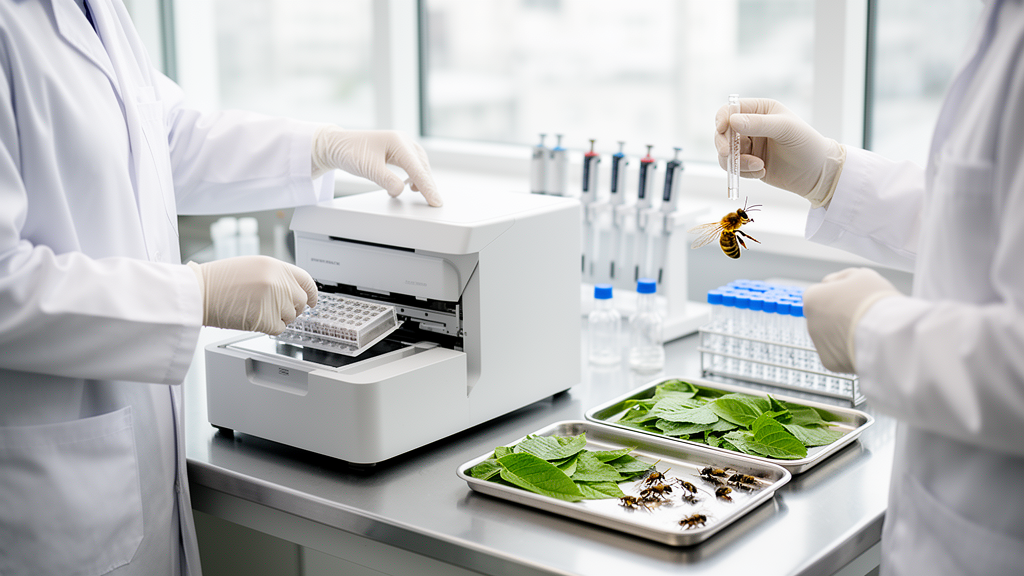
Genomics has completed a remarkable journey. What was once a specialized pursuit confined to a handful of model systems and well-equipped laboratories has become a routine enterprise, with sophisticated sequencing and analysis methods now commercially available at a cost that most individual public research labs can manage. That is the central argument of a new perspective article published in Frontiers in Genetics by Andrew H. Paterson of Auburn University and Nanjing Agricultural University and Brock A. Harpur of Purdue University, who trace how technologies originally developed for biomedical applications have swept across plants and their associated organisms, transforming the study of genes and genomes, the regulatory cues that govern them, and the variation embedded within both.
The scale of the change is easiest to grasp by comparing eras. Obtaining the sequence of even a single gene was once a major undertaking, and whole-genome sequencing demanded dispersed efforts involving complex coordination among many international teams. Today, entire genomes can be sequenced for roughly one hundred dollars, and reduced-representation methods that capture haplotype information for large numbers of individuals cost little more than a nominal outlay. Massive sampling of expressed nucleic acid sequences has likewise become accessible, empowering what the authors describe as an ever-growing slate of long-standing questions and new opportunities across the life sciences.
Yet the revolution remains strikingly incomplete. Currently available genome sequences sample most major clades of life, but they cover fewer than 0.4 percent of the roughly 400,000 known green plant species. Ongoing initiatives such as the Earth BioGenome Project, the Darwin Tree of Life and PLANeT are expected to push that fraction upward, but the gap between technological capability and biological coverage remains enormous. The authors argue that reference genome quality itself is a moving standard, improving continuously as technology enables more precise and less costly sequencing, so that assemblies produced only a few years ago can already be superseded.
Plants, the authors note, were an early test bed for the DNA-based whole-genome mapping methods envisioned by pioneers of the Human Genome Project. Crop plants and their relatives could be routinely crossed without ethical concerns, formed large populations that could be maintained at modest cost, and could be measured for suites of economically important traits. Early examples of whole-genome mapping in crops spawned a rich literature spanning agricultural, ecological and even medical genomics, identifying diagnostic DNA markers that could be assessed independently of phenotype, whether as predictive tools to select for traits in breeding or to identify likely disease subjects and carriers in medicine.
The intellectual foundations of this work run deep. Quantitative inheritance, the principle that many differences between organisms in the same gene pool arise from the collective effects of subtle variations in large numbers of genes, has challenged agriculture, evolution and medicine for more than a century. The idea that individual quantitative trait loci underlying such variation might be identified dates back over a hundred years, and seminal work with morphological markers and isozymes enriched the backdrop against which genome-wide tools would later operate. A persistent practical challenge was the need for populations in strong linkage disequilibrium, with DNA markers positioned no more than a few centiMorgans from the trait-determining sequences, enabling the interval mapping approaches that became standard.
Genome-wide association studies then changed the calculus entirely. Once a relationship between a trait and a nearby single-nucleotide polymorphism was established through linkage disequilibrium in an early landmark analysis, researchers realized that historical accumulations of recombination could complement recent designed crosses. Association studies could search for linkages and causal genes without controlled crosses at all, even in wild populations or in populations derived from recent founders within the last few hundred generations. Somewhat serendipitously, that generational window coincides with the Columbian Exchange, the extensive bidirectional flow of plants, animals and microbes between the Old and New Worlds driven by human migration, in which genetic bottlenecks a few centuries old still leave enough linkage disequilibrium for modern genome scans to detect.
The authors illustrate these advances with a case study of the Western honey bee in North America, a plant-associated organism and a deliberately challenging example. Honey bees were absent from the New World for nearly ten million years, between the extinction of a relative known only from fossils and the post-Columbian introduction of Old World strains. The genus Apis was present in North America during the Miocene but went extinct on the continent long before human arrival, and was reintroduced only when European settlers carried the western European subspecies to the eastern seaboard around or before 1620. Over the following two centuries, deliberate introductions of additional lineages, most consequentially the Italian subspecies, layered further genetic contributions onto the founding population. The contemporary North American honey bee is thus a human-mediated admixture whose diversity can exceed that of any single ancestral source, a stratigraphy of introductions that includes nineteenth-century imports of eastern European lineages and the escape of African-lineage bees in Brazil that began the Africanized expansion reshaping the genetic landscape of the southern United States.
Honey bee genomics also showcases the technical arc of the field. Genetic mapping was long constrained by reproductive biology: queens mate on the wing with many drones, so controlled crosses depend on instrumental insemination, a specialized surgical technique, and the required sample sizes can exceed what a single apiary can maintain. Early linkage work relied on a handful of visible morphological mutants and produced sparse maps; the first genome-wide map, built from RAPD markers in 1995, identified 26 linkage groups and revealed the honey bee’s exceptionally high recombination rate, later confirmed to be roughly an order of magnitude above the metazoan average. The honey bee was among the earliest agricultural species sequenced, the first Hymenopteran and fourth insect, with an unusually AT-rich, slowly evolving genome depleted in transposable elements relative to Drosophila. That first assembly was fragmented, a community-led upgrade recovered thousands of previously missing or mismodeled genes, and long-read and long-range scaffolding technologies eventually yielded a chromosome-length assembly that closed most remaining gaps.
Connecting DNA diversity to traits in honey bees spans the pre-genomic and post-genomic eras. Hygienic behavior, the removal of diseased brood by nurse bees, was the first behavioral trait shown to have a genetic basis and among the first animal social behaviors genetically dissected, with quantitative trait locus mapping later refining the associated regions. Modern genomic approaches have extended this dissection to artificially selected high-royal-jelly strains, signatures of climatic and thermal adaptation in European and desert-dwelling subspecies, a single locus governing the parasitic laying-worker phenotype in the thelytokous clone of the Cape honey bee, and most recently spontaneous eye-colour mutations. Most translationally urgent, the authors write, is resistance to the parasitic mite Varroa destructor, where mapping of Varroa-sensitive hygiene is beginning to yield candidate loci and marker-assisted selection tools, building on decades of pedigree-based breeding-value estimation now moving into genomic prediction.
Substantial barriers remain, however, and many of them are institutional rather than technical. For Columbian Exchange taxa in particular, distributions are now often international, and broad, deep sampling across species, local populations and breeding lineages can be blocked by practical and legal constraints at geographic boundaries that the organisms themselves regularly cross. There is, for good reason, natural resistance to exchanging living organisms known to be invasive: the authors cite the intentional import of African-lineage honey bees to Brazil and their rapid escape and spread over roughly fifty years, and the introduction of the weedy grass Sorghum halepense to the southeastern United States shortly after 1783, whose spread beyond the cultivated range of one of its progenitors continues today. Historical controversies over access to plant genetic material, and concerns that improved cultivars developed in one country may offer no benefit to the source of the germplasm, have motivated a series of international legal frameworks balancing access and utilization, a decades-long controversy the authors see showing little sign of resolution. Additional pressures include exponentially growing computational loads, the need for faster and standardized phenotyping to relate DNA variation to traits, and funding constraints. Perhaps the single greatest change that could mitigate these obstacles, they conclude, is a qualitative shift in how society values ecosystem services: the pollination services honey bees provide annually in the United States alone are variously estimated at ten to twenty times the market value of the bees themselves, while other Columbian Exchange crops, pests and invasive species carry a collective economic impact estimated at 26 billion dollars annually. Genomics, they argue, is no longer confined to favorable models, and its true impact across biology is only beginning to be felt.
Subject of Research: The expansion of genomic technologies from model systems to plants, plant-associated organisms and natural populations
Article Title: The spread of genomics
Article References: Paterson, A. H., & Harpur, B. A. (2026). The spread of genomics. Frontiers in Genetics, 17, Article 1985860. https://doi.org/10.3389/fgene.2026.1985860
Image Credits: AI Generated
DOI: 10.3389/fgene.2026.1985860
Keywords: genomics, plants, honey bee, genome-wide association studies, Columbian Exchange, quantitative trait loci, reference genomes, gene expression, microbiome, linkage disequilibrium, Varroa destructor, ecosystem services
News Source: Juliet Wilcox. (October 29, 2026). Genomics Goes Routine: From Model Labs to Honey Bees, Crops and Wild Populations. Scienmag.



