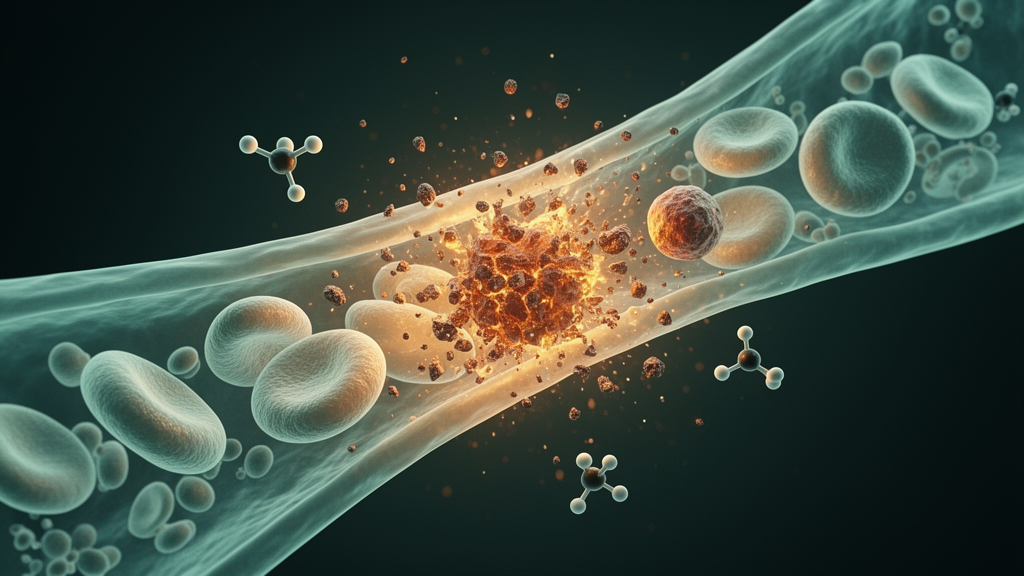
Iron-dependent cell death genes appear to shape the risk of acute myeloid leukemia both directly and through specific immune cell populations, according to a Mendelian randomization study published in Blood Research. Using large-scale genetic datasets, researchers identified 29 ferroptosis-related genes with unidirectional causal effects on leukemia risk and showed that myeloid immune subsets, including monocyte-derived myeloid-derived suppressor cells, mediate part of those effects.
Acute myeloid leukemia, or AML, is a highly heterogeneous clonal malignancy arising from hematopoietic stem and progenitor cells. Its core features include blocked myeloid differentiation, uncontrolled proliferation, and resistance to apoptosis, producing an abnormal accumulation of immature blast cells in the bone marrow and peripheral blood. Recurrent driver mutations in genes such as FLT3, NPM1, TP53, IDH1/2, and DNMT3A, chromosomal abnormalities like t(8;21), and epigenetic dysregulation involving DNA methylation and chromatin remodeling are major engines of the disease. These alterations, together with aberrant signaling, metabolic reprogramming, and supportive cues from the bone marrow microenvironment, sustain leukemic stem cell survival and contribute to therapeutic resistance.
Ferroptosis is a distinct form of regulated cell death driven by iron-dependent lipid peroxidation, marked by glutathione depletion and inactivation of the antioxidant enzyme glutathione peroxidase 4. Leukemic cells in AML commonly show dysregulated iron metabolism, elevated reactive oxygen species, and heavy reliance on the SLC7A11–GSH–GPX4 antioxidant axis, which makes them intrinsically vulnerable to ferroptosis—yet high expression of key regulators such as GPX4 can also confer drug resistance. Emerging evidence suggests ferroptosis does more than kill tumor cells directly: expression of ferroptosis-related genes has been associated with enrichment of immunosuppressive populations such as myeloid-derived suppressor cells and suppressive macrophages, along with reduced T-cell and NK-cell infiltration, fostering an immune-cold microenvironment that favors immune evasion.
To move beyond correlation, the research team employed two-sample Mendelian randomization, a technique that uses genetic variants as instrumental variables to test whether an exposure causally influences an outcome. Because alleles are randomly allocated at conception, the approach largely mimics a randomized trial at the genetic level and reduces confounding. The investigators retrieved 564 ferroptosis-related genes from the FerrDb database and matched them to expression quantitative trait loci from the GTEx project, yielding 24,244 eQTL datasets. Outcome data came from a genome-wide association study of AML in the GWAS Catalog comprising 318 cases and 404,466 controls of British ancestry. All analyses were restricted to participants of European ancestry to limit confounding from population stratification.
The inverse variance–weighted method served as the primary estimator, with MR-Egger regression, weighted median, and simple median analyses, MR-PRESSO, Cochran’s Q test, and leave-one-out procedures used to probe horizontal pleiotropy and heterogeneity. Weak instruments with F-statistics below 10 were excluded, and Steiger filtering removed variants showing evidence of reverse causality. After these filters, 29 ferroptosis-related genes showed significant, unidirectional causal effects on AML risk; reverse MR analyses treating AML as the exposure found no evidence that the disease alters expression of these genes. No significant heterogeneity or horizontal pleiotropy was detected in the retained results.
The team then extended the analysis to immunity. Drawing on 731 immune cell trait GWAS datasets from the IEU OpenGWAS database, they identified 28 immune traits causally associated with AML risk—15 positively and 13 negatively. A third round of MR examined the 29 genes against 27 immune traits significantly linked to AML, finding significant causal associations between 27 genes and 28 immune traits. Mediation analysis then decomposed each gene’s total effect on AML into direct and immune-mediated components by multiplying the gene-to-immune-cell estimate by the immune-cell-to-AML estimate.
The mediation results were striking. SLC40A1, which encodes the iron export protein ferroportin, showed a significant positive total effect on AML risk (β = 0.291), part of which flowed through CD33 measured on CD33dim HLA-DR+ CD11b− cells (β = 0.040, P = 0.026), on monocyte-derived myeloid-derived suppressor cells (β = 0.030, P = 0.043), and on CD66b++ myeloid cells (β = 0.040, P = 0.044). Its direct effect remained significant, indicating a predominantly direct influence accompanied by smaller immune-mediated contributions. BCAT2, a branched-chain amino acid transaminase that negatively regulates ferroptosis, showed a protective negative total effect (β = −0.448), with a mediated effect via Mo-MDSC AC cells (β = −0.086, P = 0.036) accounting for roughly 19.2% of the total. SIRT1, an NAD+-dependent deacetylase linked to ferroptosis and chemoresistance in leukemia, had a positive total effect (β = 0.208) partially mediated through CD33 on CD33dim HLA-DR+ CD11b− cells (β = 0.020, P = 0.042).
Two genes displayed more complex patterns. RPL8, a ribosomal protein that bolsters antioxidant defenses and suppresses lipid peroxidation–induced ferroptosis, showed a positive total effect on AML risk (β = 0.216) but a significant negative mediated effect through CD33 on CD66b++ myeloid cells (β = −0.020, P = 0.048), hinting at an antagonistic regulatory role for that subset. CREB5, a CREB-family transcription factor with no previously characterized function in AML, had a protective negative total effect (β = −0.263) alongside a positive mediated effect via activated naïve double-negative (CD4−CD8−) T cells (β = 0.037, P = 0.049)—a discordance the authors attribute, speculatively, to a balance between antileukemic T-cell activity and AML-associated immune exhaustion. Mediation effects for PIEZO1, GSK3B, and ALOX15 through their respective immune traits did not reach statistical significance.
The authors are careful to frame these findings as genetic inference rather than established biology. The analysis relied on a single European-ancestry AML GWAS dataset without an independent validation cohort, the outcome data lacked molecular subtype information such as FAB classification or ELN risk groups, and the small number of instrumental variables in some analyses may have reduced precision. The proposed immune mechanisms for BCAT2 and RPL8 in myeloid suppressor subsets lack direct experimental support, and no studies have yet examined CREB5 function in AML. Independent, clinically well-characterized cohorts, multi-ancestry GWAS data, and in vitro functional assays will be needed to confirm the causal mechanisms and determine their clinical relevance.
Even with those caveats, the study sketches an interconnected metabolism–immune network in AML pathogenesis in which ferroptosis genes coordinate the sensitivity of both leukemic and immune cells to ferroptotic stress, tilting the balance between immunosuppression and immune clearance. Because the overall effects were driven mainly by direct gene influences, the ferroptosis–immune axis emerges as a modulating layer rather than the sole pathway—one the authors suggest could inform patient stratification and, eventually, therapeutic strategies that pair ferroptosis targeting with immunomodulation.
Subject of Research: Mendelian randomization analysis of ferroptosis-related genes, immune cell mediation, and acute myeloid leukemia risk
Article Title: Ferroptosis-related genes influence AML risk through immune cell–mediated pathways: a Mendelian randomization study with mediation analysis
Article References: Meng, Q., Zhou, Z., & Zhang, W. (2026). Ferroptosis-related genes influence AML risk through immune cell–mediated pathways: a Mendelian randomization study with mediation analysis. Blood Research, 61(1), Article 57. https://doi.org/10.1007/s44313-026-00166-x
Image Credits: AI Generated
DOI: 10.1007/s44313-026-00166-x
Keywords: acute myeloid leukemia, ferroptosis, Mendelian randomization, immune cells, myeloid-derived suppressor cells, SLC40A1, BCAT2, SIRT1, GWAS, iron metabolism, genetics, hematology
News Source: Juliet Wilcox. (October 29, 2026). Genetic Study Links Iron-Cell Death Genes to Leukemia Risk via Immune Cells. Scienmag.