


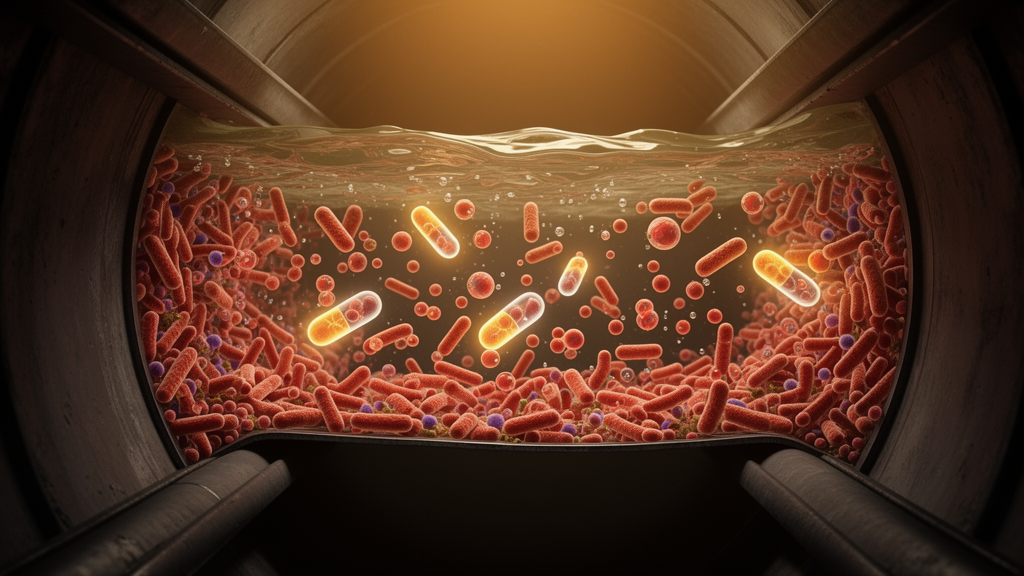
Antibiotic-resistant bacteria are not merely passing through hospital sewer systems — they are being actively selected and enriched there, according to a new study of Swedish hospitals published in Nature Communications. Researchers found that wastewater from ten major hospitals consistently drove Escherichia coli to become resistant to multiple antibiotics in laboratory assays, while corresponding municipal wastewaters showed no detectable selection at all. Crucially, the team also captured evidence of selection happening in situ, directly inside hospital sewer pipes, making hospital sewers one of the clearest field-observed environments where human pharmaceutical pollution drives resistance evolution.
Hospital wastewater is known to contain far more antibiotics than municipal wastewater — up to hundreds of micrograms per litre for some drugs, compared with typically only a few micrograms per litre in municipal sewage — because just over a third of Swedish hospital in-patients are on antibiotic therapy at any given time, versus roughly one in 300 people in the general population. Yet a higher prevalence of resistant bacteria in hospital wastewater alone is not proof of selection, since patients naturally carry more resistant faecal bacteria than the general public. The researchers therefore designed their study to distinguish genuine selection from simple differences in bacterial sources.
Between September and November 2024, the team collected wastewater from the seven largest hospitals in the Västra Götaland Region of Sweden, plus Uppsala’s main hospital, and their corresponding municipal treatment facilities, gathering at least four 24-hour composite samples per location. Earlier samples from two Stockholm hospitals were also analysed. In laboratory experiments, sterile-filtered wastewater was exposed to natural wastewater bacterial communities over three daily passages. Wastewater from all studied hospitals significantly selected for E. coli resistant to both ciprofloxacin and cefotaxime, with one exception where only ciprofloxacin resistance was selected. No municipal wastewater, whether influent or effluent, produced significant selection.
The most striking evidence came from the sewers themselves. The researchers submerged plastic plates into sewer pipes at hospitals and municipal sites for roughly 30 days, allowing biofilms to develop, and then compared resistance levels in E. coli between the wastewater and the biofilms at each site. At hospitals, resistant E. coli were significantly enriched in biofilms relative to the incoming wastewater: resistance rates were about three times higher in biofilms for both ciprofloxacin (a ratio of 3.11) and cefotaxime (a ratio of 3.48). At municipal sites, no such enrichment was observed, with ratios close to one and no statistical significance. This contrast indicates that the enrichment in hospital sewers is not simply a consequence of resistant E. coli being better at forming biofilms — if it were, the same pattern should have appeared at municipal sites.
Metagenomic sequencing of the samples provided broader, though more limited, support. Analyses of total mobile antibiotic resistance genes showed a significant interaction between sample type and location: resistance genes were marginally enriched from hospital wastewater to hospital biofilms, while they were clearly reduced from wastewater to biofilm at municipal sites. The authors caution that metagenomic data cannot separate true within-species selection from shifts in community composition, so these results should be seen as supportive rather than definitive. Notably, resistance gene abundance in municipal effluent biofilms was strongly reduced compared with municipal influent biofilms, consistent with the possibility that many municipal wastewaters actually deselect resistant bacteria.
To identify which antibiotics were responsible, the team combined chemical measurements with antibiotic usage data from the connected hospital wards. At the Sahlgrenska University Hospital, piperacillin with tazobactam was the most heavily used drug by mass, but the highest measured wastewater concentrations belonged to cefotaxime (16,115 nanograms per litre) and ciprofloxacin (14,192 nanograms per litre). When compared against the lowest percentile of minimum inhibitory concentrations for E. coli, only ciprofloxacin and cefotaxime exceeded the thresholds expected to exert selection pressure. Exposing wastewater communities to those measured concentrations confirmed the effect: ciprofloxacin at 0.01 milligrams per litre selected for resistance to all eight tested antibiotics, and cefotaxime at 0.0125 milligrams per litre selected for resistance to seven of eight, most likely through co-selection, since resistance determinants to different drug classes commonly co-occur in bacterial genomes. Both drugs also selected for resistant Klebsiella pneumoniae.
Two further lines of evidence strengthened the case. First, hospital wastewater caused rapid cellular effects in E. coli within one hour of exposure that are characteristic of β-lactam antibiotics: the protein MreB, which orchestrates cell wall synthesis, detached from the cell membrane and dispersed into the cytoplasm, the same phenotype produced by cefotaxime. Control experiments with MinD, a protein whose movement depends on membrane potential, showed the membrane remained intact, ruling out nonspecific membrane damage and confirming that cell wall synthesis inhibitors were present at biologically active concentrations. Second, the researchers engineered an antibiotic-sensitive E. coli strain to carry resistance genes for fluoroquinolones (qnrB) and β-lactams (blaNDM-1). Adding these genes restored the strain’s ability to grow in hospital wastewaters, while all strains grew well in municipal wastewaters. This rescue experiment demonstrated that quinolones and β-lactams are the only major growth-inhibiting antibiotic classes in the studied hospital wastewaters — and therefore the dominant drivers of selection.
The study also uncovered a methodological pitfall with implications for environmental monitoring. The researchers discovered that freezing wastewater samples before filtering them — as done in the 2024 regional campaign — markedly reduced concentrations of several β-lactams, particularly cefotaxime, piperacillin and mecillinam, while leaving ciprofloxacin unaffected. They speculate this loss may be linked to cell lysis releasing β-lactamases from indigenous resistant bacteria. Because of this, the evidence for cefotaxime-driven selection across all hospitals is weaker than for ciprofloxacin, and the authors recommend filtering wastewater before freezing and analysing samples without unnecessary delays.
The findings have implications well beyond Sweden. Ciprofloxacin has been among the most used antibiotics worldwide for decades, and concentrations at or above those detected in this study have been reported in hospital wastewaters in many countries. Sweden has comparatively low total antibiotic use, but in-patient hospital use is comparable to other European countries, with roughly a third of hospital patients receiving antibiotics at any given time. The detailed usage data generated at the seven regional hospitals allows the researchers to extrapolate: hospitals with similar or higher use of ciprofloxacin and/or cefotaxime face apparent risks of resistance selection in their sewers. Cefotaxime use is typically higher at other large Swedish hospitals than at the ones studied, suggesting its importance may have been underestimated nationally, though the picture is more uncertain internationally where other third-generation cephalosporins such as ceftriaxone dominate.
The authors argue that mitigations should be prioritized at hospital sewers specifically, since the absence of detectable selection at municipal sites suggests dilution downstream at treatment plants may have limited effect once resistance has already been selected. Options include on-site wastewater treatment at hospitals or upstream changes in prescribing, such as substituting fluoroquinolones and cefotaxime with alternatives where clinically appropriate — a shift already underway in some places, partly because cefotaxime also drives recurrent Clostridioides difficile infections. The researchers note remaining uncertainties: it is unknown how far the selection effects extend across other bacterial taxa, and more replication would be needed to compare individual hospitals. But the core conclusion stands: hospital sewer biofilms, where concentrated antibiotics meet dense, surface-attached bacterial communities, are a more likely arena for resistance evolution than previously recognized, and the first field evidence of this kind linked to excreted human pharmaceuticals since the ethinylestradiol and fish feminization cases of the late 1990s.
Subject of Research: Selection of antibiotic-resistant bacteria by antibiotics in hospital sewer systems
Article Title: Widespread selection of antibiotic resistance within hospital sewers
Article References: Gray, D. A., Nhung, N. T., Coertze, R. D., Ekwanzala, M. D., Waters, N., Järhult, J. D., Wenzel, M., Åhrén, C., Fick, J., Flach, C.-F., & Larsson, D. G. J. (2026). Widespread selection of antibiotic resistance within hospital sewers. Nature Communications, 17(1), Article 11162. https://doi.org/10.1038/s41467-026-78836-8
Image Credits: AI Generated
DOI: 10.1038/s41467-026-78836-8
Keywords: antibiotic resistance, hospital wastewater, sewer biofilms, Escherichia coli, ciprofloxacin, cefotaxime, antibiotic pollution, metagenomics, selection pressure, Klebsiella pneumoniae, environmental microbiology, Sweden
News Source: Ophelia Keating. (October 29, 2026). Hospital sewers are hotspots where antibiotics actively breed resistant bacteria. Scienmag.



