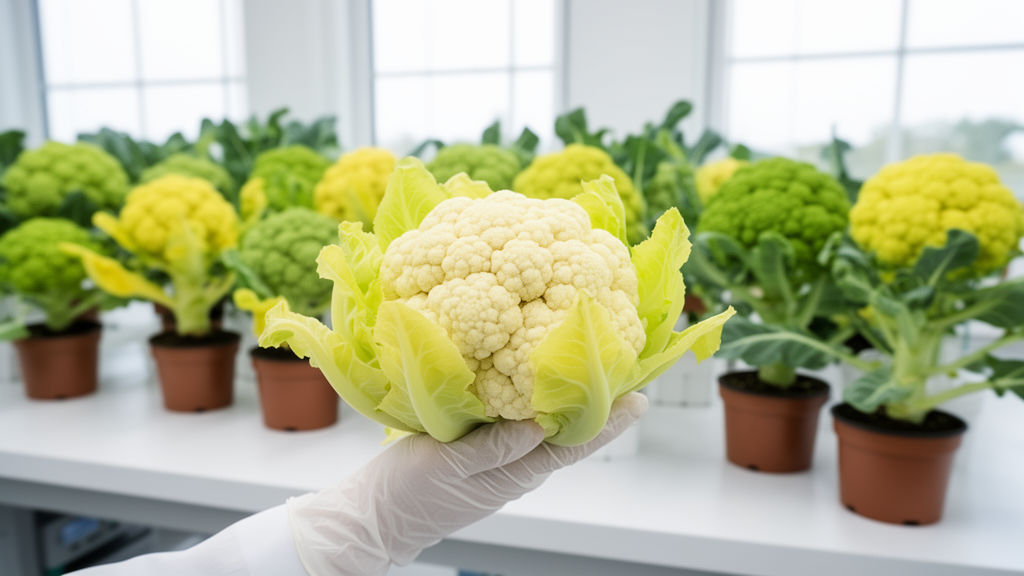
A yellow-green cauliflower mutant has led researchers to a gene that the plant cannot live without if it wants to stay green. Writing in Theoretical and Applied Genetics, a team reporting under first authors Wei Huang, Jinying Cui and Zhenghua Wen identified CauYL, the gene BOB03G201420 encoding the H subunit of magnesium chelatase, as the causal gene behind a stable yellow-green leaf phenotype in cauliflower. The finding fills a notable gap: although chlorophyll is central to how vegetables capture light and display their characteristic color, the genetic regulation of chlorophyll accumulation in cauliflower had remained largely unknown.
The story began in a mutagenized population. From cauliflower plants treated with ethyl methanesulfonate, a chemical mutagen commonly used to generate random point mutations for genetic screens, the researchers isolated a mutant line designated K-6 that displayed a stable yellow-green phenotype. Compared with wild-type plants, the mutant showed much lower chlorophyll contents and a decreased photosynthetic rate, confirming that the color change reflected a genuine defect in the photosynthetic apparatus rather than a cosmetic quirk.
Genetic inheritance analysis revealed that the yellow-green trait was controlled by a single recessive gene, meaning the mutant phenotype only appears when both copies of the gene carry the disabling change. To locate that gene, the team combined BSA-seq, bulked segregant analysis by sequencing, with traditional linkage analyses. Together these approaches mapped the target gene, which they named CauYL, to an approximately 103.07 kb region on chromosome 3.
Within that interval, the strongest candidate was BOB03G201420, which encodes the H subunit of magnesium chelatase. Sequence analysis of the candidate gene in the mutant uncovered a non-synonymous single nucleotide polymorphism within the coding sequence, producing an alanine-to-threonine substitution at a highly conserved residue, precisely the kind of change expected to impair a critical protein function.
Correlation alone is not proof, so the researchers turned to CRISPR/Cas9 genome editing. Knocking out CauYL directly in the wild-type background generated mutants that displayed a yellow-green trait resembling that of the K-6 mutant. This independent recapitulation of the phenotype satisfies a key standard of causal gene validation: disrupting the candidate gene in an otherwise normal plant reproduces the mutant condition, while the original mutant carries a damaging mutation in the same gene.
To understand the broader consequences of losing CauYL function, the team performed transcriptome analysis comparing K-6 and wild-type plants. Differentially expressed genes between the two were significantly enriched in photosynthesis, riboflavin metabolism, and related pathways, indicating that the mutation reverberates well beyond chlorophyll synthesis itself and reshapes the expression of genes tied to the plant’s light-harvesting and metabolic machinery.
Collectively, the results demonstrate that CauYL is essential for maintaining the green coloration and photosynthetic competence of cauliflower. Because the study was conducted in cauliflower using a mutagen-induced line and edited lines, the findings apply to this crop’s leaf-color trait specifically; the authors position CauYL as a valuable genetic target for improving photosynthetic efficiency and leaf color traits in cauliflower breeding programs.
Subject of Research: Genetic basis of a yellow-green leaf mutant in cauliflower
Article Title: CauYL, encoding a magnesium chelatase H subunit, is required for chlorophyll accumulation and normal leaf coloration in cauliflower
Article References: Huang, W., Cui, J., Wen, Z., Wu, Y., Shan, X., Sun, D., Han, F., & Zhang, X. (2026). CauYL, encoding a magnesium chelatase H subunit, is required for chlorophyll accumulation and normal leaf coloration in cauliflower. Theoretical and Applied Genetics, 139(11), Article 319. https://doi.org/10.1007/s00122-026-05419-y
Image Credits: AI Generated
DOI: 10.1007/s00122-026-05419-y
Keywords: cauliflower, chlorophyll, magnesium chelatase, CauYL, CRISPR/Cas9, fine mapping, EMS mutagenesis, transcriptome, photosynthesis, plant genetics, encoding, magnesium
News Source: Juliet Wilcox. (October 29, 2026). Gene Behind Yellow-Green Leaves in Cauliflower Identified and Confirmed by CRISPR. Scienmag.