


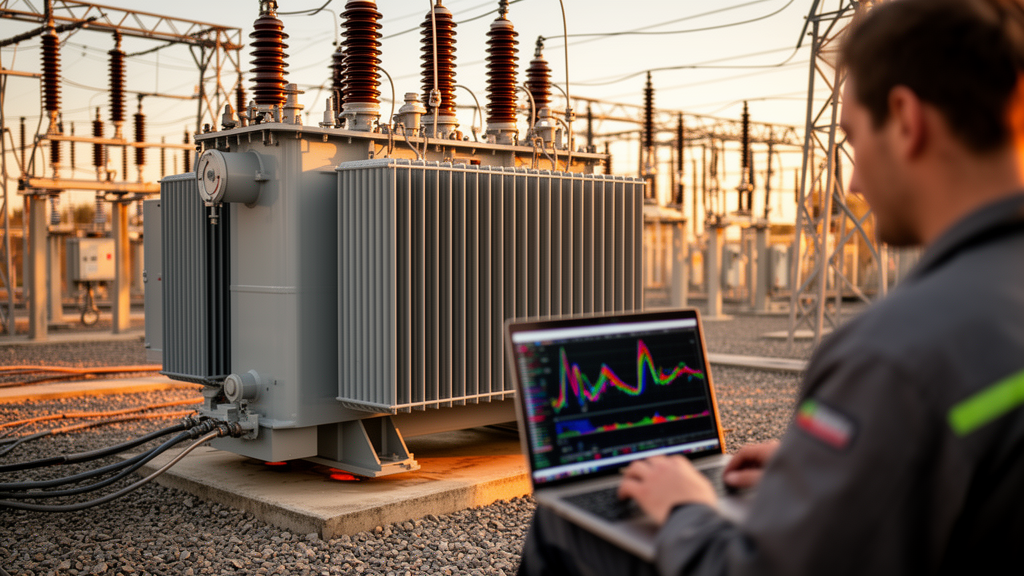
Power transformers sit at the heart of electrical grids, quietly stepping voltage up and down so that generation, manufacturing, and transportation systems can function. When one fails, the consequences ripple outward in operational disruption and economic cost. A study published in Advanced Modeling and Simulation in Engineering Sciences now presents a framework that estimates how many years such a transformer has left, using a combination of high-fidelity thermal simulation, a fast reduced-order surrogate, and data-driven learning of insulation degradation, all without invasive measurements.
The starting point is temperature. According to the international standard IEC 60076-7, the dominant driver of transformer ageing is the hotspot temperature, the peak temperature near the insulating paper that separates the windings from the mineral oil used for cooling. Prolonged exposure to elevated temperatures accelerates the degradation of that paper, and once the insulation breaks down, direct contact between the windings and the oil can trigger abrupt and potentially catastrophic malfunctions. Tracking this hotspot accurately is therefore central to any credible estimate of remaining useful life.
Existing approaches each carry trade-offs. The analytical equations of IEC 60076-7 rely on generalized assumptions and empirical constants, giving only coarse approximations for transformers with specific designs. Data-driven machine learning models can predict a scalar hotspot temperature under monitored conditions but remain decoupled from the underlying thermo-fluid mechanisms, limiting generalization. Physics-informed neural networks embed governing equations into training but have so far been applied mainly to simplified heat-diffusion formulations with reduced spatial dimensionality and steady-state operation. Full three-dimensional computational fluid dynamics, or CFD, captures conduction, convection, and buoyancy-driven laminar flow in detail, but at a computational cost that makes routine, real-time use impractical.
The new work, led by Lila Achour, Sebastian Rodriguez, and colleagues including Francisco Chinesta, bridges this gap. The team built a three-dimensional CFD model of an ONAN-type transformer based on a reference configuration, resolving the oil volume inside the unit, including oil channels within the core and windings and hollow cooling fins in the tank. The model, implemented in the open-source library OpenFOAM with the buoyantSimpleFoam solver, solves the averaged Navier–Stokes equations with temperature-dependent oil properties and natural convection as the dominant heat transfer mechanism. Because the maximum Rayleigh number stays below ten to the ninth, the flow is treated as laminar. The selected mesh contained roughly 10.7 million cells.
Validation came first. Under full-load conditions, with uniform heat fluxes of 470 watts per square meter on the windings and 380 watts per square meter on the core at an ambient temperature of 28 degrees Celsius, the predicted hotspot temperatures agreed with an experimentally validated reference study to within a relative error of less than 0.5 percent. The simulations also showed that the hotspot remains consistently in the upper section of the low-voltage winding, shifting only slightly over time, an observation that justified fixing its location in the reduced model.
The computational breakthrough comes from sparse Proper Generalized Decomposition, or sPGD. The researchers ran fifty CFD simulations spanning ambient temperatures from minus 18.8 to 50 degrees Celsius and heat loads from 205 to 841 watts per square meter, sampled with a Latin Hypercube design. From this sparse dataset, the sPGD surrogate constructs a low-rank, separated representation of the hotspot temperature as a function of ambient temperature and load, with Kriging used to approximate the univariate functions. Across the full dataset, the surrogate achieved a relative L2 error of just 1.19 percent compared with the high-fidelity CFD results, while evaluating almost instantly.
With the surrogate in hand, the team demonstrated what it can do over realistic horizons. Using fifty years of real ambient temperature data for a location near Paris, from 1970 to 2020, obtained from publicly available meteorological records, they estimated transformer load under two scenarios: a simple inverse relationship between load and ambient temperature, and a more realistic piecewise affine model in which heating demand activates below 18 degrees Celsius and cooling demand above 26 degrees. Feeding these profiles through the surrogate, the model simulated the hotspot temperature across the entire fifty-year span in less than two seconds, faithfully reproducing the predictions of the multiphysics high-fidelity models. Integrating the standard IEC ageing rate over that history then yielded the predicted time of failure, defined as the moment cumulative loss of life reaches the twenty-year rated insulation lifetime.
The framework also tackles a deeper problem: the IEC degradation function is an idealized exponential approximation that may not capture the complex thermo-chemical mechanisms of paper degradation in real transformers. The authors therefore inferred the degradation law directly from data using two complementary techniques. SINDy, the Sparse Identification of Nonlinear Dynamics, fits a parsimonious polynomial model of the degradation rate against hotspot temperature; in this study only four polynomial terms were retained, and the identified law matched the classical IEC formulation with a pointwise relative error of roughly five percent, while the integrated, cumulative loss-of-life predictions remained essentially identical to the standard. Neural Ordinary Differential Equations offered a flexible deep-learning alternative, trained on a synthetic dataset of 450 simulated transformer life cycles in which only the total time to failure was known. The trained network predicted total lifespan with an average error of about 69 days on the test set and 63 days on the training set.
Robustness and data efficiency emerged as notable themes. When Gaussian noise was added to the thermal load signal, the SINDy pipeline remained reliable at signal-to-noise ratios of 20 decibels and above, with substantial degradation only at an extreme 10-decibel level exceeding typical monitoring disturbances. For the neural approach, injecting expert knowledge about the functional form, specifically that insulation ageing follows an exponential of inverse temperature, allowed the network to recover the exact degradation function from as few as four data points. The authors note that their demonstrations rely on synthetic datasets and assumed load-temperature relationships, since actual consumption data for the investigated transformer were unavailable, and they present the framework as a route toward real-time health assessment and condition-based maintenance that transmission system operators could apply when real measurements are at hand.
Subject of Research: Remaining useful life estimation of power transformers using surrogate thermal modeling and deep learning
Article Title: Remaining useful life of power transformers using efficient surrogates and deep learning techniques
Article References: Achour, L., Rodriguez, S., Langlois, P.-H., Hafid, F., Ghnatios, C., Kestelyn, X., & Chinesta, F. (2026). Remaining useful life of power transformers using efficient surrogates and deep learning techniques. Advanced Modeling and Simulation in Engineering Sciences, 13(1), Article 9. https://doi.org/10.1186/s40323-026-00329-6
Image Credits: AI Generated
DOI: 10.1186/s40323-026-00329-6
Keywords: power transformers, remaining useful life, hotspot temperature, surrogate modeling, sparse Proper Generalized Decomposition, computational fluid dynamics, SINDy, Neural ODEs, insulation degradation, IEC 60076-7, deep learning, predictive maintenance
News Source: Blake Davidson. (October 29, 2026). Surrogate Models and Deep Learning Predict Power Transformer Lifespans in Seconds. Scienmag.



