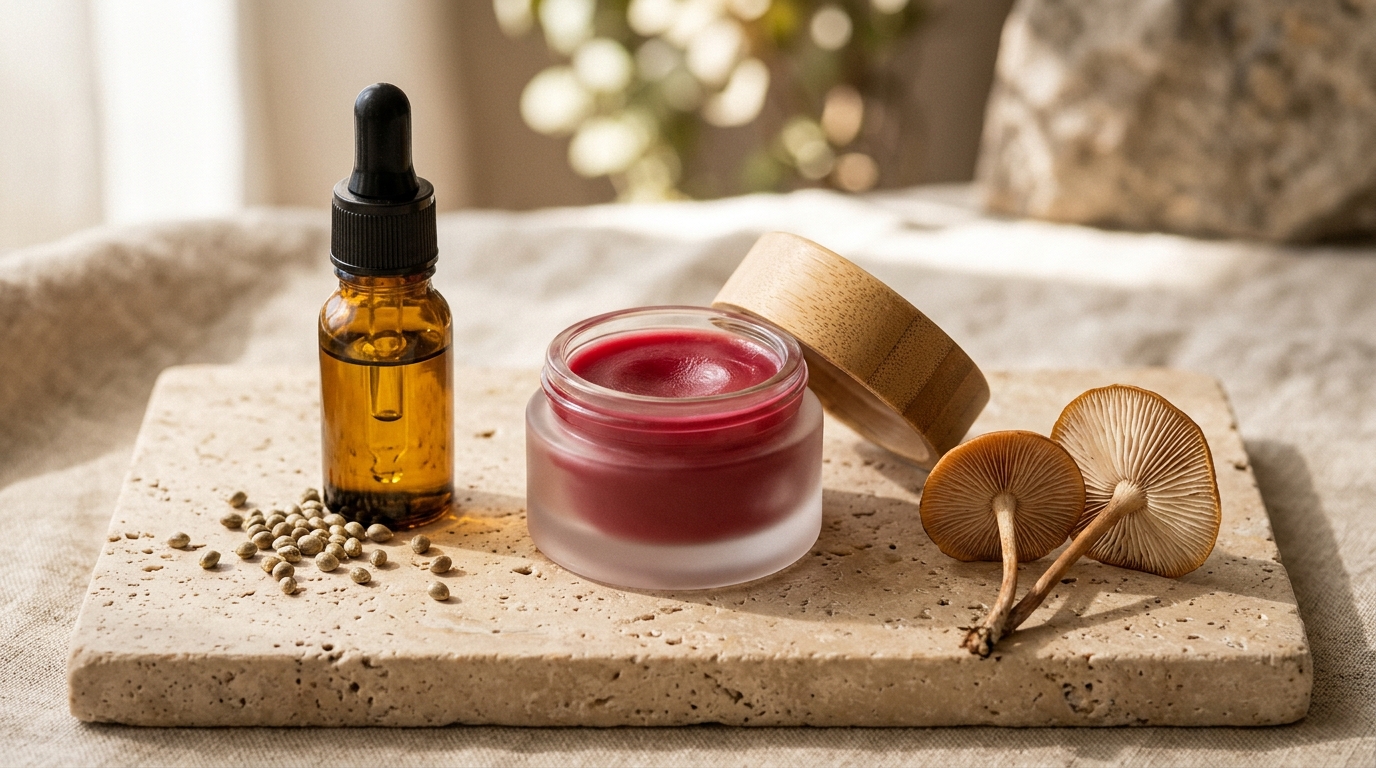
Researchers in India have turned a red pigment produced by an endophytic fungus into a tinted lip salve, pairing the microbial colorant with hemp seed oil extracted using supercritical carbon dioxide. The team, led by Mehak Kaur and Mayurika Goel, formulated the product from the pigment of Talaromyces assiutensis strain CPEF04, an endophytic fungus originally isolated from the mangrove plant Avicennia marina in the Western Ghats of India. Their findings, published in the journal Biotechnology for Sustainable Materials, describe a formulation that softened the texture of the salve, improved its sun protection factor and remained stable for four weeks under accelerated storage conditions.
The pigment was not a new discovery. It had been isolated and characterized in a previous study, where the methanol extract from a 14-day broth culture of CPEF04, grown at 45 rpm and 28 degrees Celsius, was collected, lyophilized and shown to carry antioxidant, antibacterial and anticancer activity while remaining non-toxic to human embryonic kidney 293T cells. That earlier work also identified p-benzoquinone and an anthraquinone derivative among the pigmented compounds, alongside N-benzyladriamycin 14-valerate as an anticancer agent and mycobactin S as an antibacterial compound. The fungal sequence, amplified with ITS1-ITS4 primers, is deposited in GenBank under accession number MW475279.
Hemp seed oil formed the lipid backbone of the salve. The researchers ran 10 grams of dried, milled hemp seeds through a supercritical carbon dioxide extraction system at 450 bars of pressure, 40 degrees Celsius and a carbon dioxide flow rate of 10 millilitres per minute for 240 minutes. The process yielded 37 percent oil by weight, a figure that sits comfortably within the 22 to 42 percent range reported in earlier supercritical extraction studies. Gas chromatography-mass spectrometry of the oil revealed high concentrations of mono- and polyunsaturated fatty acids, including linoleic, linolenic, oleic and palmitoleic acids. Roughly 70 percent of the oil consisted of essential fatty acids from the omega-3 and omega-6 families, which the human body cannot synthesize on its own. The omega-6 to omega-3 ratio measured 2.47 to 1 in this extraction, close to the 3 to 1 ratio often cited in nutritional literature.
Supercritical carbon dioxide extraction was chosen deliberately. Unlike conventional solvent extraction, which relies on chemicals such as chloroform, methanol or hexane, supercritical carbon dioxide leaves no residual solvent, preserves bioactive compounds and can be reused, meeting the stringent standards required for cosmetic ingredients. The authors note that this green technique also avoids the amplified chemical hazard that comes with extracting plant lipids through toxic solvents, a concern they highlight in their introduction to the study.
Building the salve itself required balancing four components: butter, oil, beeswax and pigment. The team tested multiple ratios, dividing each formulation into a lipid phase of beeswax, butters and oils and an aqueous phase of aloe vera juice and fungal pigment. Hemp oil and coconut oil were mixed at an 8 to 2 ratio to increase the viscosity of the oil phase, while vitamin E oil was added as a preservative. The winning formulation, labelled F7T, settled on a butter to oil to beeswax to pigment ratio of 1 to 1 to 0.25 to 1 for the dark shades. It contained 0.02 millilitres of vitamin E oil, the minimum concentration needed to prevent microbial contamination, which stayed absent throughout the one-month stability study. Two earlier formulations, F4T and F5T, showed microbial growth because they contained too little or no vitamin E oil. Beeswax, while useful as a solidifying agent, reduced pigment vibrancy at higher concentrations, so the researchers kept its proportion low.
Physicochemical testing compared the pigmented F7T salve against an unpigmented control with the same base ratio but no pigment. The control registered a hardness of 1.6 plus or minus 0.2 kilograms, typical of butter-based formulations, while F7T was measurably softer, a difference the authors attribute to the softening effect of the microbial pigment. Colour analysis placed F7T’s shade close to Pantone 2449 CP, with a lightness value of 17.95 plus or minus 0.82, a redness value of 15.44 plus or minus 0.78, a yellowness value of 7.17 plus or minus 0.78 and a chroma value of 17.03 plus or minus 1.03. The hue angle came out at 24.85 plus or minus 1.33.
Perhaps the most striking result was the sun protection factor. Measured spectrophotometrically by dissolving 0.1 grams of salve in 10 millilitres of ethanol and scanning absorbance from 290 to 320 nanometres, then applying Mansur’s equation, the pigmented salve reached an SPF of 34 plus or minus 1.3, substantially higher than the unpigmented control. The authors suggest this reflects UV-protective properties inherent to the fungal pigment itself, though they caution that this was an in vitro spectrophotometric estimate and that in vivo SPF testing on skin cell lines remains a necessary next step.
Stability testing ran for four weeks across three temperatures: 4, 37 and 45 degrees Celsius, with room temperature at 25 plus or minus 2 degrees Celsius as the control condition. Weight, pH, colour and texture were checked weekly. All formulations held their pH, colour and weight steady across the temperature range. The unpigmented control, however, showed changes in spreadability and texture at cold temperature, while the pigmented F7T salve remained stable at low temperatures. The researchers attribute this resilience to the pigment’s softening effect, which reduces excessive solidification of the butters and beeswax in the cold.
Sensory evaluation brought ten untrained panellists, aged 25 to 45 and split 60 percent female and 40 percent male, into the picture. Using a 9-point hedonic scale from 1 for least liked to 9 for most liked, the panellists rated aroma, taste, appearance, application and after-effects. F7T scored higher than the control on appearance, aroma, application and after-effects, with a majority of panellists giving it 8 or 9 for application and after-effects. The control, however, scored better on taste, which the authors flag as a key area for further optimization. They also acknowledge limitations in the sensory design: the panel was small, the setup was not double-blinded, and a general human bias toward coloured commodities may have influenced the results. They describe the study as a preliminary consumer preference assessment and call for larger, more detailed panels in future work.
The broader context matters here. Synthetic colorants used across cosmetic, food and textile industries are known to be recalcitrant, toxic, mutagenic and carcinogenic, and their effluents reduce sunlight penetration, photosynthesis and plant proliferation in water bodies. Lip care products in particular can contain heavy metals such as lead, cadmium and chromium, which carry neurological, cardiac and carcinogenic risks when absorbed through the lip surface or inadvertently ingested. Microbial pigments offer a vegan, cruelty-free and biotechnologically scalable alternative, yet the authors note that only about 1 percent of microbial flora has been explored for pigment extraction and that no fungal pigment has previously been formulated into a lip salve. Their work, they argue, demonstrates both the functional and economic viability of combining a fungal colorant with supercritically extracted hemp oil, pointing toward a shift from fossil-based linear production to a bio-based circular economy in cosmetics. They also stress that future research should address dermatological, toxicological and allergenic safety studies, reduce the capital cost of industrial-scale supercritical extraction facilities, and conduct lifecycle assessments to quantify the environmental benefits with transparency.
Subject of Research: Development and testing of a tinted lip salve made from a fungal red pigment and supercritical CO2-extracted hemp seed oil
Article Title: Physiochemical and sensory assessment of lip salve formulation utilizing red microbial colourant from Talaromyces assiutensis, CPEF04 and supercritical carbon dioxide extracted hemp seed oil
Article References: Kaur, M., Jauhari, J., Ali, U., Garg, M., & Goel, M. (2025). Physiochemical and sensory assessment of lip salve formulation utilizing red microbial colourant from Talaromyces assiutensis, CPEF04 and supercritical carbon dioxide extracted hemp seed oil. Biotechnology for Sustainable Materials, 2(1), Article 24. https://doi.org/10.1186/s44316-025-00049-8
Image Credits: AI Generated
DOI: 10.1186/s44316-025-00049-8
Keywords: Talaromyces assiutensis, microbial pigment, hemp seed oil, supercritical CO2 extraction, lip salve, cosmetics, sun protection factor, sensory evaluation, stability testing, biocosmetics, endophytic fungus, natural colorants
News Source: Alan Morgan. (November 5, 2026). Fungal red pigment and hemp seed oil combine into a stable, sun-protective lip salve. Scienmag.