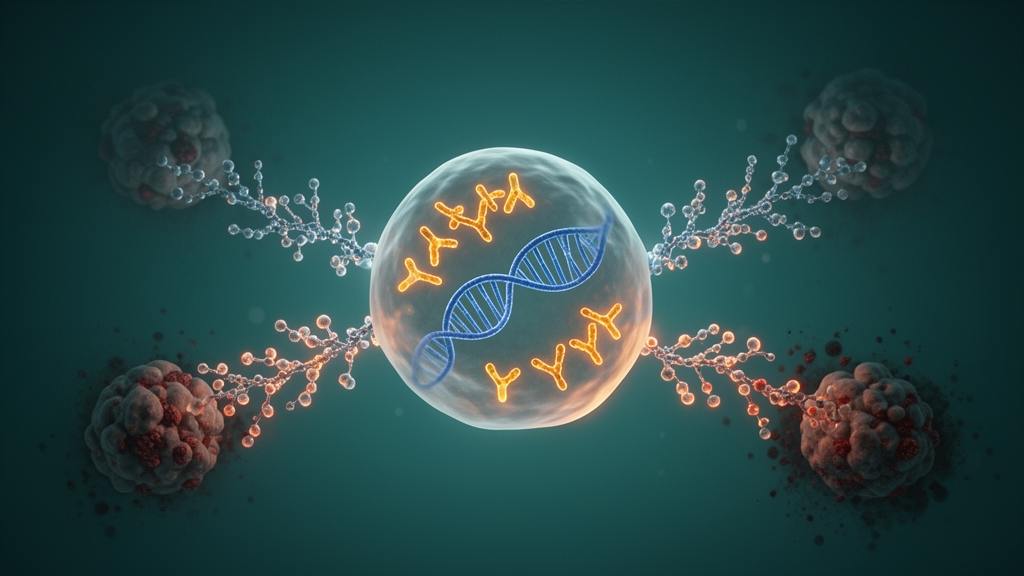
A single fruit fly protein appears to do double duty in protecting the genome, according to a new study published in PLOS Genetics. The protein, called Xrp1, helps cells respond to DNA damage in the immediate aftermath of genotoxic stress, and then, hours later, helps eliminate cells whose genomes were never properly repaired. The findings, from Chaitali Khan, Nasser M. Rusan, and Nicholas E. Baker, offer a detailed picture of how two quality-control systems—one driven by the tumor suppressor p53 and one driven by cell competition—work in sequence to keep damaged cells from accumulating in a developing tissue.
The research centers on a long-standing question in cancer biology: how does p53, the most frequently inactivated tumor suppressor in human cancers, actually suppress tumorigenesis? Decades of work in mammalian cells have catalogued dozens of p53-regulated genes, but the sheer complexity of mammalian genomes has made it difficult to assign specific tumor-suppressing functions to individual downstream effectors. Model organisms with simpler gene regulatory landscapes can help. In the fruit fly Drosophila melanogaster, the authors note, the primary transcriptional target of p53 is the gene encoding Xrp1, a transcription factor of the bZip AT-hook family. That simplicity makes the fly an unusually clean system for asking what a single p53 target gene actually accomplishes when the genome comes under attack.
The study’s first major finding is that Xrp1 is not merely one p53 target among many—it is a genuine mediator of p53’s functions in the DNA damage response, often abbreviated DDR. When the authors examined flies with reduced Xrp1 function, they found defects in p53-dependent gene transcription following DNA damage, indicating that Xrp1 feeds back into the transcriptional program that p53 initiates. They also found that Xrp1 contributes to p53-dependent apoptosis, the programmed cell death that eliminates severely damaged cells before they can propagate mutations. In other words, Xrp1 sits downstream of p53 and helps execute two of p53’s most important protective outputs: amplifying the damage-response transcriptional program and triggering the destruction of compromised cells.
But the story does not end with p53. Previous work had established a second, p53-independent role for Xrp1 in a phenomenon known as cell competition. Cell competition is a form of intercellular comparison in which cells that are less fit—because of mutations, defects in protein synthesis, or other suboptimal states—are actively eliminated by their more fit neighbors. Crucially, cell competition can remove cells whose genomes have been altered by DNA damage and subsequent repair, even after the acute damage response has subsided. This makes it a plausible second line of defense: where the DDR fails to fully restore a normal genome, competition may cull the imperfect cells from the tissue altogether.
To understand how Xrp1 is recruited into this second pathway, the authors turned to a protein called RpS12. During cell competition, Xrp1 is induced by RpS12, which acts as a sensor of defective ribosome biogenesis—the process by which cells build their protein-making machinery. Cells with compromised ribosome production or function trigger RpS12-dependent signaling, which in turn elevates Xrp1, marking them for elimination by their neighbors. This places Xrp1 at the hub of two distinct regulatory circuits: one routed through p53 in response to DNA strand breaks, and another routed through RpS12 in response to defects in the cellular protein synthesis apparatus.
The temporal relationship between these two circuits emerged as one of the most striking aspects of the study. The researchers irradiated developing fly tissues—specifically imaginal discs, the larval precursors of adult structures—and tracked Xrp1’s behavior over time. They found that the p53-independent, RpS12-dependent function of Xrp1 began only as the acute DNA damage response was coming to an end. In other words, the two pathways do not operate simultaneously; they are staged. First, the p53-dependent DDR confronts the damage directly, activating repair genes and apoptosis. Then, as that acute phase winds down, the RpS12-dependent competitive mechanism takes over, targeting any cells that remain abnormal.
Even more revealing was what happened when the authors reduced p53 function in irradiated tissues. Under these conditions, the RpS12-dependent Xrp1 response became even more prominent, suggesting that the competitive pathway can compensate, at least partially, when the canonical DDR is weakened. But the compensation came at a cost. Inhibition of p53 resulted in the persistence of DNA damage after irradiation, which the authors detected through the accumulation of γH2Av, the fly equivalent of γH2AX, a phosphorylated histone variant widely used as a marker for DNA double-strand breaks. Persistent γH2Av signaling indicated that breaks that should have been repaired—or the cells carrying them—were lingering in the tissue.
Taken together, these results support a model in which Xrp1 limits the accumulation of abnormal cells arising from genotoxicity through two complementary mechanisms. In the acute phase, acting as a p53 effector, it promotes the transcriptional response to damage and the apoptotic removal of heavily injured cells. In the later phase, acting in an RpS12-dependent, p53-independent manner consistent with cell competition, it contributes to the elimination of cells in which DNA repair failed to restore a normal genome. The two mechanisms are not redundant so much as sequential and overlapping, with the competitive pathway becoming more prominent precisely when the DDR is compromised.
The evolutionary implications extend well beyond the fly. Both p53 and the core machinery of the DNA damage response are conserved from insects to mammals, and cell competition has been documented in mammalian tissues as well. If Xrp1-like mechanisms operate in vertebrates, the study suggests that the tumor-suppressing power of p53 may depend not only on the genes it directly controls but also on how those genes hand off responsibility to surveillance systems that operate on longer timescales. A cell that escapes p53-mediated apoptosis after irradiation or chemotherapy might still be vulnerable to competitive elimination—unless it also acquires mutations that disable the competition pathway, a possibility that could help explain why tumors so often exhibit defects in multiple quality-control systems simultaneously.
The work also carries practical resonance for cancer treatment. Many therapies, including radiation and several classes of chemotherapy, act by inflicting DNA damage on dividing cells, relying on the patient’s own DDR and tissue surveillance to finish the job. The finding that p53 inhibition allows DNA damage to persist in fly tissues—while simultaneously shifting the burden onto an RpS12-dependent competitive mechanism—illustrates how the genetic context of a cell shapes its fate after genotoxic insult. Understanding the handoff between the acute DDR and cell competition, and the central role that Xrp1 plays in both, may therefore illuminate not only how genomes are protected during normal development but also why some damaged cells survive, persist, and ultimately seed disease.
Subject of Research: The dual roles of the Drosophila protein Xrp1 in the DNA damage response and cell competition
Article Title: Dual contributions of Xrp1 to genome integrity through the DNA damage response and cell competition
Article References: Khan, C., Rusan, N. M., & Baker, N. E. (2026). Dual contributions of Xrp1 to genome integrity through the DNA damage response and cell competition. PLOS Genetics, 22(9), e1012309. https://doi.org/10.1371/journal.pgen.1012309
Image Credits: AI Generated
DOI: 10.1371/journal.pgen.1012309
Keywords: Xrp1, p53, DNA damage response, cell competition, Drosophila, RpS12, genome integrity, apoptosis, ribosome biogenesis, tumor suppression, gamma-H2Av, PLOS Genetics
News Source: Juliet Wilcox. (October 9, 2026). Fruit Fly Protein Xrp1 Guards the Genome Through Two Separate Tumor-Suppressing Pathways. Scienmag.