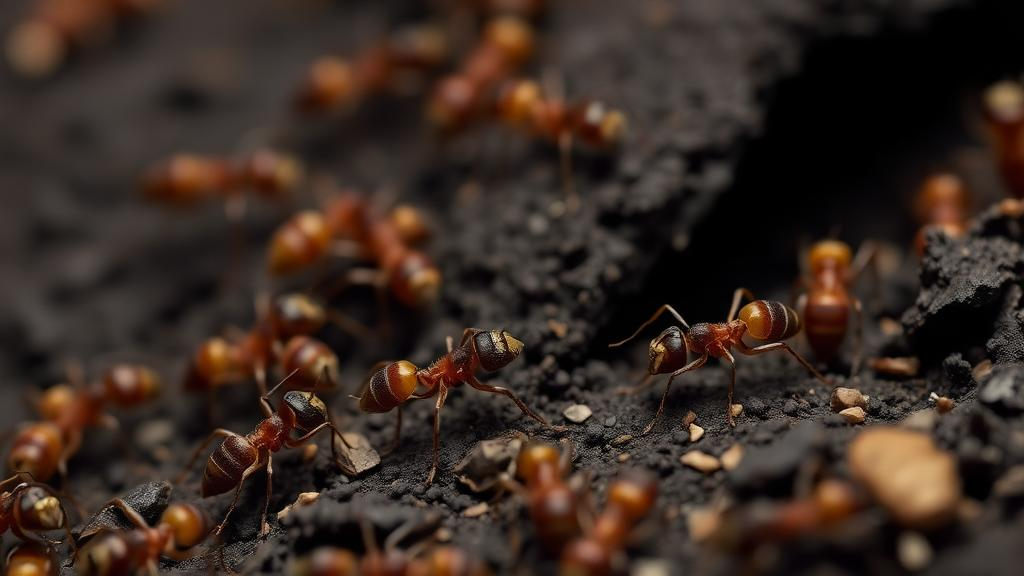
In the bustling world of an ant colony, a curious pattern has long puzzled biologists: a substantial fraction of workers seem to do almost nothing. They linger near the nest while their sisters march out in search of food, appearing for all the world like freeloaders riding on the colony’s collective effort. A new computational study published in PLOS Computational Biology argues that these apparently lazy ants are anything but parasitic. Instead, they function as a carefully managed reserve workforce, held in a state of low activity and mobilized only when the colony’s energy budget demands it. The finding offers a functional explanation for one of the most striking patterns in social insect biology, the sublinear scaling of metabolism with colony size, and suggests that workforce flexibility may be a cornerstone of the evolutionary success of eusocial insects.
The research, conducted by Daniel Campos, Javier Cristín, Pol Fernández-López, Roger Lloret-Cabot, Meritxell Genovart and Frederic Bartumeus, set out to tackle a central question in behavioral ecology: what fitness advantages does eusociality actually confer? One promising route to an answer is to identify collective strategies that shift the efficiency of a group relative to the sum of its individuals. The team focused on reserve workforces, the pool of weakly engaged workers that characterizes large colonies, and tested the hypothesis that this reserve represents an adaptive mechanism enhancing flexibility and foraging efficiency under fluctuating environmental conditions. Rather than treating inactive workers as an anomaly to be explained away, the researchers built them into the very core of their model of colony energetics.
At the heart of the study lies an energetic-balance framework, a way of accounting for the colony’s economy in units of energy. Every ant that leaves the nest to forage incurs costs: the metabolic expense of moving, the time spent searching, and the risk of returning empty-handed. Meanwhile, the entire colony, including its inactive members, continuously burns energy to meet basal metabolic demands. For a colony to remain viable, the energy flowing in from successful foraging trips must exceed these combined costs. The researchers integrated this accounting with stochastic search simulations, computational models of random and semi-directed movement, calibrated with empirical results from four colonies of the ant species Aphaenogaster senilis. This combination allowed them to quantify, with unusual precision, the energetic requirements a colony must satisfy to stay alive.
Aphaenogaster senilis, a Mediterranean species commonly used in laboratory studies of ant behavior, provided the biological grounding for the simulations. By drawing on measurements from real colonies, the team ensured that their modeled foragers did not move like abstract particles but like actual ants, with realistic departure patterns, search dynamics and return behavior. The stochastic component of the simulations captured the inherent unpredictability of foraging: food items appear at irregular locations, and a searching ant cannot know in advance where the next reward will be. Within this uncertain landscape, the colony’s task is to tune how many foragers are out searching at any moment, and how their departures and returns are timed relative to one another.
The model’s first major result concerns colony growth. As colonies become larger, maintaining a positive energy balance requires a disproportionately larger relative workforce. In other words, a colony twice the size does not simply need twice the foraging effort; it needs more than twice, in relative terms, to keep its books balanced. This is because the colony’s basal metabolic demands scale with its total population, while the returns from foraging are constrained by the search process itself. The finding echoes the well-documented sublinear metabolic scaling of eusocial groups, in which larger colonies consume less energy per capita than smaller ones, and it provides a mechanistic bridge between that macroscopic pattern and the day-to-day decisions of individual workers.
The second major result explains how colonies manage this growing burden. By modulating the departure and return rates of foragers over time, colonies control the synchrony of their collective search. When departure rates are high and returns are staggered, many foragers are in the field simultaneously, maximizing the chance that at least some of them find food. When the colony needs to conserve energy, it can suppress departures and let the active workforce dwindle. Crucially, the model shows that this time-dependent modulation allows colonies to efficiently activate or suppress their reserve workforce, scaling foraging effort up or down as circumstances require. The reserve is not a fixed caste of idle ants but a dynamic buffer, continuously adjusted in response to the colony’s energetic state.
This buffering function gives the seemingly lazy workers a clear adaptive role. In good times, when food is abundant and a modest active workforce suffices, the reserve remains dormant, saving the energy that would be wasted on unnecessary searching. In lean times, or when the colony’s demands spike, the reserve can be mobilized rapidly, expanding the search force without the delays that would come from producing new workers. The researchers’ simulations indicate that colonies employing this strategy stabilize their energetics and enhance their responsiveness to environmental fluctuations. A colony that keeps a reserve can absorb shocks, a failed foraging patch, a sudden change in temperature, a burst of brood requiring feeding, that would push a fully committed workforce into deficit.
The implications extend beyond ants. Eusociality, the form of social organization in which overlapping generations cooperate in brood care and reproduction is divided among castes, has evolved independently in ants, bees, wasps and termites, and it underpins some of the most ecologically dominant animal societies on Earth. Explaining its advantages has occupied evolutionary biologists for decades. This study contributes a specific and testable mechanism: workforce modulation as a collective strategy that shifts the efficiency curve of a social group. The reserve workforce, in this view, is not a cost of sociality but one of its principal benefits, a form of biological insurance that solitary foragers cannot purchase because every individual must search for itself.
The work also reframes how biologists should interpret variation in activity levels within colonies. Rather than asking why some workers are lazy, the more productive question may be how colonies regulate the balance between active and reserve workers, and what cues trigger the transition between the two states. The study’s emphasis on departure and return rates suggests that these transitions are governed by time-dependent dynamics rather than fixed individual identities, meaning that the same ant might shift between active foraging and reserve status as the colony’s needs change. Such plasticity would make the reserve truly flexible, and it points toward future empirical work tracking individual workers over time to see whether the model’s predictions hold in living colonies.
By linking the behavior of individual foragers to the metabolic scaling of whole societies, the study exemplifies a growing trend in computational biology: using energetically explicit models, grounded in empirical data, to explain collective patterns that emerge from individual decisions. The authors’ integration of an energetic-balance framework with stochastic search simulations inspired by Aphaenogaster senilis demonstrates that the paradox of the idle worker dissolves once the colony is treated as an economic unit managing risk. The lazy ants, it turns out, are the colony’s savings account, and their disciplined inactivity may be one of the quiet inventions that helped eusocial insects conquer nearly every terrestrial habitat on the planet.
Subject of Research: Reserve workforce dynamics and foraging energetics in eusocial ant colonies
Article Title: Dynamic workforce modulation and foraging efficiency in Eusocial insect colonies
Article References: Campos, D., Cristín, J., Fernández-López, P., Lloret-Cabot, R., Genovart, M., & Bartumeus, F. (2026). Dynamic workforce modulation and foraging efficiency in Eusocial insect colonies. PLOS Computational Biology, 22(10), e1014258. https://doi.org/10.1371/journal.pcbi.1014258
Image Credits: AI Generated
DOI: 10.1371/journal.pcbi.1014258
Keywords: eusociality, ant colonies, foraging efficiency, reserve workforce, metabolic scaling, Aphaenogaster senilis, collective behavior, energetic balance, stochastic search, behavioral ecology, computational biology, PLOS Computational Biology
News Source: Gavin Prescott. (October 9, 2026). Ant Colonies Keep Idle Reserves of Workers to Survive Hard Times, Study Finds. Scienmag.