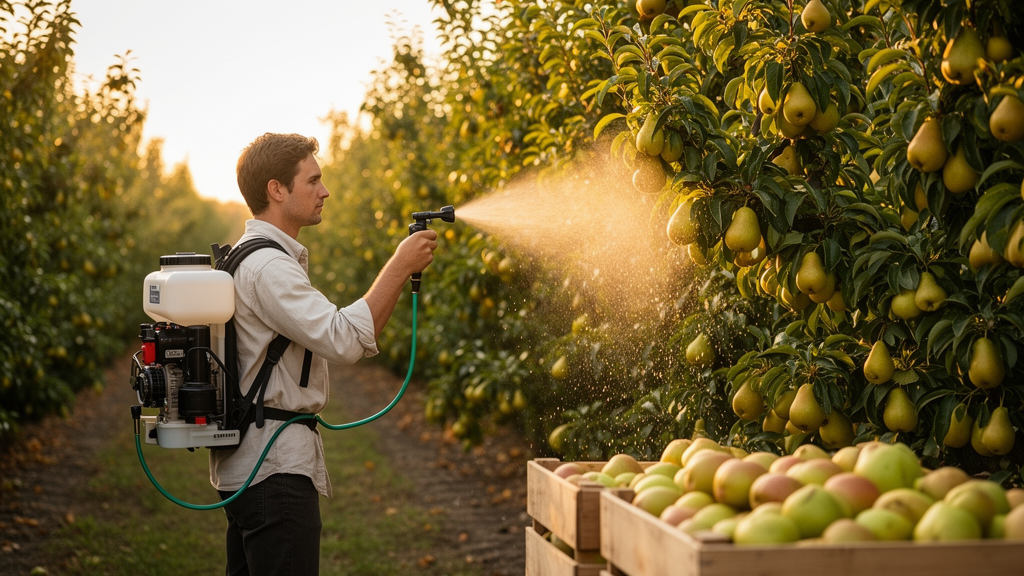
Spraying pear trees with gamma-aminobutyric acid (GABA), a non-protein amino acid involved in plant growth, stress responses and metabolic regulation, substantially increased fruit yield and quality of ‘Le Conte’ pear in a two-season open-field study published in Chemical and Biological Technologies in Agriculture.
Researchers tested foliar applications of GABA at 0, 50 and 100 mM across two consecutive growing seasons, measuring fruit yield, physical and biochemical quality, antioxidant-related parameters and endogenous leaf phytohormones. The study addressed a gap in knowledge about preharvest GABA effects on pear under open-field conditions, since most prior reports concerned other horticultural crops.
The 100 mM treatment produced the strongest responses. Compared with the untreated control, it increased initial fruit set by 73.7% in the first season and 69.2% in the second, reduced fruit abscission by 33.1% and 32.9%, and raised fruit yield by 78.2% and 75.1%, respectively.
Fruit quality also shifted with treatment. GABA increased fruit weight, firmness, fruit shape index and flesh lightness. Treated fruits showed higher total soluble solids, total sugars, ascorbic acid, total amino acids, total phenolic content and total antioxidant capacity, indicating broad changes in the biochemical profile of the harvested fruit.
Enzyme activity measurements revealed that peroxidase activity increased in treated fruits, while polyphenol oxidase activity decreased. These antioxidant-related changes coincided with the observed improvements in productivity and quality during the study period.
The leaf hormone status of the trees also changed. Foliar GABA application was associated with increased concentrations of the auxin indole-3-acetic acid and decreased concentrations of abscisic acid, alterations that occurred during rapid fruit expansion.
The authors conclude that foliar GABA, particularly at 100 mM, was associated with improved fruit productivity and quality of ‘Le Conte’ pear under field conditions, and that these responses coincided with changes in fruit antioxidant-related parameters and leaf IAA/ABA status. They note that the findings indicate foliar GABA application may improve pear fruit performance in association with these physiological changes.
Because the reported associations come from a single cultivar over two seasons, the results describe what was observed in this trial rather than establishing universal recommendations; the physiological changes accompanied the yield and quality gains but the causal mechanisms were not separately demonstrated in the reported findings.
Subject of Research: Effects of preharvest foliar GABA application on yield, quality, antioxidant metabolism and leaf phytohormones of 'Le Conte' pear
Article Title: γ-aminobutyric acid improves fruit yield and quality of ‘Le Conte’ pear in association with changes in antioxidant metabolism and phytohormone status
Article References: Alomran, M. M., & Khedr, E. H. (2026). γ-aminobutyric acid improves fruit yield and quality of ‘Le Conte’ pear in association with changes in antioxidant metabolism and phytohormone status. Chemical and Biological Technologies in Agriculture. https://doi.org/10.1186/s40538-026-01127-3
Image Credits: AI Generated
DOI: 10.1186/s40538-026-01127-3
Keywords: GABA, pear, Le Conte, fruit yield, fruit quality, antioxidant metabolism, phytohormones, foliar application, preharvest, horticulture, aminobutyric, acid
News Source: Gregory Coleman. (October 28, 2026). Foliar GABA boosts yield and quality of Le Conte pear in two-season field trial. Scienmag.