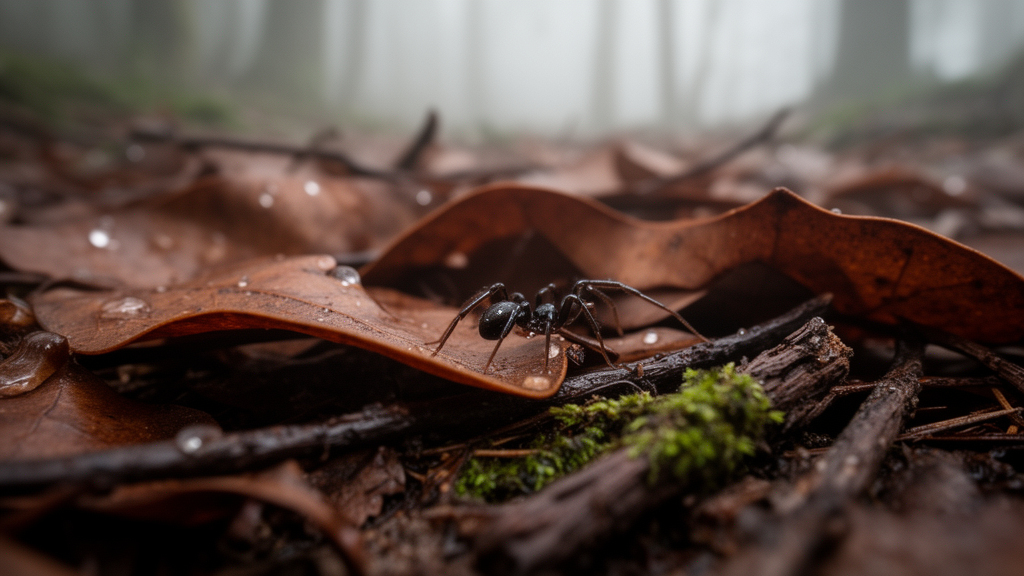
Hidden in the leaf litter of mountain forests across four Chinese provinces, five previously unknown species of dwarf spiders have been formally described, expanding a genus that scientists say remains far more diverse than current records suggest. The new species belong to Shaanxinus, a genus of sheet-web weaving spiders in the family Linyphiidae, and were collected from Gansu, Guizhou, Shaanxi, and Sichuan Provinces. Each is named for its type locality, and each is defined by minute but decisive differences in male and female genital structures, the standard currency of spider taxonomy.
The newly described species are Shaanxinus baitianhe, S. kuankuoshui, S. liangdang, S. micangshan, and S. zhongzhai. The new species are placed in the family Linyphiidae, one of the most diverse spider families worldwide. The holotypes of Shaanxinus baitianhe, S. kuankuoshui, S. liangdang, and S. micangshan are deposited in the School of Life Sciences at Southwest University in Chongqing. Alongside the descriptions, the study provides photographs of the copulatory organs and body form of all five species, a distribution map, and new colour images of the body and genitalia of a sixth, previously known species, Shaanxinus griseolineatus.
Specimens were collected by sieving leaf litter and preserved in 75 percent ethanol. Measurements were taken under a Leica M205A stereomicroscope with a Leica DFC450 camera, and focus-stacked photographs of habitus and copulatory organs were produced with a CCD camera mounted on an Olympus BX53 compound microscope using Helicon Focus software. Eye sizes were measured as maximum dorsal diameter, and all measurements are reported in millimetres.
Shaanxinus baitianhe, from Baitianhe Nature Reserve in Zhenba County, Shaanxi, is described from a male holotype collected at 1048 metres altitude in May 2013, and the species is known only from the type locality. The male measures 3.45 millimetres in total length, with a yellow carapace 1.63 millimetres long bearing a raised cephalic lobe, and a pale abdomen with a greenish-black pattern. The species resembles S. rufus in the shape of its C-shaped paracymbium but is distinguished by the tip of the anterior radical process, which carries one long projection and two small teeth, features absent in S. rufus.
Shaanxinus kuankuoshui was collected at Kuankuoshui Nature Reserve in Guizhou Province at 1435 metres. The male holotype is 3.09 millimetres long, yellowish brown, with a grey abdomen marked by six transverse chevrons and a black ventral side. Its pedipalp carries a small, strongly sclerotised anterior radical process with a pointed end, and the lateral extension of the radix forms a robust arc-shaped projection in retrolateral view. That arc-shaped tip separates it from the closely similar S. longiembolus, in which the same structure is thumb-shaped. Shaanxinus zhongzhai, from Zhongzhai Village in Nayong County, Guizhou, is the smallest of the new species at 2.26 millimetres, and stands apart from all its congeners by a paracymbium whose distal arm tip bears several small teeth, a reduced protegulum, and a lateral arm of the radix that forms a perpendicular angle.
Shaanxinus liangdang, described from Heihe Forest Park in Liangdang County, Gansu, is the best-sampled of the new species, with a type series of 28 males and 27 females gathered from sites on the southern slope of Taibai Mountain in Shaanxi as well as the Gansu type locality, at altitudes ranging from 1004 to 1979 metres. The male holotype is 3.12 millimetres long and the female paratype 3.71 millimetres. Males have a U-shaped paracymbium whose distal arm covers more than half of the proximal part and tapers to a tip, while the anterior radical apophysis lacks a projection. Females have a reduced ventral plate, and the spermathecae point laterally at the centre rather than towards the epigastric furrow, distinguishing the epigyne from that of S. shoukaensis, which also has a reduced ventral plate but a narrower copulatory duct loop.
Shaanxinus micangshan, from Micang Mountain in Nanjiang County, Sichuan, at 1368 metres, is described from a type series of three males and three females, with additional paratype material from Li County and Kangding City at altitudes above 2400 metres. The male holotype is 3.31 millimetres long, and in this species leg IV is longer than leg II. Its paracymbium is U-shaped with a straight-tipped distal arm covering half of the proximal part, and the anterior radical apophysis tip carries a triangular projection, the inverse of the condition in S. liangdang.
The study also examined new material of Shaanxinus griseolineatus, a species originally described as Gonatium griseolineatum by Schenkel in 1936 and shuffled through several genera before being transferred to Shaanxinus in 2025.
With these five additions, the genus Shaanxinus now comprises 26 described species, up from 21 before this study. The genus was established by Tanasevitch in 2006 with the type species Shaanxinus rufus, and its known range previously spanned China’s Shaanxi, Hebei, Hunan, Chongqing, and Taiwan, together with the Russian Far East and Vietnam. The new records extend this range into Gansu, Guizhou, and Sichuan, and the authors note that the genus remains insufficiently documented, particularly in mainland China and adjacent regions, leaving additional undescribed species likely to be found.
The wider context underscores how little is still known about these spiders. The family Linyphiidae, to which Shaanxinus belongs, is one of the most diverse spider families in the world, currently comprising 641 extant genera and 4967 species, including 11 fossil genera and 62 fossil species. In China, 639 species in 185 genera have been recorded, and roughly 51 species in 34 genera have recently been reported from the four provinces covered by this study alone. The authors argue that the concentration of new species in continental mountain regions, complementing earlier work that focused on Taiwanese and Vietnamese material, shows that the diversity of Shaanxinus in East Asia remains significantly underestimated and that more intensive collecting, together with integrative taxonomic approaches, is needed in this biologically rich but poorly sampled region.
Subject of Research: Taxonomic description of five new species of the linyphiid spider genus Shaanxinus from China
Article Title: Five new species of Shaanxinus Tanasevitch, 2006 ( Araneae , Linyphiidae ) from China
Article References: Irfan, M., Rehman, T., Wang, L.-Y., & Zhang, Z.-S. (2026). Five new species of Shaanxinus Tanasevitch, 2006 (Araneae, Linyphiidae) from China. ZooKeys, 1296, 27-44. https://doi.org/10.3897/zookeys.1296.213068
Image Credits: AI Generated
DOI: 10.3897/zookeys.1296.213068
Keywords: Shaanxinus, Linyphiidae, Erigoninae, new species, spider taxonomy, China, Gansu, Guizhou, Shaanxi, Sichuan, leaf litter, pedipalp morphology
News Source: Drew Townsend. (October 28, 2026). Five New Dwarf Spider Species Unearthed in China’s Mountain Leaf Litter. Scienmag.