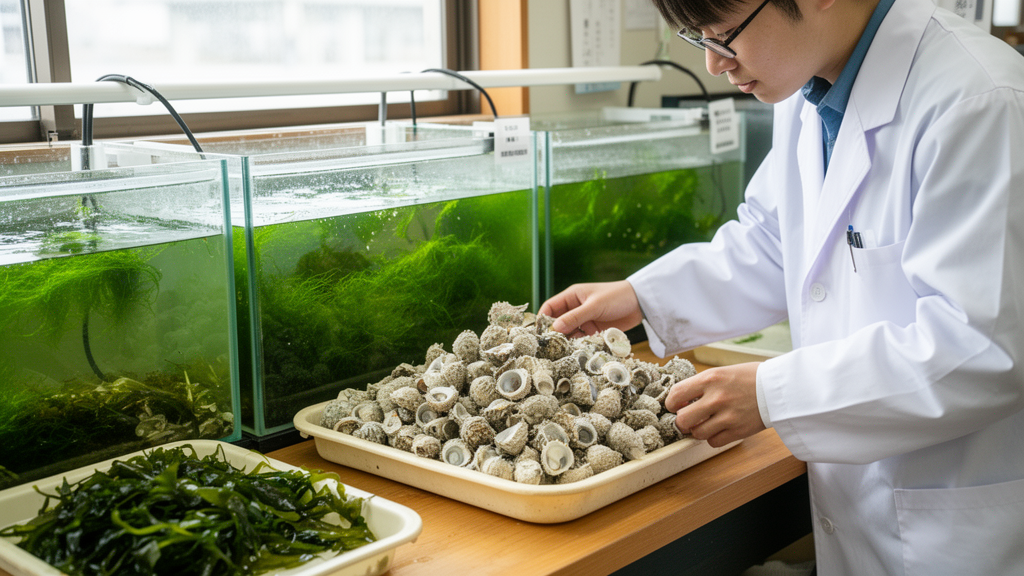
A team of Japanese aquaculture scientists has reported the first successful method for mass seed production of the edible acorn barnacle Balanus rostratus, a large cold-water species prized as a delicacy in northern Japan. Writing in the open-access journal Aquaculture Science and Management, the researchers describe how a locally collected diatom, Thalassiosira sp., finally allowed them to raise the species’ larvae reliably through settlement, producing an estimated 1.14 million settled juvenile barnacles from roughly 9.0 million hatched larvae during a single production season from December 2024 to February 2025. Until now, no successful method for mass seed production of this species had been reported, and aquaculture output has remained far below market demand.
Balanus rostratus, known in Japan as “miné-fujitsubo”, is distributed from the northern coast of the Sea of Japan and the Pacific coast of northeastern Japan to the northern Pacific coast of North America and Canada. The species attracted attention as a food resource in Aomori, northern Japan, in the 1990s after being recognized by a local chef, but intensive harvesting during that period led to a significant reduction in the number of large individuals suitable for consumption, although the overall wild population did not necessarily diminish. Small-scale aquaculture using wild-collected juvenile barnacles began in Mutsu Bay in the late 1990s, yet successful spat collection still depends on the skills of experienced personnel, and production has never met demand.
The new study was carried out at the Aomori Prefecture Fisheries Stock Enhancement Association in Hashikami, Aomori. Approximately 300 adult barnacles with basal shell diameters of 25 to 40 millimeters were purchased from a fisherman in Mutsu Bay in late November 2024, during the species’ natural reproductive period, and used as broodstock. Hatched larvae were collected via overflow into a separate tank to isolate them from the adults, and fifteen rearing trials were conducted, each in a 200-liter tank stocked with an average of 6.0 × 10⁵ ± 2.3 × 10⁵ larvae. Water temperature was held at 11 to 13 degrees Celsius, with daily exchange of 30 to 40 liters of filtered seawater and continuous aeration.
The larval feed appears to have played an important role, although it alone was not sufficient to ensure consistent larval development. Over the past decade the team had tested various diatom species, including Skeletonema costatum, Chaetoceros gracilis and Chaetoceros calcitrans, but stable settlement was achieved only recently using Thalassiosira sp. collected from coastal waters off Nemuro, at the eastern tip of Hokkaido. The diatom was maintained at concentrations of 1.7 to 4.1 × 10⁴ cells per milliliter, with 20-watt LED lamps above each tank promoting its growth in the rearing water. When roughly half the larvae in a trial had reached the cyprid stage, the larvae were pooled into a settlement tank containing scallop shells coated with silicone antifouling paint, which left small uncoated areas designated for settlement.
Across the fifteen trials, the average survival rate from the start of rearing to cyprid emergence was 44.3 percent within 19 days. In successful trials, defined as those in which approximately half or more of the larvae reached the cyprid stage, development progressed steadily every two to three days, with cyprids appearing by day 16 and rearing ending on average on day 19. However, in six of the fifteen trials the larvae failed to reach naupliar stage 6. In unsuccessful trials, growth slowed after the N5 stage and the larvae generally failed to progress beyond early N6, and survival rates at termination were markedly lower than in successful trials.
The production rate represents a dramatic improvement over the team’s own history. Historical records show that before 2020, using various diatom species, the production rate was extremely low, typically 0.01 percent, and the introduction of Thalassiosira sp. as a secondary feed in 2022–2023 raised it to only 0.07 percent. From 2023 onward, using Thalassiosira sp. as the primary feed was associated with a marked improvement in performance. The reasons appear to be partly nutritional and partly physical. Microscopic measurements showed that the Thalassiosira sp. cells used in the study had a mean diameter of 27.5 ± 4.6 micrometers, roughly 5.6 times larger than C. calcitrans, giving an estimated cell volume about 176 times greater. The relatively low cell concentrations used therefore corresponded to an equivalent biomass of approximately 3.0 to 7.2 × 10⁶ cells per milliliter of C. calcitrans, suggesting that B. rostratus larvae may require a greater nutritional input than other barnacle species.
Lipid analysis strengthened that interpretation. Compared with commercially supplied C. gracilis, Thalassiosira sp. contained higher levels of the omega-3 fatty acids EPA and DHA on a per-cell basis, and its total lipid content per cell was approximately 200 times greater. To investigate whether larval lipid dynamics were associated with settlement success, the researchers compared fatty acid composition and triacylglycerol levels in larvae from successful and unsuccessful trials, grouping naupliar stages 1 to 3 separately from post-stage-4 larvae. In successful trials, the levels of all detected fatty acids were maintained from the N1–N3 stage through the late larval stage, and triacylglycerol levels were similar between these groups. In unsuccessful trials, by contrast, fatty acid and triacylglycerol levels decreased significantly after stage 4, falling below both the N1–N3 larvae and the larvae from successful trials, according to a Kruskal–Wallis rank-sum test with Bonferroni-corrected post hoc comparisons.
Notably, no significant difference was observed in total lipid content between the groups, indicating that while fatty acids and triacylglycerols were markedly depleted in failing batches, the overall quantity of lipid remained relatively constant. The authors suggest that late-stage larvae in unsuccessful trials may contain a greater proportion of lipids not stored as triacylglycerols, and they caution that the total lipid measurement in unsuccessful trials may have been overestimated because contamination by exuviae, which contain lipid components such as wax esters, could not be completely avoided during sample collection. The analysis of the Thalassiosira sp. used in successful and unsuccessful trials showed no clear trend, and the authors note that additional non-nutritional factors, such as handling, water quality or subtle environmental variation, may also influence rearing success, since unsuccessful batches occurred even under identical feeding conditions.
The findings connect to a broader pattern in cold-water crustacean aquaculture. Supplementation with Thalassiosira sp. has significantly improved the survival of horsehair crab larvae, and the supply of essential fatty acids, particularly DHA and EPA, has been shown to be important for larval development in snow crabs and other species. In B. rostratus, adults are known to store triacylglycerols including DHA and EPA in their ovaries, where they are thought to support larval development and hatching. The new results suggest these same n-3 fatty acids may play a key role in promoting successful settlement, as lipids accumulated during the naupliar stages are reported to support the energy demands of settlement and metamorphosis.
The study also documented remarkably fast development under artificial conditions: nauplii developed into cyprids within 19 days, whereas a field survey in Ofunato Bay, Iwate, reported cyprid larvae appearing two months after the first N2 larvae and continuing for up to six months. Growth analysis of the nauplii showed a steady increase in body weight with developmental stage, described by an exponential regression model with an R² of 0.841. The authors emphasize that further optimization and validation, including addressing variability among trials and nutritional requirements, will be necessary before large-scale commercial implementation. They also highlight a practical advantage of the technique: because cyprids can settle on various substrate types, silicone-coated scallop shells can help prevent the biofouling that has limited the expansion of B. rostratus aquaculture, offering a promising step toward sustainable cultivation and a stable supply of this sought-after seafood.
Subject of Research: Mass seed production of the edible acorn barnacle Balanus rostratus using Thalassiosira diatoms as larval feed
Article Title: Mass seed production for aquaculture of the edible acorn barnacle, Balanus rostratus
Article References: Ido, A., Yamada, H., Matsuhashi, S., Uwano, S., & Tsurumi, K. (2026). Mass seed production for aquaculture of the edible acorn barnacle, Balanus rostratus. Aquaculture Science and Management, 3(1), Article 12. https://doi.org/10.1186/s44365-026-00040-y
Image Credits: AI Generated
DOI: 10.1186/s44365-026-00040-y
Keywords: Balanus rostratus, acorn barnacle, aquaculture, seed production, larval rearing, Thalassiosira, fatty acids, triacylglycerols, EPA, DHA, settlement, Japan
News Source: Alan Morgan. (October 29, 2026). Diatom diet unlocks mass production of Japan’s edible acorn barnacle. Scienmag.