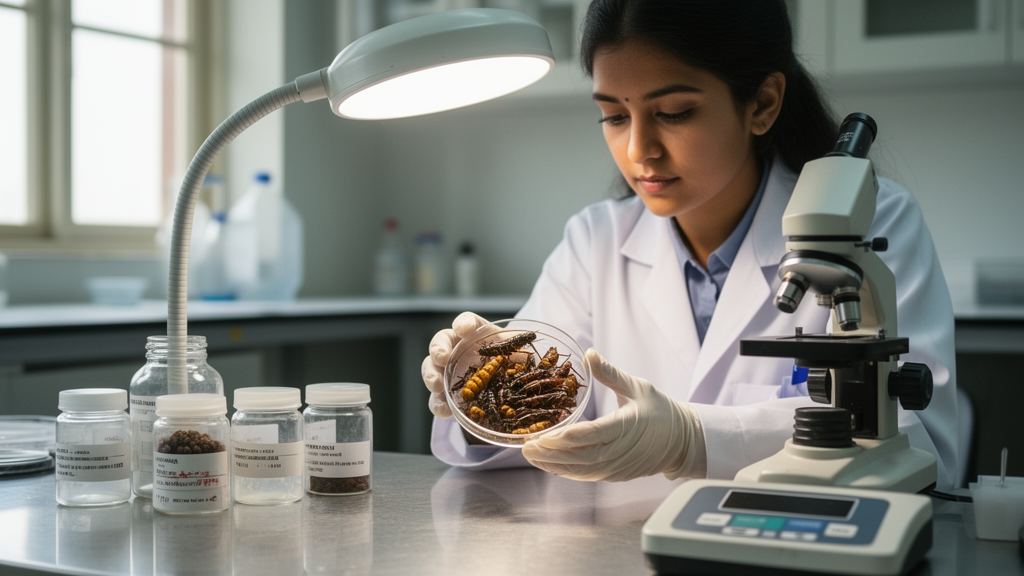
India is among the most entomophagically diverse countries on Earth, with peer-reviewed inventories documenting more than 300 edible insect species across at least 14 states, yet the country has not converted this biological resource into a regulated protein sector. A narrative review published in Frontiers in Sustainable Food Systems identifies three structural barriers standing in the way: taxonomic under-documentation outside the northeast, the absence of a species-specific standard from the Food Safety and Standards Authority of India (FSSAI), and culturally mediated food neophobia. The review, which synthesizes literature from 1997 to 2025 alongside primary regulatory documents, argues that the binding constraint is not the lack of a legal pathway but the near-total absence of the primary safety data any regulatory dossier would require.
The biodiversity numbers themselves are less stable than their frequent repetition suggests. The widely cited figure of 158 edible species in Arunachal Pradesh originates in a 2014 national overview aggregating tribe-specific surveys, while a later review reported Nagaland leading with 92 species and Manipur with 69. The divergence is methodological rather than contradictory: counts restricted to scientifically identified species differ substantially from those admitting vernacular records only. Recent fieldwork keeps shifting the picture, with 44 previously unrecorded species added from a single Arunachal district in 2024, bringing that district’s total to 97 and demonstrating that even the most intensively surveyed state remains incompletely inventoried. The authors conclude that no stable national inventory currently exists and call a standardized national survey applying uniform identification criteria the single most consequential unfilled task in Indian entomophagy research.
The tradition extends beyond insects. Spider consumption, or arachnophagy, has been documented in both Nagaland and Manipur, where the golden orb-weaver Nephila pilipes and the orb-weaver Trichonephila clavata are harvested by Lotha Naga communities during October and November and prepared by removing head and legs, repeated hot-water soaking, and simmering with ginger, chilli and bamboo shoot extract. Both species returned a use value index of 0.9, indicating near-unanimous informant consensus on their status as meat substitutes. The review treats arachnids separately from insects throughout, because pooling the records inflates edible insect counts and obscures differences in biology, allergen profile and processing behavior.
Compositional evidence remains concentrated in fewer than twenty of the more than 300 consumed species. The most complete analysis, covering two Arunachal Pradesh species, reported 55.28 percent protein on a dry-weight basis for adult red weaver ants (Oecophylla smaragdina) with a monounsaturated-dominant lipid fraction and all essential amino acids except methionine, while monsoon-swarming termite alates contained 33.67 percent protein but 50.93 percent fat, delivering 617.41 kilocalories per 100 grams. The highest protein value identified for any India-consumed insect is 65.81 percent in the ant Eupreponotus inflatus from Assam. Fresh-weight analyses of three Assam species reported protein from 16.71 to 28.88 percent, with leucine and valine limiting for every age category, a finding the authors link directly to the formulation of insect-fortified complementary foods.
The only controlled thermal processing data for any India-consumed edible arthropod come from the spiders. Raw Nephila pilipes contained 73.62 percent protein by the Lowry method; roasting at 70 and 100 degrees Celsius retained roughly 50 percent, boiling retained 47.69 percent, and roasting at 130 degrees reduced measurable protein to 36.03 percent, a decline attributed to denaturation, aggregation, Maillard browning and thermal hydrolysis. Trichonephila clavata behaved differently, losing protein on boiling through leaching but remaining largely stable across the full roasting range. The generalizable conclusion is that moderate dry heat between 70 and 100 degrees is the preferable processing window, while boiling, the most common traditional preparation, may impose the largest nutritional penalty. The authors note that the Lowry assay measures soluble protein, so part of the apparent loss at high temperature may reflect reduced extractability rather than amino acid destruction, and no equivalent processing study exists for any Indian edible insect.
On safety, the picture is stark: to the authors’ knowledge, no systematic microbiological, parasitological or pesticide-residue survey has been published for any India-consumed species. Drawing on international evidence, they map the hazard entry points along the harvest-to-consumer chain, from substrate contamination and gut contents at harvest to storage under ambient tropical conditions favoring spore-formers and mycotoxigenic moulds. A caution runs through the analysis: detection of a microorganism or parasite establishes exposure potential, not demonstrated foodborne disease, and documented outbreaks attributable to edible insects are few. The appropriate output of Indian surveillance, they argue, is quantitative microbial criteria for defined product categories rather than a qualitative list of detected organisms. Allergenicity is the best-documented hazard internationally, with tropomyosin and arginine kinase shared between insects, crustaceans and house dust mites, making allergen labeling a first-order requirement given the relatively high prevalence of shellfish allergy in coastal Indian populations.
Environmental claims receive similarly careful qualification. Published life-cycle assessments consistently favor farmed insects over beef, with syntheses placing cricket production at roughly 2.7 to 4 kilograms of carbon dioxide equivalent per kilogram of protein against approximately 295 for beef, but the insect values derive from European pilot-scale systems and the beef values from global averages including land-use change. The only tropical commercial-scale assessment the authors identified compared cricket production in northeastern Thailand against broiler production in the same region and found lower impacts for crickets on most categories, with feed as the dominant hotspot. That result, rather than the hundred-fold comparison with beef, is the appropriate reference for Indian planning, and no Indian life-cycle assessment has been published. India’s climate does reduce one cost component, since the tropical black soldier fly requires no supplementary heating across most of the country, but no peer-reviewed Indian substrate trial exists for the candidate residues such as bagasse, rice bran and brewery spent grain.
On regulation, the review distinguishes legal pathways that are often conflated. The European Union requires pre-market novel food authorization and has approved four insect species in specified forms since 2021; Singapore’s Food Agency published an Insect Regulatory Framework in July 2024 permitting sixteen species of low regulatory concern, provided they are farmed under food safety controls and not wild-harvested; Thailand has certified cricket farms under a national good agricultural practice standard since 2017; and the United States has issued no insect-specific authorization, with ingredient status resting on self-determined GRAS conclusions. India’s FSSAI maintains no dedicated standard, category or criteria, but the Food Safety and Standards (Approval for Non-Specified Food and Food Ingredients) Regulations of 2017 provide a prior-approval route under which a dossier can be submitted for scientific-panel evaluation. No insect-derived product appears on the published list of approvals, and a secondary industry report of pending cricket flour and black soldier fly applications could not be corroborated against an official source.
The review also separates levels of bioactive evidence. Antioxidant and anti-inflammatory claims for Indian species rest almost entirely on crude-extract assays in vitro, and no peptide from an India-native edible arthropod has been sequenced with confirmed activity. The single clinical-level entry concerns a standardized pharmaceutical cockroach extract evaluated in China, which is neither an Indian study nor a food preparation. Therapeutic traditions are extensive, from termite preparations for ulcers and anemia in Odisha to spider use for skin rashes and asthma in Assam, but traditional use establishes ethnomedical relevance, not efficacy. A four-phase commercialization roadmap is presented explicitly as a conceptual framework rather than a predictive timeline, grounded in Indigenous knowledge protection under the Biological Diversity Act and the Nagoya Protocol, ecological monitoring before commercial harvest, regulatory science developed alongside entrepreneurship, and community enterprise as the primary vehicle for local value capture, exemplified by the January 2024 Geographical Indication tag awarded to Odisha’s red weaver ant Kai chutney.
The authors’ conclusion is blunt: India possesses the biological resource, a climatic advantage, an organic substrate supply and a traditional knowledge base, and almost none of the primary safety evidence needed to build a sector from them. They call on the scientific community to generate the microbiological, parasitological, residue, allergenicity and processing data that a regulatory dossier requires, prioritizing species already consumed at scale and the silkworm pupae already produced at industrial scale by the world’s second-largest sericulture sector. FSSAI, they argue, should develop a species-specific standard drawing on the European Union list specifications and the Singapore framework while evaluating early submissions under the existing non-specified food route, so that regulation and evidence develop together rather than one waiting indefinitely for the other.
Subject of Research: Edible insect and spider consumption in India: biodiversity, nutrition, food safety evidence gaps and regulatory pathways
Article Title: Entomophagy at India’s nutrition-sustainability nexus: biodiversity, nutritional evidence, food safety, regulatory gaps and a conceptual commercialization roadmap
Article References: Kumar, J. A., Dar, S. A., Singh, J., Riyaz, M., & Nazir, A. (2026). Entomophagy at India’s nutrition-sustainability nexus: biodiversity, nutritional evidence, food safety, regulatory gaps and a conceptual commercialization roadmap. Frontiers in Sustainable Food Systems, 10, Article 1963061. https://doi.org/10.3389/fsufs.2026.1963061
Image Credits: AI Generated
DOI: 10.3389/fsufs.2026.1963061
Keywords: entomophagy, edible insects, India, food safety, FSSAI, arachnophagy, insect protein, food neophobia, life-cycle assessment, Nagoya Protocol, silkworm pupae, novel food regulation
News Source: Gavin Prescott. (October 29, 2026). India’s 300 Edible Insect Species Await Safety Data Before Any Regulatory Green Light. Scienmag.