


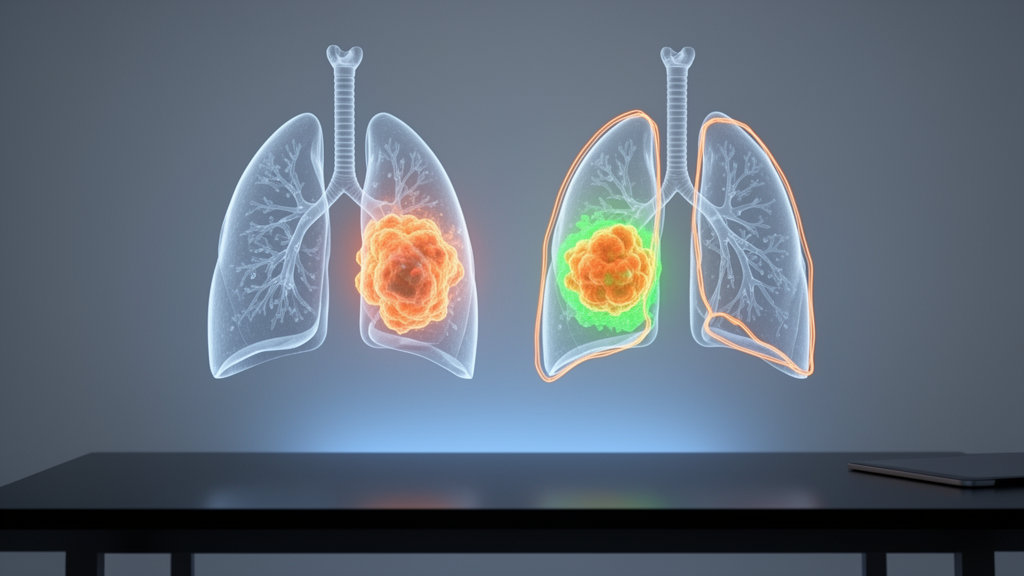
Automated delineation of lung tumors on computed tomography scans could become more reliable following a systematic comparison of nine deep learning configurations, published open access in BioData Mining. The study combined three encoder-decoder segmentation architectures—U-Net, U-Net++, and UNet 3+—with three pre-trained encoder backbones (VGG16, ResNet50, and Xception), producing nine model configurations evaluated under identical conditions. The goal was to give clinicians and medical imaging engineers evidence-based guidance on which architecture to choose when segmenting lung tumors across the full range of tumor sizes.
The researchers assembled a combined dataset of 161 subjects: 63 public Kaggle cases comprising 1,647 CT slices, and 98 patients from Imam Reza Hospital in Tabriz, contributing 500 slices collected retrospectively in 2025. After preprocessing, 1,322 tumor-containing CT slices standardized to 128 × 128 pixels were used. A morphological pipeline applying contrast-limited adaptive histogram equalization (CLAHE), Otsu thresholding, and automated lung extraction isolated pulmonary structures before segmentation, a step the authors report effectively reduced false positives.
All models were trained with a combined Dice-Focal loss function and the Adam optimizer using 5-fold stratified cross-validation with an 80/20 split. Performance was measured with seven metrics—intersection over union (IoU), Dice coefficient, sensitivity, specificity, precision, accuracy, and F1-score—and differences between configurations were tested with ANOVA and Kruskal-Wallis statistical tests. Tumors were also retrospectively stratified into five size categories, with diameters ranging from approximately 0.6 to 30.2 mm, and evaluated with both a generalist model and independently trained size-specific models.
U-Net paired with the VGG16 backbone achieved the highest overall performance, with an IoU of 0.8838 ± 0.0229 and a Dice score of 0.9342 ± 0.0164. U-Net++ with Xception and UNet 3+ with VGG16 showed the greatest stability across folds, with a Dice standard deviation of just 0.0009. UNet 3+ with ResNet50 attained the highest sensitivity, at 0.9338 ± 0.0142, and the highest precision, at 0.9449 ± 0.0059. Every configuration achieved specificity of at least 0.9991 and accuracy of at least 0.9980, with ANOVA p-values below 0.001 and Kruskal-Wallis tests significant for IoU and accuracy (p < 0.001) and for Dice (p < 0.01).
Tumor size strongly influenced segmentation difficulty. Performance improved steadily with tumor size, rising from an IoU of 0.7912 ± 0.0287 in the smallest category to 0.9106 ± 0.0131 in the largest.
The authors position the work as practical guidance for clinical applications such as radiation therapy planning and computer-aided detection, where manual tumor delineation on CT is time-consuming and subject to inter-observer variability. Because the hospital data were collected retrospectively from a single center and the study is a technical benchmarking exercise rather than a clinical trial, further validation on independent, multi-center datasets would be needed before deployment in patient care.
Subject of Research: Comparing U-Net architecture and backbone combinations for automated lung tumor segmentation on CT images
Article Title: Automated lung tumor segmentation using enhanced U-Net architectures: a multi-backbone comparative study for clinical applications
Article References: Jefri Canatalay, P., Asghari, A., Ostadhassan, R., Asghari, E., & Najafzadeh, H. (2026). Automated lung tumor segmentation using enhanced U-Net architectures: a multi-backbone comparative study for clinical applications. BioData Mining. https://doi.org/10.1186/s13040-026-00604-7
Image Credits: AI Generated
DOI: 10.1186/s13040-026-00604-7
Keywords: lung cancer, tumor segmentation, deep learning, U-Net, computed tomography, VGG16, ResNet50, Xception, Dice score, medical imaging, computer-aided detection, cross-validation
News Source: Nathaniel Bowman. (October 29, 2026). U-Net Variants Compared for Automated Lung Tumor Segmentation on CT Scans. Scienmag.



