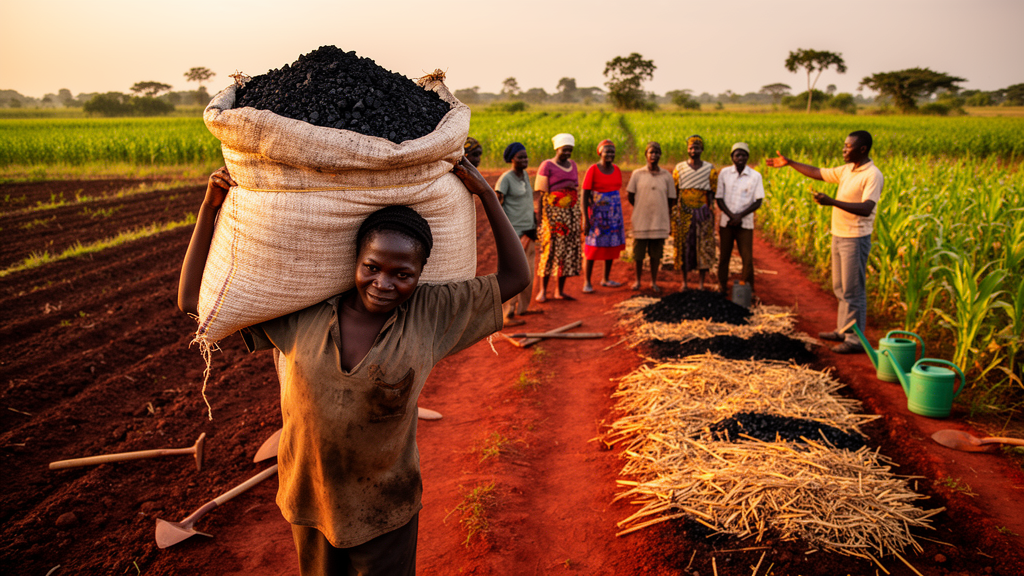
A randomised controlled trial involving 400 smallholder farmers in Uganda has found that training in conservation agriculture combined with biochar soil amendment increased total farm labour demand by roughly 36 percent while delivering no significant gains in labour productivity. The study, published in Agricultural and Food Economics, tracked farmers in two districts between a baseline survey in 2021 and an endline survey in 2024, and its results challenge a common assumption that climate-smart farming packages ease the workload of resource-poor households.
One village per district served as a control, one received training in conservation agriculture alone, and two received combined training in conservation agriculture and biochar. Conservation agriculture involves minimal soil disturbance through no-till or reduced tillage, crop rotation, and permanent soil cover, while biochar is a carbon-rich material produced from agricultural waste such as pigeon pea residues through pyrolysis in a low-oxygen environment.
Attendance was exceptionally high: households in the conservation agriculture group attended on average 4.5 of 5 sessions, and those in the combined group attended 6.3 of 7 sessions, with 90 percent of households attending overall. Farmers were trained once and then left to implement the practices independently, without follow-up from experts during the study period.
The analysis relied on a first-difference regression model comparing changes between baseline and endline for treated and control households, supplemented by an inverse-probability-weighted regression adjustment model designed to correct for baseline imbalances and for the 17 percent attrition in the panel. Attrition was not random: female-headed households, wealthier households, and households in Mubende district were significantly more likely to drop out, so the researchers constructed attrition weights from a probit model to reduce potential selection bias. Formal tests found no significant spillover effects from treated villages to nearby control villages, which were separated by roughly three to five kilometres.
The headline result concerns the combined conservation agriculture and biochar package. Total labour use in that group rose by about 65 person-days per hectare above the control-group average of 179 person-days per hectare, an increase of roughly 36 percent. Family labour drove most of this shift, rising by about 70 person-days per hectare, equivalent to a 54 percent increase, while hired labour costs fell by approximately 128,000 Ugandan shillings per hectare. Total labour costs per hectare were about 581,300 Ugandan shillings higher than in the control group. In other words, the extra work demanded by the new practices was met by household members rather than by paid workers, a pattern the authors interpret as households prioritising internal resources to offset cash constraints.
Labour productivity told a less encouraging story. When measured across all crops grown, the value of harvested output per person-day in the combined treatment was about USD 1.74 lower than in the control group, whose average stood at USD 3.80 per person-day, a roughly 45 percent decrease in returns to labour. The conservation-agriculture-only treatment showed significantly lower labour productivity for legumes, with the value of legume output per person-day between USD 0.80 and USD 1.30 lower depending on the model, and bean output per person-day between USD 0.70 and USD 0.90 lower. Neither treatment significantly changed labour productivity for cereals or maize. Supplementary analyses found no statistically significant differences in land productivity, measured as the value of harvested crop output per hectare, between treatments and control groups.
Breaking labour down by production stage revealed one genuine saving. Land preparation labour in the combined treatment was significantly lower than in the control group, with the share of total labour devoted to land preparation about 3 percentage points lower, reflecting the labour-saving potential of minimum tillage. However, labour use and costs in fertilisation, weeding, and harvesting did not differ significantly from conventional practice. The authors caution that single-stage estimates were unstable due to substantial idiosyncratic noise in the data, so they emphasise the aggregate labour measures, which pool across stages and more reliably recover the cumulative treatment effect.
What explains the higher labour burden? The study examined adoption-related outcomes at endline and found that the combined treatment group cultivated about 0.5 hectares more total land and 0.2 hectares more per adult-equivalent labour unit than controls, planted 0.2 more crops per labour unit, implemented 0.5 more climate-smart management practices, and were 13 percent more likely to grow any legume and 15 percent more likely to grow pigeon peas. Area under minimum tillage increased by 0.12 hectares per household, and biochar application averaged 48 kilograms per hectare, against none in the control group. Because adoption itself was not randomised, the authors interpret these patterns as supportive evidence that training changed farm behaviour, rather than as a formal causal mediation analysis. The modest size of the changes also suggests partial rather than full adoption of the promoted package.
The authors are explicit about the limitations of their evidence. The trial was small, spanning only two districts and eight villages, which limits statistical power and generalisability. With only baseline and endline data, the study cannot track the timing or sequence of household adjustments, and the survey did not capture how family labour was reallocated between own-farm and off-farm activities, so welfare effects of any displaced off-farm work cannot be quantified. Reliance on farmer self-reports for adoption, labour use, and farm size introduces potential measurement error, and outcomes were winsorised at the 3rd and 96th percentiles to limit the influence of extreme outliers.
The policy implications are sobering for proponents of climate-smart agriculture. The authors argue that one-off training without follow-up may be insufficient, and that bundling training with complementary interventions, such as affordable labour-saving technologies, improved market access, credit, and institutional support, may be necessary to achieve both labour-saving and labour productivity gains from conservation agriculture and biochar adoption. They note that benefits of these practices may accrue only over longer periods as soil quality and farmer expertise evolve, while previous research suggests soil quality improvements may be unlikely even after five seasons. During the study period, at least, the promoted package in this Ugandan setting was associated with higher labour demand, greater reliance on unpaid family labour, and no clear productivity payoff per unit of work.
Subject of Research: The effects of conservation agriculture and biochar training on labour use and productivity among Ugandan smallholder farmers in a randomised controlled trial
Article Title: Impact of conservation agriculture and biochar interventions on labour demand and productivity in Uganda: evidence from a field experiment
Article References: Makate, C., Cornelissen, G., Mulder, J., Martinsen, V., Ogenrwoth, B., Bonabana-Wabbi, J., Obia, A., Kaweesi, G., & Handberg, Ø. N. (2026). Impact of conservation agriculture and biochar interventions on labour demand and productivity in Uganda: evidence from a field experiment. Agricultural and Food Economics, 14(1), Article 68. https://doi.org/10.1186/s40100-026-00515-5
Image Credits: AI Generated
DOI: 10.1186/s40100-026-00515-5
Keywords: conservation agriculture, biochar, Uganda, smallholder farming, labour productivity, randomised controlled trial, climate-smart agriculture, family labour, minimum tillage, soil amendment, agricultural training, Sub-Saharan Africa
News Source: Alan Morgan. (October 29, 2026). Biochar and conservation agriculture training raises labour burden for Ugandan farmers. Scienmag.