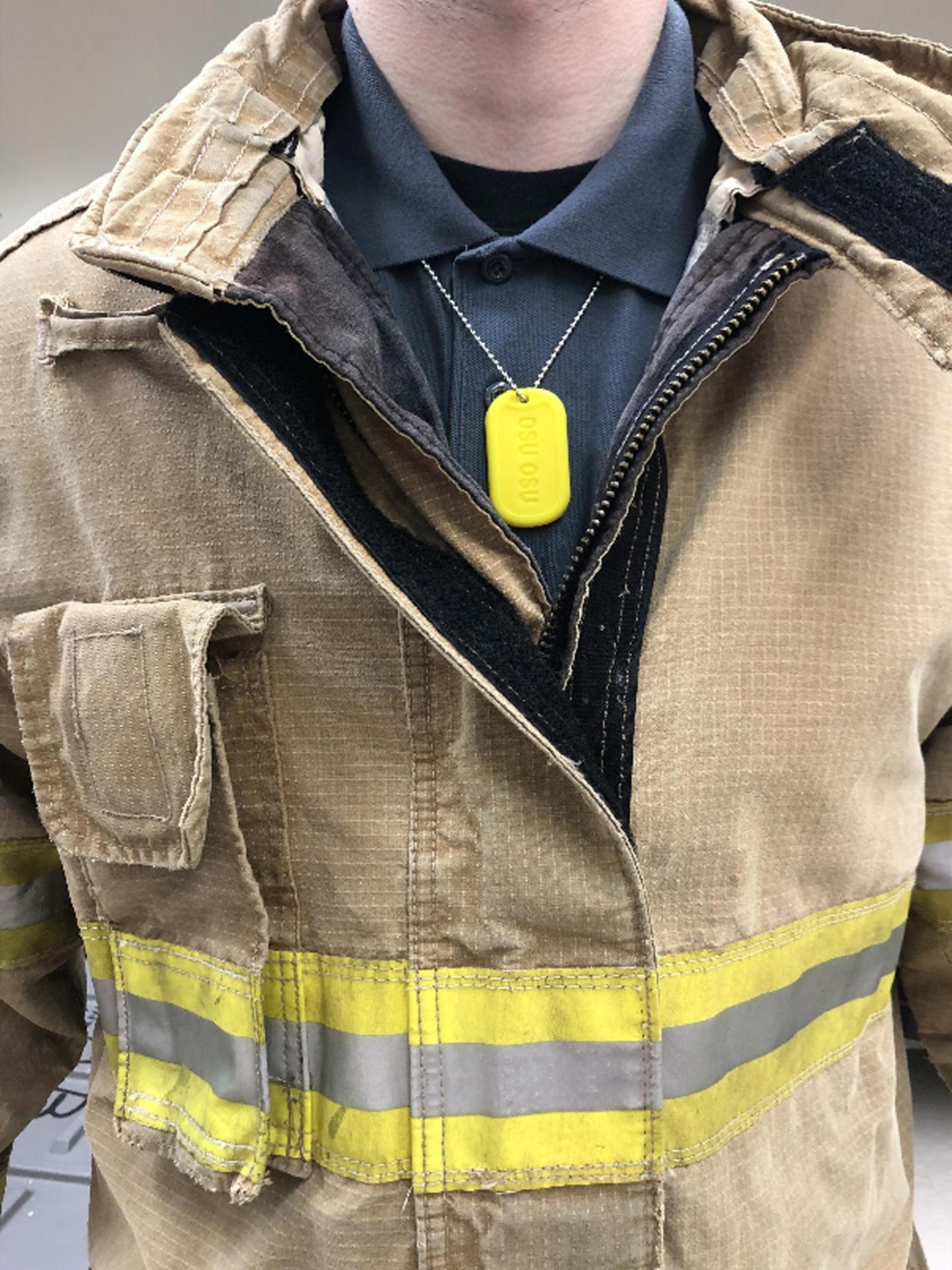
Credit: Carolyn Poutasse, Oregon State University.
CORVALLIS, Ore. – A new Oregon State University study suggests that firefighters are more likely to be exposed to potentially harmful chemicals while on duty compared to off duty.
The on-duty firefighters in the Kansas City, Missouri, area experienced higher exposures of polycyclic aromatic hydrocarbons, or PAHs, which are a family of chemicals that are known to have the potential to cause cancer. They were also exposed to 18 PAHs that have not been previously reported as firefighting exposures in earlier research.
The study, funded by the Federal Emergency Management Agency, is published in the journal Environment International.
The results are important because previous studies have shown that firefighters have an increased risk of developing cancer and other damaging health effects, said study lead Kim Anderson, an environmental chemist and Extension specialist in OSU’s College of Agricultural Sciences.
PAHs are a large group of chemical compounds that contain carbon and other elements. They form naturally after almost any type of combustion, both natural and human-created. In addition to burning wood, plants and tobacco, PAHs are also in fossil fuels.
“We don’t have enough data to profile the source of the PAHs, but we know PAHs appear from combustion, and obviously combustion is their work,” Anderson said. “They are also putting on a heavy load of protective gear that has PAHs, and they use cleaning products that have PAHs.”
The firefighters in the study wore personal passive samplers in the shape of a military-style dog tag made of silicone on an elastic necklace. The tags are made of the same material as OSU’s patented silicone wristbands that Anderson’s lab has been using for several years to study chemical exposure in humans and cats.
This study demonstrates that the dog tags, which absorb chemicals from the air and skin, appear to be a reliable sampling technology necessary for assessing chemical exposures in firefighters, Anderson said.
“I’m quite confident those exposures existed but if you don’t have something to help you find them you don’t know for sure,” Anderson said. “Certainly, we found that it’s a lot more than what people had thought.”
For their study, the researchers sampled individual firefighters’ exposures at two departments – the Raytown Fire Protection District and Southern Platte Fire Protection District. They defined the Raytown department as a “high call volume” department, with a historic average of 12 fire calls per month, and the Southern Platte department as “low call volume,” with less than two calls per month historically.
After completing a survey on demographics, occupational history, and suspected current exposures, the recruited firefighters wore a dog tag during the next 30 on- and off-shift days. During fire calls, tags were worn over clothing but underneath their gear. The firefighters were instructed to wear the dog tags continuously during all regular activities, including eating, showering and sleeping. Sampling occurred from November 2018 to April 2019.
When they analyzed the dog tags that were returned to Anderson’s lab at Oregon State, 45 unique PAHs, of which 18 have not been previously reported as firefighting exposures, were detected. PAH exposures increased as the number of fires a participant responded to increased. PAH concentrations were not only higher when on-duty compared to off-duty, but also higher from the high call volume department compared to the low call volume department.
Each of the participating firefighters has been provided a report on their basic health information and chemical exposure, Anderson said. The participants also received a fact sheet about firefighters and cancer risk. The fact sheet includes some simple steps firefighters can take to reduce their exposure to harmful chemicals, such as always wearing their personal protective equipment, taking a shower after each fire and before ending their shift, and cleaning their gear after every fire.
###
Anderson directs the Food Safety and Environmental Stewardship Program in OSU’s College of Agricultural Sciences. She co-founded MyExposome Inc., a start-up company that is marketing the silicone wristbands.
Co-authors on the study were Carolyn Poutasse, Peter Hoffman, Christopher Haddock and Lane Tidwell – all members of Anderson’s lab – and Walker S. Carlos Poston and Sara Jahnke, both of the Center for Fire, Rescue and EMS Health Research in Leewood, Kansas.
Media Contact
Chris Branam
[email protected]
Original Source
https:/
Related Journal Article
http://dx.