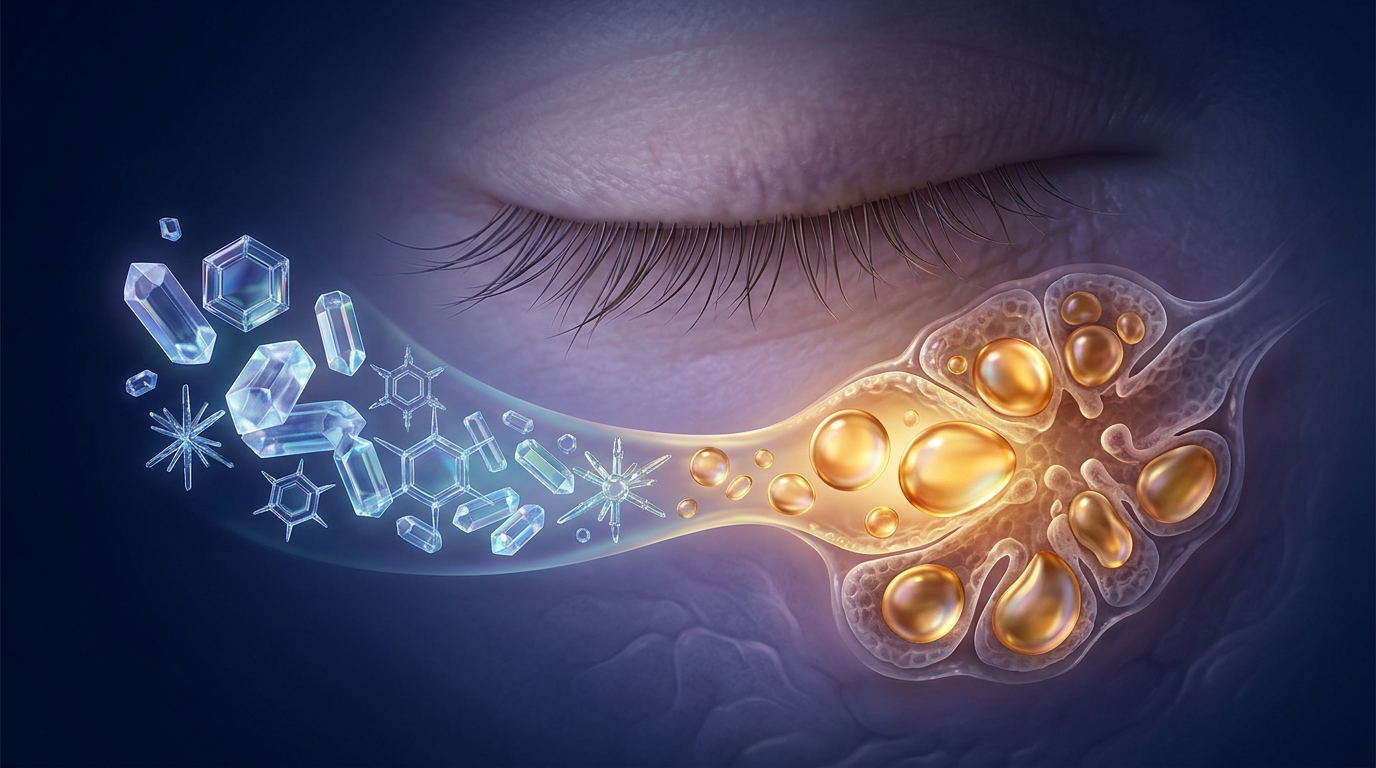
The oil-producing glands hidden inside the eyelids turn out to be among the most sugar-hungry tissues in the body, according to a study published in the journal Eye and Vision. Meibomian glands, the tiny sebaceous structures that secrete the lipid layer keeping tears from evaporating, rely heavily on glycolysis — the rapid, oxygen-independent breakdown of glucose — to power their specialized work. The research, led by Yaoyao Ren, Wenjing Li, Yuan Zhang and senior author Yang Liu, combined clinical imaging of living patients with tissue staining and laboratory experiments to map how these cells generate energy, and it found that the shift from proliferating to differentiating cells comes with a marked increase in glycolytic activity.
The first clue came from whole-body scans. The team retrospectively analyzed 18F-fluorodeoxyglucose positron emission tomography/computed tomography data from 70 patients who had undergone the imaging at Zhongnan Hospital of Wuhan University between January 2023 and December 2024 for unrelated reasons. FDG is a radioactive glucose analog that cells import through glucose transporters and phosphorylate with hexokinase; once trapped as FDG-6-phosphate, it cannot proceed further down the glycolytic pathway, so its accumulation rate directly reflects how fast glucose enters glycolysis. On the scans, the meibomian glands lit up. Their maximum standardized uptake values were significantly higher than those of the adjacent orbicularis oculi muscle and the surrounding subcutaneous connective tissues outside the tarsal plate, with a paired t-test yielding P < 0.0001 across the 70 patients. That pronounced signal indicated substantial glucose utilization and glycolytic activity in living human tissue, consistent with the gland’s known hypoxic physiology.
That hypoxic setting is no accident. Meibomian glands lack intraglandular blood flow because their vasculature sits outside the basement membrane, limiting oxygen diffusion into the gland. Differentiating meibocytes migrate toward the acinar center, moving farther from the peripheral oxygen supply, and the acini themselves measure roughly 150–200 micrometers in diameter — at or beyond the upper limit of oxygen diffusion, which is about 150 micrometers. The result is an oxygen gradient within each gland, with the lowest concentrations in the central acinar region where holocrine secretion occurs. The authors’ earlier work had already shown that hypoxia-inducible factor 1α, or HIF-1α, plays a regulatory role in the gland, and under hypoxia this transcription factor activates genes encoding glycolytic enzymes and glucose transporters such as GLUT1, boosting glucose uptake and lactate production to sustain ATP generation.
To confirm the glycolytic phenotype at the protein level, the researchers performed immunofluorescence staining on meibomian gland tissue from both humans and mice. They found strong expression of HIF-1α and a suite of key glycolysis-related proteins — GLUT1, hexokinase 2, 6-phosphofructo-2-kinase/fructose−2,6-biphosphatase 3 (PFKFB3), pyruvate kinase M2 (PKM2) and lactate dehydrogenase A (LDHA) — at significantly higher levels in the glands than in surrounding tissues. The human samples came from donated cadavers, and the quantification covered five independent human cadavers and five independent mouse clusters, analyzed with two-way ANOVA. Together with the PET findings, the staining supported the presence of an active glycolytic metabolic profile in vivo.
The study’s central question was whether basal, proliferating cells differ metabolically from the differentiating cells deeper in the acini. To find out, the team turned to immortalized human meibomian gland epithelial cells, or IHMGECs, grown in the laboratory. Differentiation was induced by culturing the cells for seven days in DMEM/F-12 supplemented with 10% fetal bovine serum, following a published protocol. Non-targeted metabolomics on proliferating and differentiated cells, performed by ultra-performance liquid chromatography-tandem mass spectrometry with three biological replicates per group, revealed 845 significantly altered metabolites — 565 upregulated and 280 downregulated in differentiated cells — and clear separation of the two metabolic profiles. Pathway enrichment suggested that proliferating cells channel glucose toward biomass accumulation, while differentiating cells scale up organic acid production and lipid backbone synthesis to supply the precursors needed for meibum, the oily secretion itself.
Because steady-state levels of upstream glycolytic intermediates did not reach statistical significance in the metabolomics data, the researchers measured dynamic flux instead. Using an Agilent Seahorse XFe24 analyzer with a Glycolytic Rate Assay, they tracked the extracellular acidification rate, or ECAR, which reflects the efflux of lactic acid and protons during glycolysis. Differentiated IHMGECs showed significantly higher basal and compensatory glycolysis than proliferating ones, with five independent cell culture replicates per condition and one-way ANOVA confirming the differences. Both states outperformed human conjunctival fibroblasts, which primarily use oxidative phosphorylation, though the gland cells’ basal glycolysis remained below that of HeLa tumor cells, a glycolysis positive control. After oligomycin blocked mitochondrial ATP production, both proliferating and differentiated cells mounted a robust compensatory glycolytic response, and the differentiated cells’ compensatory rate was comparable to that of HeLa cells — evidence of substantial metabolic flexibility.
Terminal metabolite and enzyme data reinforced the picture. Lactate, the end product of glycolysis, was significantly higher in differentiated cells than in proliferating ones (P < 0.01 across four independent cell culture replicates). Western blot analysis confirmed significant upregulation of the glycolytic enzymes HK2, PFKFB3 and PKM2 in differentiated cells (P < 0.05 across three replicates); the authors note that upregulation of HIF-1α and GLUT1 had already been demonstrated in their previous publication. A three-dimensional spheroid culture model, in which cells embedded in Matrigel form structures mimicking in vivo acinar organization, added spatial texture: proliferative spheroids showed a pronounced gradient of glycolytic proteins and neutral lipids, with higher levels in the core regions where oxygen is scarcest, while differentiated spheroids displayed a more uniform distribution of these markers.
The authors interpret the shift as an adaptation to the gland’s hypoxic microenvironment and its specialized secretory function. Glycolysis yields less ATP per glucose molecule than oxidative phosphorylation, but it provides critical intermediates such as glyceraldehyde-3-phosphate and pyruvate that fuel biosynthetic processes including lipid synthesis. Accelerated glycolysis generates abundant pyruvate that enters mitochondria to become acetyl-CoA, which is exported back to the cytoplasm as a building block for fatty acid elongation and cholesterol synthesis — the primary components of meibum. Routing glucose through the pentose phosphate pathway also supplies the NADPH reducing equivalents needed to drive these energy-demanding lipogenic pathways. Elevated lactate production, meanwhile, may help sustain the acidic intracellular environment required for DNase II activation, a lysosomal enzyme the authors previously showed is exclusive to lipid-containing differentiated meibomian gland cells and central to the gland’s unique holocrine form of programmed cell death.
The researchers are careful about the limits of their evidence. They acknowledge that the findings primarily establish a strong correlation between meibocyte differentiation and enhanced glycolytic activity rather than direct causality, and that functional perturbation studies — pharmacological inhibition with 2-deoxy-D-glucose or targeted genetic knockdowns — will be needed to establish the pathway’s causal necessity. They also note the absence of direct oxygen consumption rate measurements, which limits their ability to quantify the relative ATP contributions from glycolysis versus oxidative phosphorylation, and they caution that immortalization can inherently upregulate baseline glycolysis, so absolute rates should not be extrapolated directly to living tissue. The in vitro differentiation protocol’s switch from serum-free to serum-supplemented medium may also independently modulate metabolic enzymes, a confound the authors flag for future work with chemically defined differentiation factors.
Meibomian gland dysfunction is a leading cause of dry eye disease, affecting approximately 35.8% of the global population according to the TFOS DEWS III report, so understanding the gland’s metabolic strategy carries clinical weight. The authors suggest that when the glands undergo pathological changes such as hyperkeratinization or ductal occlusion, the local hypoxic microenvironment can be disrupted, causing meibocytes to fail to scale up glycolysis and ultimately producing lipid-deficient disease. They propose that small-molecule prolyl hydroxylase inhibitors such as roxadustat, which stabilize HIF-1α and are already clinically approved for systemic indications, could potentially be repurposed as topical ophthalmic formulations to reinforce the hypoxic signaling cascade and restore glycolytic flux — though they frame this as a therapeutic avenue for future investigation rather than a validated treatment. For now, the study establishes that the eyelid’s oil glands are hardwired to burn sugar, and that this metabolic preference deepens as the cells mature into their lipid-secreting fate.
Subject of Research: Glycolytic energy metabolism in meibomian gland epithelial cells during differentiation
Article Title: Meibomian gland epithelial cells demonstrate enhanced reliance on glycolysis for energy metabolism and differentiation
Article References: Ren, Y., Li, W., Zhang, Y., Tian, Y., Yi, S., Tian, X., Chen, Y., Ke, M., Xia, F., & Liu, Y. (2026). Meibomian gland epithelial cells demonstrate enhanced reliance on glycolysis for energy metabolism and differentiation. Eye and Vision, 13(1), Article 48. https://doi.org/10.1186/s40662-026-00518-9
Image Credits: AI Generated
DOI: 10.1186/s40662-026-00518-9
Keywords: meibomian glands, glycolysis, dry eye disease, HIF-1alpha, FDG-PET, lactate, cell differentiation, meibum, hypoxia, metabolomics, Seahorse assay, eye and vision
News Source: Ophelia Keating. (November 4, 2026). Eyelid’s oil glands run on sugar, study finds. Scienmag.