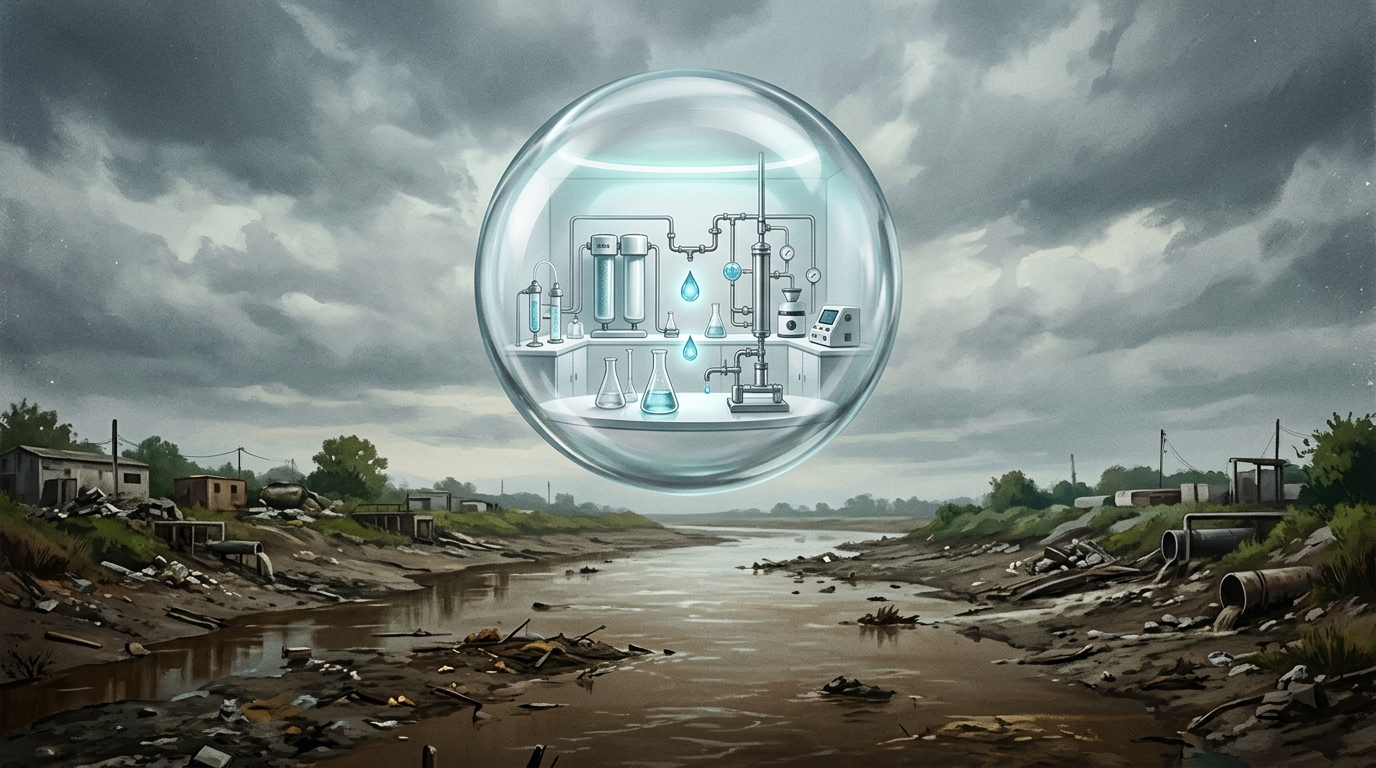
Most published research on removing contaminants from water may be largely irrelevant to real-world treatment, according to an editorial published in Environmental Chemistry Letters in November 2026. The authors, a group of researchers led by Virender K. Sharma, argue that the problem lies in how laboratory experiments are designed: reactions are typically tested under homogeneous, pure conditions that bear little resemblance to the messy, solid-laden reality of contaminated water. Their proposed remedy is a shift toward heterogeneous systems, where oxidation chemistry happens at surfaces rather than in bulk solution, an approach they classify as advanced surface oxidation processes.
The core critique is straightforward. In the laboratory, a typical experiment involves only two compounds: an oxidant and a contaminant dissolved in pure water. Real wastewater, by contrast, contains solids that can adsorb and sequester both reactants and contaminants. Contaminants in real waters commonly occur at trace levels within a solution containing many other organic and mineral compounds at much higher concentrations, present both as soluble matter and as insoluble solids such as polymeric networks like humic substances. Under those conditions, the authors argue, contaminants are most likely to be mainly adsorbed onto surfaces or trapped within polymers and solids, meaning only a small percentage of the contaminant actually evolves in the aqueous solution where most experiments assume the chemistry takes place.
There is also a terminology problem that the editorial highlights. The reaction process is commonly termed degradation, but the data typically shows the percentage of contaminant removal, measured as decreasing concentrations. The authors contend that this is wrong and not evidence of degradation, because decreasing concentrations are very likely explained by adsorption onto the surface of organic and mineral solids, and even onto laboratory materials during sample preparation. A disappearing contaminant, in other words, may simply have moved from the water onto a surface rather than been chemically destroyed. Research should therefore better focus on heterogeneous reactions in genuinely contaminated conditions, they argue.
The editorial places this critique in the context of decades of work on reactive species-based chemistry in homogeneous aqueous solutions, research that has spanned water and wastewater remediation, atmospheric chemistry, mineral weathering, geochemistry, and enzymatic reactions. For treatment purposes, advanced oxidation processes utilize sulfate radicals, high-valent metal species, and reactive oxygen species such as superoxide, singlet oxygen, and the hydroxyl radical, operating under bulk conditions, or the homogeneous phase, to treat water and wastewater. Yet the authors note that the relevance of the results is largely limited to laboratory scales.
These reactive species do have the capability to react with targeted contaminants to depollute water. However, their usefulness under real conditions is limited by two intrinsic properties: short lifetimes and high diffusivity. Both cause a decline in the availability of the reactive species to react with contaminants before they can do their work. Furthermore, these species are easily quenched by constituents of treated water such as chloride, bromide, bicarbonate and carbonate, sulfate, and phosphate ions, which in certain instances generate less reactive oxidants. Competing reactions in bulk solutions may also result in incomplete mineralization of contaminants due to unintended or side reactions. Taken together, the authors conclude that studying advanced oxidation processes in simple, homogeneous systems is often irrelevant, and that reactions should instead be done under heterogeneous conditions.
The alternative they champion rests on surface-bound reactive species confined on catalyst surfaces. In the past decade, many investigations have suggested that such species may overcome the limitations of reactive species in bulk systems. The proposed advantages include potentially longer lifetimes, which may decrease the self-destruction of reactive species, and higher local concentrations of adsorbed contaminants, which likely increase reaction rates, as well as the capacity for interfacial electron-transfer processes. Under such conditions, surface-adsorbed contaminants and locally generated reactive species should have a higher capacity to oxidize contaminants in heterogeneous systems, and may be classified as advanced surface oxidation processes, abbreviated ASOP. The surface reactive species radicals may be generated by activating relatively sluggish oxidants with different types of catalysts under neutral and mild alkaline conditions.
The editorial cites several illustrative systems from the recent literature. Surface singlet oxygen, formed in the peroxymonosulfate and nitrogen-doped biochar system, could remove the antibiotic sulfamethoxazole efficiently over a wide pH range. Reactive oxygen species produced in peroxymonosulfate with iron-based single atom nanosheets were able to effectively remove organic contaminants. Surface hydroxyl and sulfate radicals in a peroxymonosulfate and single atom-double layer hydroxides system were able to oxidize contaminants over a wide pH range. Combinations of bimetallic oxides may also stabilize surface radicals to result in activation that oxidizes contaminants. And when solids are combined with ferrate(VI), an iron-based oxidant, the oxidation of organic contaminants is enhanced, possibly through the generation of multi-oxidant species such as iron(V), iron(IV), and the hydroxyl radical. Metal oxides or metal-based oxidants more broadly may produce multi-oxidant systems containing reactive high-valent metal species in addition to reactive oxygen species, sulfate, and organic radicals.
Why should confinement to a surface make such a difference? The editorial lays out several mechanistic reasons. Reactive species at a surface are not surrounded by bulk-solution water molecules that behave as a physical barrier, meaning there is a lower water cage effect on surface reactive species. Surface reactive species are bound to solids in a two-dimensional way, compared with three-dimensional radicals in homogeneous solution, which should increase the collision probability with surface-bound reactive species. The adsorption of contaminants on solids may weaken the contaminants’ bonds and, in turn, favor their oxidation by surface reactive species by lowering the reaction activation energy. Depending on the surface type, the redox potentials and Gibbs free energy of surface-bound reactive radicals are altered compared with their aqueous counterparts, which should favor inner-sphere electron transfer between surface reactive species and adsorbed contaminants as a result of direct orbital overlap. Finally, reactions at the solid-water interface may minimize the inhibitory effects of constituents of the real water matrix, the very ions that quench radicals in bulk solution.
The authors are careful to note that surface oxidation is not a panacea. They list several limitations. First, the activation must remain thermodynamically feasible with a negative free energy; products of the oxidative reactions should be more stable than the reactants. Second, the catalyst surface should modify the properties of the adsorbed or entrapped contaminant, and possibly actively participate in the involved reactions. As an example, they cite porous silica, which influences the properties of adsorbed compounds through the formation of silica radicals when hydrogen peroxide is adsorbed on the silica surface; as a consequence, the oxidation of a contaminant may be either negatively or positively influenced by the formation of such radicals in heterogeneous systems. Third, matrix ions or competing ions in solution may prevent contact between the reactive species, the active site of the catalyst, and the adsorbed contaminant. Diffusion processes involving charged surfaces and contaminants may also play a role in catalytic activity. In addition, reactive species may not reach the reactive site of an adsorbed contaminant if that site is facing the catalyst solid surface, or if the contaminant becomes encapsulated within the catalyst. Finally, the positive activation of oxidants by solid surfaces must ensure that the catalyst remains non-poisonous so it can perform its intended catalytic activity.
Overall, the editorial argues that advanced surface oxidation processes should overcome the limitations of bulk homogeneous systems. Realizing that potential, however, requires new measurement and new materials. The assessment of the role of reactive species in oxidizing contaminants requires the determination of their rate constants, which the authors note are different from the corresponding rate constants in bulk solutions. There is also a need, they write, to develop novel smart materials that can be integrated with oxidants in order to exploit the phenomena of surface-bound reactive species at the solid-solution interface for efficient, sustainable water treatment technology. Whether the field takes up that challenge will determine if the next generation of water purification research finally reflects the conditions of the waters it aims to clean.
Subject of Research: Advanced surface oxidation processes for water treatment
Article Title: Advanced surface oxidation processes for water treatment
Article References: Sharma, V. K., Herrmann, H., Meyerstein, D., Kornweitz, H., Zboril, R., & Lichtfouse, E. (2026). Advanced surface oxidation processes for water treatment. Environmental Chemistry Letters. https://doi.org/10.1007/s10311-026-01933-z
Image Credits: AI Generated
DOI: 10.1007/s10311-026-01933-z
Keywords: water treatment, advanced oxidation processes, surface chemistry, heterogeneous catalysis, reactive oxygen species, sulfate radicals, ferrate, contaminant removal, water purification, catalyst surfaces, Advanced, surface
News Source: Bethany Barker. (November 4, 2026). Scientists Say Water Purification Research Is Stuck in an Unrealistic Lab Bubble. Scienmag.