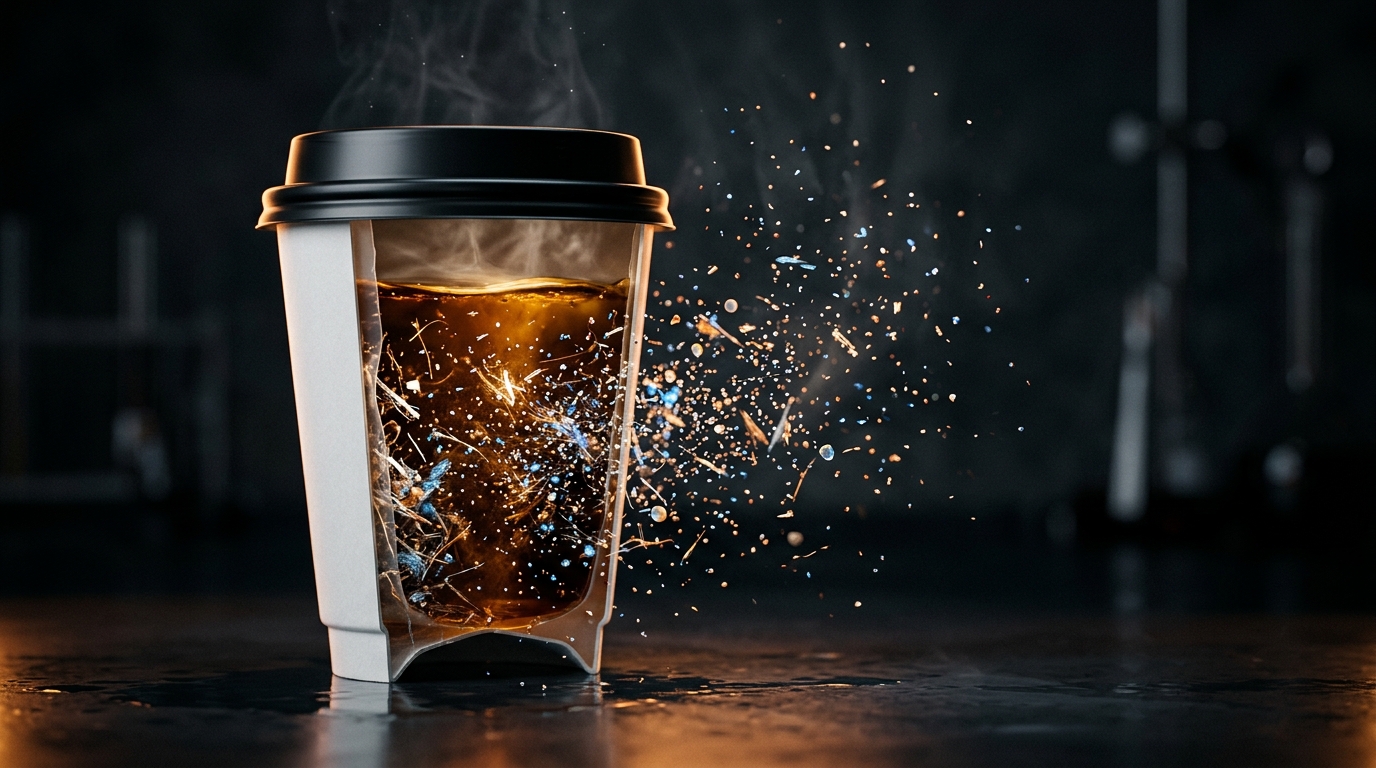
Disposable coffee cups may release far more plastic than most drinkers realize. A new study estimates that under the most aggressive use conditions, a single person drinking from plastic-lined paper cups could ingest roughly 2.74 × 10¹¹ particles smaller than one micrometer per day, equivalent to about 0.37 micrograms per milliliter of beverage. The work, published in Microplastics and Nanoplastics, pairs a realistic method for generating liner-derived plastic particles with laboratory hazard screening to ask whether routine cup use produces exposures at biologically meaningful levels.
The scale of the exposure source is large. Between 250 and 300 billion plastic-lined paper cups are used worldwide each year, making them a substantial but underrecognized route of micro- and nanoplastic intake. Yet the authors note a persistent gap in the field: most toxicity studies rely on commercially manufactured, uniform plastic spheres, which poorly represent the irregular, heterogeneous particles that actually detach from food-contact materials during everyday use.
To close that gap, the researchers turned to femtosecond laser ablation. By firing ultrafast laser pulses at films taken from cup liners, they generated irregular polyethylene particles spanning 1 to 2000 nanometers, with more than 80 percent below 500 nanometers. Crucially, these laboratory-made particles closely matched the particles released from actual cups during hot-water contact, both in morphology and in size distribution. That fidelity matters because particle shape and size strongly influence how plastics interact with biological tissue.
The release experiments on commercial cups revealed that particle shedding is not a fixed property of the cup but depends heavily on how the drink is consumed. Contact time, water temperature, agitation, and whether the cup was washed before first use all changed the amount of plastic released. Vigorous agitation produced the highest-release scenario, driving the estimated daily intake of submicron particles into the hundreds of billions.
With realistic particles in hand, the team moved to hazard screening in two biological models. In human proximal tubule epithelial cells, a kidney-derived line known as HK-2, cell viability declined as particle concentration and exposure time increased. But across the entire tested range, from 7.81 to 1000 micrograms per milliliter, viability never fell below 50 percent, suggesting a measurable but incomplete cytotoxic response at these acute doses.
The blood compatibility results were more concerning. When murine red blood cells were exposed to the liner-derived particles at concentrations from 15.62 to 125 micrograms per milliliter, hemolysis, the rupture of red blood cells, exceeded the ASTM International threshold at every concentration tested. Exposure duration, rather than concentration alone, largely governed the extent of damage, indicating that longer contact with these particles compounds the effect.
Placing the laboratory doses against real-world intake reveals an important context. The highest-release drinking scenario corresponds to a mass-equivalent concentration of roughly 0.37 micrograms per milliliter, which sits below every concentration tested in the cell viability assay and about 42-fold below the lowest hemolysis concentration, at which damage was already evident. On its face, that gap could look like a comfortable margin.
The authors are careful to warn against that interpretation. The concentration of particles in a consumed beverage and the nominal concentrations applied to cells in a dish represent fundamentally different exposure scenarios, so the comparison cannot be translated directly into a safety margin or a tissue-level risk estimate. Mass may also not be the governing dose metric for particles dominated by the submicron fraction, where number concentration and surface area could matter more than weight.
Several critical unknowns remain. Size-dependent uptake into cells, the effects of chronic low-dose exposure over years of daily coffee consumption, the potential for particles to translocate from the gut into circulation, and cumulative intake across multiple sources all remain uncharacterized. The study is a hazard screening exercise, not a risk assessment, and its in vitro and ex vivo findings cannot be extrapolated directly to human health outcomes.
What the work does deliver is a methodological advance and a quantified baseline. By producing liner-derived particles that genuinely resemble those released during use, rather than relying on idealized commercial spheres, the study offers a more realistic foundation for future toxicology. And by anchoring that hazard data to measured release behavior under defined use conditions, it gives regulators, manufacturers, and consumers a concrete starting point for evaluating a ubiquitous exposure source that has long flown under the radar.
Subject of Research: Micro- and nanoplastic particle release from disposable coffee cups and laboratory hazard screening of liner-derived polyethylene particles
Article Title: Particle release from disposable coffee cups in context: hazard screening with liner-derived polyethylene micro- and nanoplastics
Article References: Irumva, O., Romanova, S., Dong, H., Hussain, K. A., Islam, M. S., Das, A., Lu, Y., Qian, W., & Li, Y. (2026). Particle release from disposable coffee cups in context: hazard screening with liner-derived polyethylene micro- and nanoplastics. Microplastics and Nanoplastics. https://doi.org/10.1186/s43591-026-00249-7
Image Credits: AI Generated
DOI: 10.1186/s43591-026-00249-7
Keywords: microplastics, nanoplastics, disposable coffee cups, polyethylene, femtosecond laser ablation, hemolysis, HK-2 cells, food contact materials, particle release, exposure assessment, toxicology, Particle
News Source: Bethany Barker. (November 4, 2026). Disposable coffee cups shed trillions of tiny plastic particles daily, hazard screen finds. Scienmag.