• HOME
  • NEWS
  • EXPLORE
    • CAREER
      • Companies
      • Jobs
    • EVENTS
    • iGEM
      • News
      • Team
    • PHOTOS
    • VIDEO
    • WIKI
  • BLOG
  • COMMUNITY
    • FACEBOOK
    • INSTAGRAM
    • TWITTER
Thursday, November 5, 2026
BIOENGINEER.ORG
No Result
View All Result
  • Login
  • HOME
  • NEWS
  • EXPLORE
    • CAREER
      • Companies
      • Jobs
        • Lecturer
        • PhD Studentship
        • Postdoc
        • Research Assistant
    • EVENTS
    • iGEM
      • News
      • Team
    • PHOTOS
    • VIDEO
    • WIKI
  • BLOG
  • COMMUNITY
    • FACEBOOK
    • INSTAGRAM
    • TWITTER
No Result
View All Result
Bioengineer.org
No Result
View All Result
Home NEWS Science News Health

Drying Method Shapes Phenolic Retention in Cactus Cladodes

by
November 5, 2026
in Agriculture, Health
Reading Time: 2 mins read
0
Drying Method Shapes Phenolic Retention in Cactus Cladodes

Drying Method Shapes Phenolic Retention in Cactus Cladodes

Share on FacebookShare on TwitterShare on LinkedinShare on RedditShare on Telegram

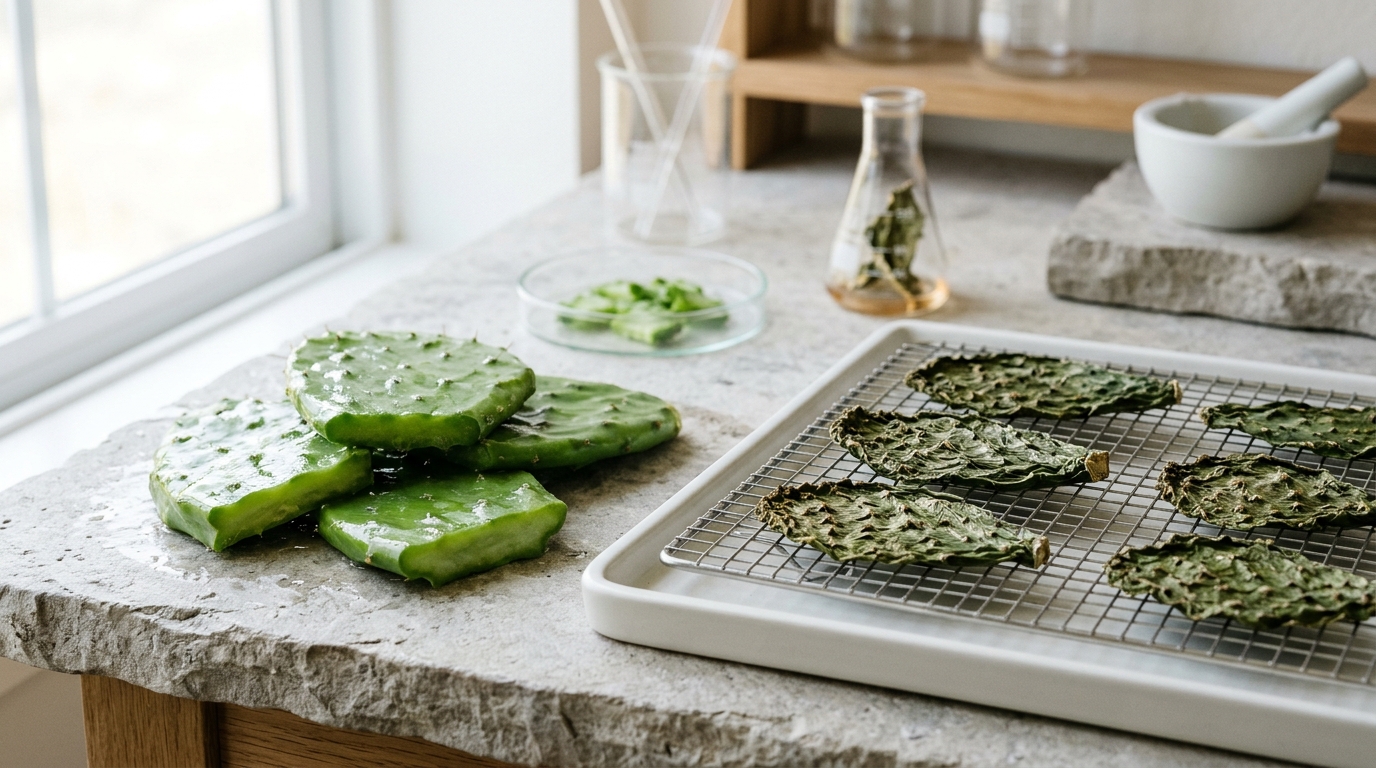
The research team collected wild cactus cladodes from a single field in Antalya, Turkey, in May, choosing medium-mature pads measuring 18 to 22 centimeters. After washing, cleaning, and removing spines, the cladodes were sliced to a uniform 5-millimeter thickness.

Convectional drying was carried out in a tray-type oven with forced-air circulation at an average airflow velocity of 0.83 meters per second, using temperatures of 50, 60, 70, and 80 degrees Celsius.

Color analysis using the CIE L*, a*, b* system revealed that total color difference from the fresh sample was highest in the ultrasound-pretreated vacuum-dried sample at 80 degrees, reaching a ΔE of 23.62. The lowest color changes appeared in microwave drying at 720 watts and convectional drying at 70 degrees.

Total phenolic content, measured by the Folin–Ciocalteu assay and expressed as milligrams of gallic acid equivalents per gram of dry matter, fell significantly after all drying processes. Fresh cladodes contained 8.85 mg GAE/g DM, while dried samples ranged from 2.16 to 5.30 mg GAE/g DM. Notably, ultrasound-pretreated vacuum drying at 60 and 70 degrees preserved more phenolics than convectional drying at the same temperatures, yielding 4.97 and 5.30 mg GAE/g DM respectively, compared with 2.75 and 3.11 mg GAE/g DM for convectional drying.

Microwave drying also outperformed convectional drying in phenolic retention, with samples dried at 720 watts reaching 4.41 mg GAE/g DM.

High-performance liquid chromatography identified nine phenolic components across the samples: eight phenolic acids—gallic, protocatechuic, syringic, ellagic, m-coumaric, caffeic, p-coumaric, and ferulic acids—and one flavonoid, chrysin. Ellagic acid dominated the fresh sample at 3.988 mg/g DM but dropped dramatically after drying, ranging from 0.150 to 0.595 mg/g DM, indicating its susceptibility to thermal and oxidative degradation.

Antioxidant capacity, measured by both DPPH and TEAC assays, decreased with drying regardless of technique, with fresh samples showing 17.42 and 54.26 μmol TE/g DM respectively. Dried samples ranged from 5.27 to 7.51 μmol TE/g DM by DPPH and 8.74 to 18.51 μmol TE/g DM by TEAC, but no significant differences emerged between drying methods or conditions.

Subject of Research: Effects of different drying methods on antioxidant compounds and physicochemical characteristics of cactus cladodes

Article Title: Valorization of Cactus Cladodes (Opuntia ficus indica): The Effects of Different Drying Methods on Antioxidant Compounds and Physicochemical Characteristics

Article References: BaÄŸirsakci, Åž. G., Karacabey, E., & Karasu, S. (2026). Valorization of Cactus Cladodes ( Opuntia ficus indica ): The Effects of Different Drying Methods on Antioxidant Compounds and Physicochemical Characteristics. Food Science & Nutrition, 14(11), Article e72461. https://doi.org/10.1002/fsn3.72461

Image Credits: AI Generated

DOI: 10.1002/fsn3.72461

Keywords: cactus cladodes, Opuntia ficus indica, drying methods, antioxidant capacity, total phenolic content, ultrasound pretreatment, microwave drying, convectional drying, ascorbic acid, phenolic profile, food preservation, scanning electron microscopy

News Source: Alan Morgan. (November 5, 2026). Drying Method Shapes Phenolic Retention in Cactus Cladodes. Scienmag.

Tags: antioxidant capacityascorbic acidcactus cladodesconvectional dryingdrying methodsFood preservationmicrowave dryingOpuntia ficus-indicaphenolic profilescanning electron microscopytotal phenolic contentultrasound pretreatment
Share12Tweet7Share2ShareShareShare1

Related Posts

Immune protein BAFF tracks delayed memory differently in first-episode schizophrenia

Immune protein BAFF tracks delayed memory differently in first-episode schizophrenia

November 5, 2026
Tumor Cell State Linked to Low Angiogenesis Identified in Lung Adenocarcinoma

Tumor Cell State Linked to Low Angiogenesis Identified in Lung Adenocarcinoma

November 5, 2026

Virtual reality anatomy learning shows no clear knowledge edge in Zambian trial

November 5, 2026

MRI Radiomics and Vascular Gene Profiles Capture Different Sides of Breast Cancer Tumor Blood Vessels

November 5, 2026

POPULAR NEWS

  • Sensor suit tracks spinal motion to flag scoliosis without X-rays

    Sensor suit tracks spinal motion to flag scoliosis without X-rays

    29 shares
    Share 12 Tweet 7
  • China-Made Metformin XR Tablets Match German Ones in Healthy Adults

    29 shares
    Share 12 Tweet 7
  • CRISPR cuts at wheat centromeres rewrite the karyotype in a single generation

    29 shares
    Share 12 Tweet 7
  • Nerves and Mesodermal Cells Drive Segment Regeneration in Polychaete Annelids

    29 shares
    Share 12 Tweet 7

About

We bring you the latest biotechnology news from best research centers and universities around the world. Check our website.

Follow us

Recent News

Wheat Straw Lignin Nanoparticles Paired with Postbiotics Outperform Azithromycin Against Acne Bacteria in Lab Tests

Immune protein BAFF tracks delayed memory differently in first-episode schizophrenia

Light People: Photonics Professor Puts Light to Work on Real-World Challenges

Subscribe to Blog via Email

Enter your email address to subscribe to this blog and receive notifications of new posts by email.

Join 86 other subscribers
  • Contact Us

Bioengineer.org © Copyright 2023 All Rights Reserved.

Welcome Back!

Login to your account below

Forgotten Password?

Retrieve your password

Please enter your username or email address to reset your password.

Log In
No Result
View All Result
  • Homepages
    • Home Page 1
    • Home Page 2
  • News
  • National
  • Business
  • Health
  • Lifestyle
  • Science

Bioengineer.org © Copyright 2023 All Rights Reserved.