• HOME
  • NEWS
  • EXPLORE
    • CAREER
      • Companies
      • Jobs
    • EVENTS
    • iGEM
      • News
      • Team
    • PHOTOS
    • VIDEO
    • WIKI
  • BLOG
  • COMMUNITY
    • FACEBOOK
    • INSTAGRAM
    • TWITTER
Friday, June 26, 2026
BIOENGINEER.ORG
No Result
View All Result
  • Login
  • HOME
  • NEWS
  • EXPLORE
    • CAREER
      • Companies
      • Jobs
        • Lecturer
        • PhD Studentship
        • Postdoc
        • Research Assistant
    • EVENTS
    • iGEM
      • News
      • Team
    • PHOTOS
    • VIDEO
    • WIKI
  • BLOG
  • COMMUNITY
    • FACEBOOK
    • INSTAGRAM
    • TWITTER
  • HOME
  • NEWS
  • EXPLORE
    • CAREER
      • Companies
      • Jobs
        • Lecturer
        • PhD Studentship
        • Postdoc
        • Research Assistant
    • EVENTS
    • iGEM
      • News
      • Team
    • PHOTOS
    • VIDEO
    • WIKI
  • BLOG
  • COMMUNITY
    • FACEBOOK
    • INSTAGRAM
    • TWITTER
No Result
View All Result
Bioengineer.org
No Result
View All Result
Home NEWS Science News Chemistry

Discovery could help lengthen lifespan of electronic devices

Bioengineer by Bioengineer
April 9, 2021
in Chemistry
Reading Time: 3 mins read
0
IMAGE
Share on FacebookShare on TwitterShare on LinkedinShare on RedditShare on Telegram

The research could lead to electronics being designed with better endurance
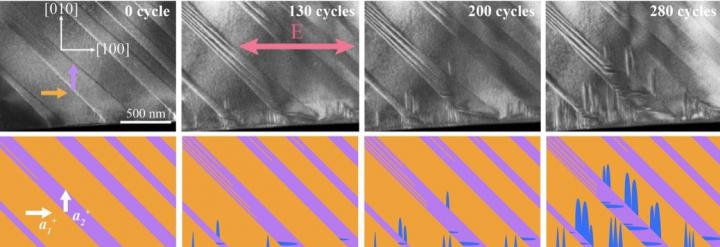
IMAGE

Credit: University of Sydney


Ferroelectric materials are used in many devices, including memories, capacitors, actuators and sensors. These devices are commonly used in both consumer and industrial instruments, such as computers, medical ultrasound equipment and underwater sonars.

Over time, ferroelectric materials are subjected to repeated mechanical and electrical loading, leading to a progressive decrease in their functionality, ultimately resulting in failure. This process is referred to as ‘ferroelectric fatigue’.

It is a main cause of the failure of a range of electronic devices, with discarded electronics a leading contributor to e-waste. Globally, tens of millions of tonnes of failed electronic devices go to landfill every year.

Using advanced in-situ electron microscopy, the School of Aerospace, Mechanical and Mechatronic Engineering researchers were able to observe ferroelectric fatigue as it occurred. This technique uses an advanced microscope to ‘see’, in real-time, down to the nanoscale and atomic levels.

The researchers hope this new observation, described in a paper published in Nature Communications, will help better inform the future design of ferroelectric nanodevices.

“Our discovery is a significant scientific breakthrough as it shows a clear picture of how the ferroelectric degradation process is present at the nanoscale,” said co-author Professor Xiaozhou Liao, also from the University of Sydney Nano Institute.

Dr Qianwei Huang, the study’s lead researcher, said: “Although it has long been known that ferroelectric fatigue can shorten the lifespan of electronic devices, how it occurs has previously not been well understood, due to a lack of suitable technology to observe it.”

Co-author Dr Zibin Chen said: “With this, we hope to better inform the engineering of devices with longer lifespans.”

Observational findings spark new debate

Nobel laureate Herbert Kroemer once famously asserted “The interface is the device”. The observations by the Sydney researchers could therefore spark a new debate on whether interfaces – which are physical boundaries separating different regions in materials – are a viable solution to the unreliability of next-generation devices.

“Our discovery has indicated that interfaces could actually speed up ferroelectric degradation. Therefore, better understanding of these processes is needed to achieve the best performance of devices,” Dr Chen said.

###

DISCLOSURE:

The research was supported by the Australian Research Council for the project, Unravelling the structural origin of cyclic fatigue in ferroelectric materials. It was facilitated by the Australian Centre for Microscopy & Microanalysis at the University of Sydney.

MEDIA CONTACT:

Luisa Low, Media Adviser (Engineering), University of Sydney

+61 438 021 390 | [email protected]

Copies of the paper are available via this link.

Media Contact
Luisa Low
[email protected]

Original Source

https://www.sydney.edu.au/news-opinion/news/2021/04/08/discovery-could-help-lengthen-lifespan-of-electronic-devices.html

Related Journal Article

http://dx.doi.org/10.1038/s41467-021-22355-1

Tags: Chemistry/Physics/Materials SciencesElectrical Engineering/ElectronicsElectromagneticsMaterialsNanotechnology/MicromachinesSuperconductors/SemiconductorsTechnology/Engineering/Computer Science
Share12Tweet8Share2ShareShareShare2

Related Posts

AI and Physics Collaborate to Design Advanced Hydrogen Storage Materials

June 25, 2026

International Team Including Dresden Scientists Develops Novel Designer Proteins for Advanced Study of Living Tissue

June 25, 2026

New Study Uncovers Key Factors Driving Water Chemistry in Nanoscale Environments

June 25, 2026

Plasma Technology Extends Catalyst Lifespan in Hydrogen Production

June 24, 2026
Please login to join discussion

POPULAR NEWS

  • Saying Goodbye to PGY-6: Pediatric Fellowship Realities

    103 shares
    Share 41 Tweet 26
  • Multi-Hospital Study Reveals Long Covid Burden Is Twice as High as Current Estimates

    92 shares
    Share 36 Tweet 23
  • Detection of EDCs in Breast Milk and Infant Urine Up to Six Months Highlights Early Exposure Risks

    77 shares
    Share 31 Tweet 19
  • New Drug Candidate Developed at McMaster Shows Potential for Treating Brain Cancer

    58 shares
    Share 23 Tweet 15

About

We bring you the latest biotechnology news from best research centers and universities around the world. Check our website.

Follow us

Recent News

Tracking Lanthanide-Labeled Microplastics in Plants

POSTECH Researchers Slash Cost of Reconstituted Cell-Free Systems by 95%

AI and Physics Collaborate to Design Advanced Hydrogen Storage Materials

Subscribe to Blog via Email

Success! An email was just sent to confirm your subscription. Please find the email now and click 'Confirm' to start subscribing.

Join 82 other subscribers
  • Contact Us

Bioengineer.org © Copyright 2023 All Rights Reserved.

Welcome Back!

Login to your account below

Forgotten Password?

Retrieve your password

Please enter your username or email address to reset your password.

Log In
No Result
View All Result
  • Homepages
    • Home Page 1
    • Home Page 2
  • News
  • National
  • Business
  • Health
  • Lifestyle
  • Science

Bioengineer.org © Copyright 2023 All Rights Reserved.