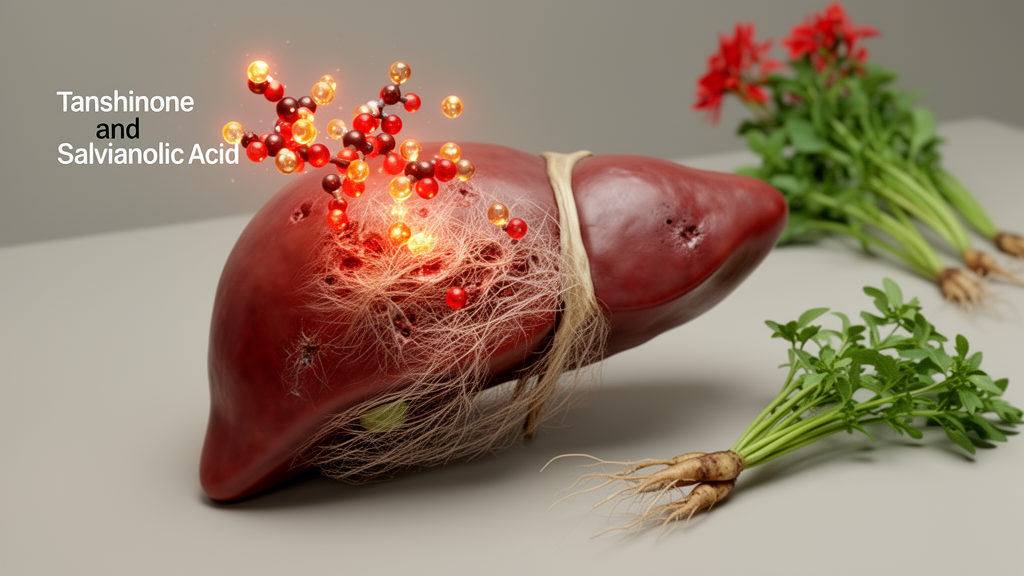
A critical narrative review published in Frontiers in Pharmacology has examined one of traditional Chinese medicine's most studied botanicals, Salvia miltiorrhiza Bunge, known as Danshen, and reached a deliberately cautious verdict. The authors, led by Yifan Liu of Hubei University of Chinese Medicine, conclude that this plant genuinely offers chemically distinct candidates that can protect hepatocytes, the liver's main working cells, and control hepatic stellate cells, the fibrosis-driving cells that scar the organ. Yet the review also finds that no single characterized intervention has so far been shown to deliver both benefits within one pharmacologically supported exposure window.
Liver fibrosis arises from a destructive conversation between injured hepatocytes and activated hepatic stellate cells. Lineage-tracing studies have identified stellate cells as the source of 82 to 96 percent of myofibroblasts in tested mouse models of toxic, cholestatic and fatty liver disease. When fibrosis resolves spontaneously, stellate cells die by apoptosis, tissue inhibitor of metalloproteinases expression falls and matrix degradation rises.
However, some stellate cells survive treatment and enter an inactive state that remains more susceptible to reactivation than the original quiescent condition. Protecting hepatocytes while controlling fibrogenic stellate cells is therefore an attractive therapeutic principle, provided that any control preserves the supportive functions these cells perform in a healthy liver. The review's central analytical move is to separate three different forms of stellate cell control: outright elimination, sustained deactivation that persists after drug withdrawal, and short-term suppression of the activated state.
Reduced alpha-smooth muscle actin or collagen production, the endpoints most often reported, indicate only state suppression. The authors also distinguish intrinsic cellular susceptibility from selectivity produced by altered drug distribution, a delivery effect rather than a pharmacological one. Findings drawn from different plant metabolites cannot establish a shared cellular mechanism, and activity of a purified metabolite does not automatically validate the parent extract from which it came.
Chemical characterization sits at the heart of the review's argument. Danshen contains two chemically distinct families of active metabolites: hydrophilic salvianolic acids and lipophilic tanshinones, which differ in solubility, metabolism and achieved exposure. Rat comparisons of pure tanshinones with a liposoluble extract found different plasma and tissue exposure despite comparable metabolite dosing.
In fibrotic rats receiving the multibotanical formula Fuzheng Huayu, increased systemic exposure to salvianolic acid B did not imply increased distribution to the liver. A formula or drug-containing serum cannot be attributed to Danshen without additional evidence separating its contribution, and poorly characterized extracts may generate hypotheses but cannot support metabolite-specific attribution. Among the strongest paired observations is salvianolic acid A. At 10 micromolar for 24 hours, it induced apoptosis in PDGF-BB-stimulated HSC-T6 cells, supported by TUNEL staining, sub-G0/G1 accumulation and caspase-related measurements.
In the same study, primary rat hepatocytes exposed to 0 to 20 micromolar for 48 hours showed no significant decrease in MTT viability. Notably, salvianolic acid A did not induce apoptosis in unstimulated HSC-T6 cells, suggesting stimulus dependence. This comparison supports stellate cell apoptosis with hepatocyte tolerance, but it did not test rescue of injured hepatocytes, authenticated quiescent stellate cells, or a paired exposure interval.
A tanshinone-enriched fraction, PF2401-SF, similarly links hepatocyte protection, stellate cell apoptosis and rat pharmacokinetics across related studies, though batch equivalence between those studies was not independently established. The review also delivers a warning about mechanistic inference from chemical class. Tanshinone I, tanshinone IIA and cryptotanshinone inhibited ferroptosis, an iron-dependent form of cell death, with mechanistic experiments implicating reduced tanshinones acting with the enzyme NQO1 to detoxify lipid peroxyl radicals.
This directly opposes any class-wide pro-ferroptotic interpretation, even as dihydrotanshinone I was associated with ALOX15-dependent ferroptosis in stellate cells. Meanwhile, danshensu reduced stellate cell activation markers while increasing lipid peroxidation, although discordant source reporting and absent death-rescue evidence preclude classifying that as verified ferroptotic death. Chemical class alone, the authors conclude, does not predict either hepatocyte protection or stellate cell elimination.
Exposure measurements expose further gaps. After oral PF2401-SF at 10 milligrams per kilogram in rats, total plasma tanshinone IIA and cryptotanshinone peaked at approximately 9.45 and 2.23 nanomolar respectively, far below the micromolar concentrations used in most cell experiments. Salvianolic acid B inhibited the enzyme ceramide glucosyltransferase with a reported IC50 of 159 micromolar, a concentration that cannot be assumed attainable in vivo.
Delivery strategies complicate the picture further: modified lipid nanocapsules increased systemic tanshinone IIA exposure, globin nanoparticles increased measured parent-drug plasma and whole-liver exposure and improved thioacetamide-associated fibrosis, and a vitamin-A/cyclodextrin carrier increased fluorescent-probe uptake in LX-2 cells. But whole-liver enrichment still does not resolve how much active drug reaches hepatocytes versus stellate cells, and several cell-line comparisons relied on L02 or HL-7702 lines whose identity limitations prevent their use as reliable human-hepatocyte safety evidence. Clinical findings remain preparation- and endpoint-specific and do not resolve the paired cellular question.
Oral salvianolic acid B showed no significant histological advantage over interferon-gamma in 60 evaluable chronic hepatitis B patients. A Fuzheng Huayu plus entecavir pilot favoured one-stage regression among 46 paired biopsies but not median Ishak-stage reduction, and a chronic hepatitis C trial found no significant F3/F4 biopsy difference. A post hoc analysis of two trials, including 218 of 232 randomized patients with compensated hepatitis B cirrhosis, associated adjunctive Fuzheng Huayu with fewer composite liver events, with an adjusted hazard ratio of 0.362 and a 95 percent confidence interval of 0.159 to 0.828, though post-randomization exclusions and limited events constrain that result.
Safety signals also warrant attention: patient surveillance of a polyphenol injection described as containing magnesium lithospermate B identified abnormal liver function in 58 of 2,633 patients, or 2.2 percent, with Naranjo scores above 5, although the absence of an unexposed comparator limits causal interpretation. The review proposes a concrete validation path. A paired human experiment should use one characterized batch in injury-challenged primary hepatocytes and activated primary stellate cells, with healthy hepatocytes and validated quiescent stellate cells as state controls.
Multicellular hiPSC-derived liver models, liver-on-chip systems and human fibrotic precision-cut liver slices are named as complementary prospective systems, provided their cellular states and endpoints are validated. The therapeutic window should be prespecified as the exposure interval meeting separate minimum hepatocyte-benefit and stellate-cell-control criteria while remaining below a defined hepatocyte-injury threshold, quantified with donor-level concentration-effect estimates and confidence intervals. Techniques such as CETSA and thermal proteome profiling could assess target engagement, while LC-MS/MS accumulation and cellular-binding methods could estimate intracellular unbound concentration, with attention to uptake for hydrophilic salvianolic acids and to binding, adsorption and sequestration for lipophilic tanshinones.
Finally, the authors stress that controlling stellate cells must not destroy the functions a healthy liver needs. HSC depletion and HSC-specific Rspo3 deletion have been shown to alter hepatocyte zonation, metabolism, liver size and regeneration. Fibrogenic programmes should therefore be assessed alongside stellate cell viability, lipid-storage or quiescence-associated programmes such as LRAT, RBP1 and PPARG, and functional support of hepatocytes.
Washout and rechallenge experiments should test persistence and reactivation susceptibility, because an inactive stellate cell can remain distinct from the original quiescent state. The review's bottom line is measured: Salvia miltiorrhiza provides real candidates for hepatocyte protection and stellate cell elimination or suppression, and existing paired observations justify further study, but the next advance must connect injured-hepatocyte benefit, fibrogenic cell control and preserved homeostatic functions within one characterized intervention and a measured exposure interval.
Subject of Research: Hepatocyte protection and hepatic stellate cell control by Salvia miltiorrhiza compounds in liver fibrosis
Article Title: Hepatocyte protection and stellate cell control by Salvia miltiorrhiza in liver fibrosis
Article References: Liu, Y., Li, W., Wu, W., Xu, Z., & Wu, D. (2026). Hepatocyte protection and stellate cell control by Salvia miltiorrhiza in liver fibrosis. Frontiers in Pharmacology, 17, Article 2006283. https://doi.org/10.3389/fphar.2026.2006283
Image Credits: AI Generated
DOI: 10.3389/fphar.2026.2006283
Keywords: liver fibrosis, hepatic stellate cells, hepatocytes, Salvia miltiorrhiza, Danshen, salvianolic acid B, tanshinones, ferroptosis, apoptosis, pharmacokinetics, therapeutic window, ethnopharmacology
News Source: Ophelia Keating. (October 27, 2026). Danshen Compounds Show Promise Against Liver Fibrosis, but Key Evidence Gaps Remain. Scienmag.