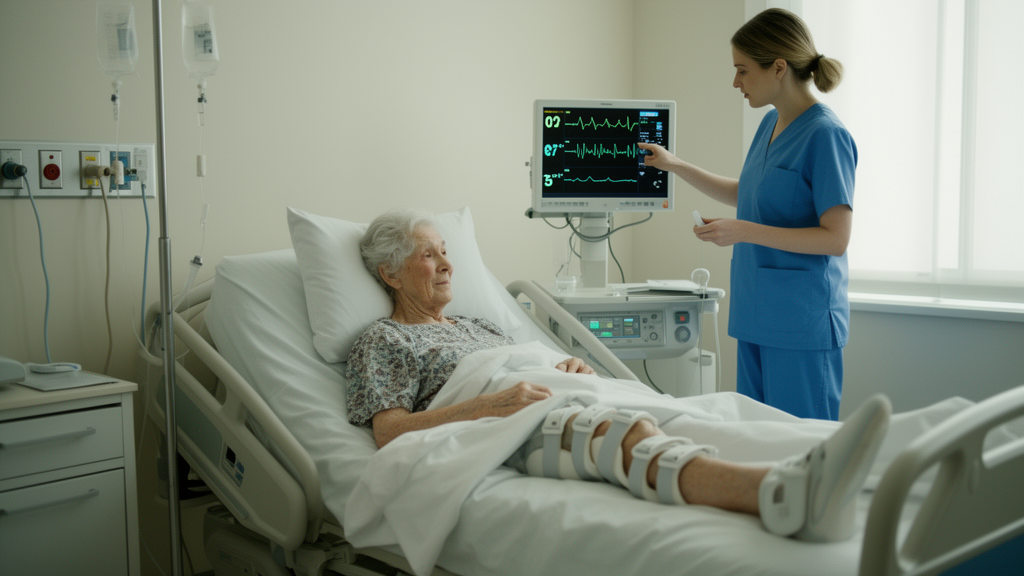
Patients aged 80 and older who develop acute kidney injury around the time of hip fracture surgery face a markedly higher risk of dying in hospital, according to a retrospective cohort study published in BMC Geriatrics. Among 200 very elderly patients undergoing hemiarthroplasty for femoral neck fractures, a quarter met a study-specific definition of perioperative acute kidney injury, and those patients were roughly five and a half times more likely to die during their hospital stay than those whose kidney function held steady. The research team, led by Hakan Kocaoğlu and colleagues, analyzed records from patients treated between January 2019 and May 2026.
The mean age of the cohort was 86.6 years, and nearly three-quarters of the patients were women, reflecting the demographics of this fracture type. Because standard acute kidney injury criteria rely on strict timing rules and urine output measurements that are often unavailable in retrospective data, the investigators applied an operational definition. They used KDIGO serum creatinine thresholds applied to measurements available through postoperative day three, without uniformly verifying the KDIGO temporal criteria or assessing urine output.
Serum creatinine and blood urea nitrogen were recorded at admission and on postoperative days zero, one, and three, allowing the team to track renal function dynamically through the critical early postoperative window. Overall, 50 patients, or 25 percent, met the operational acute kidney injury definition, and 12 patients, or 6 percent, died during hospitalization. The contrast between survivors and non-survivors was stark: two-thirds of those who died had met the kidney injury definition, compared with just over 22 percent of survivors, a difference that was statistically significant.
The longitudinal data told a similar story. An exploratory linear mixed-effects analysis revealed a significant interaction between mortality group and time for serum creatinine, meaning the two groups followed distinctly different renal trajectories over the postoperative period. Non-survivors showed significantly greater increases in creatinine during their hospital course.
This pattern held up in a log-transformed sensitivity analysis, strengthening confidence in the creatinine finding. The parallel result for blood urea nitrogen, however, was not robust: while significant in the primary raw-scale model, it disappeared in sensitivity analyses that excluded an influential observation or used log-transformed values. To estimate the independent association between kidney injury and death, the researchers turned to Firth penalized multivariable logistic regression, a method designed for situations with rare outcomes, which was essential here given only 12 mortality events.
After adjustment for the Charlson Comorbidity Index, operationally defined acute kidney injury was associated with in-hospital mortality with an odds ratio of 5.47, with a 95 percent confidence interval of 1.67 to 20.28. The comorbidity index itself was also independently associated with mortality, carrying an odds ratio of 1.70 per point. Notably, frailty told a different story.
Scores on the Modified Frailty Index, an 11-item measure widely used in perioperative risk assessment, did not differ between survivors and non-survivors, with a p-value of 0.952. Non-survivors did, however, have substantially higher Charlson Comorbidity Index scores, with a median of 7 versus 5 among survivors. This divergence suggests that in this very elderly population, accumulated comorbid disease and perioperative renal deterioration may capture mortality risk more effectively than frailty scoring, at least within this cohort.
The authors are careful to frame these findings as exploratory. The analysis was adjusted only for the Charlson Comorbidity Index, and the entire mortality association rests on just 12 deaths, which limits statistical precision and explains the wide confidence interval around the odds ratio. The blood urea nitrogen results in particular illustrate how fragile small-cohort findings can be under sensitivity testing.
Femoral neck fractures in patients over 80 carry substantial early mortality, and clinicians have long relied on frailty and comorbidity indices to stratify risk. For now, the message is one of cautious relevance rather than practice change. The findings support the clinical significance of perioperative renal dysfunction in octogenarians and nonagenarians undergoing hip fracture surgery, but the authors emphasize that the limited number of mortality events demands careful interpretation.
Subject of Research: Perioperative acute kidney injury and in-hospital mortality in very elderly hip fracture surgery patients
Article Title: Association between perioperative acute kidney injury and in-hospital mortality in patients aged 80 years and older undergoing hemiarthroplasty for femoral neck fractures: a retrospective cohort study
Article References: Kocaoğlu, H., Kocaoğlu, M. H., Baltacı, Ç., Çolakoğlu, Ç. B., Yılmaz, H., & Çakar Turhan, K. S. (2026). Association between perioperative acute kidney injury and in-hospital mortality in patients aged 80 years and older undergoing hemiarthroplasty for femoral neck fractures: a retrospective cohort study. BMC Geriatrics. https://doi.org/10.1186/s12877-026-08590-5
Image Credits: AI Generated
DOI: 10.1186/s12877-026-08590-5
Keywords: acute kidney injury, hemiarthroplasty, femoral neck fracture, in-hospital mortality, very elderly patients, serum creatinine, Charlson Comorbidity Index, Modified Frailty Index, retrospective cohort study, perioperative risk, BMC Geriatrics, geriatric surgery
News Source: Ophelia Keating. (October 27, 2026). Kidney Injury After Hip Fracture Surgery Linked to Higher Hospital Death Risk in Over-80s. Scienmag.