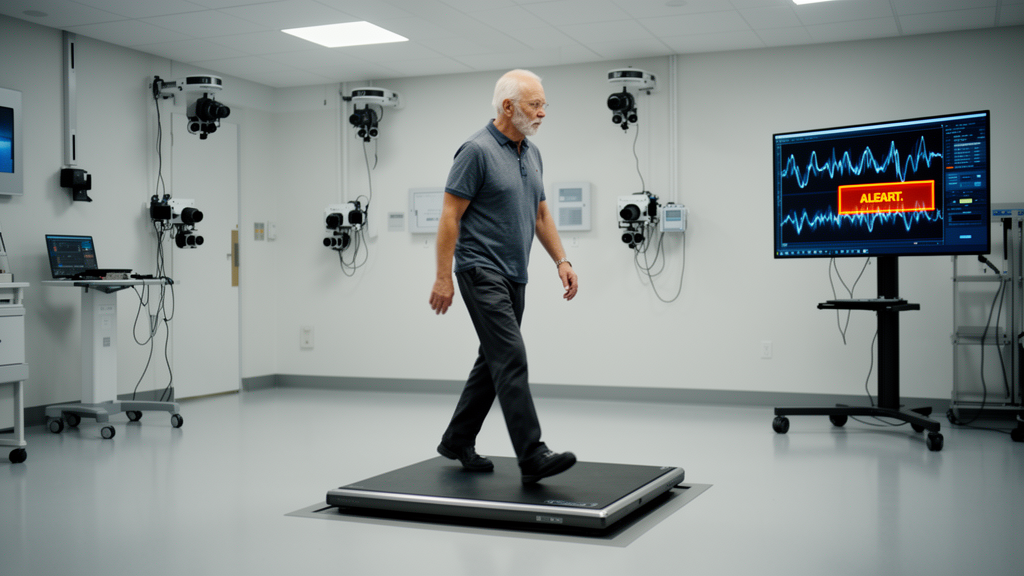
Force plates buried in laboratory walkways record that story as ground reaction forces — the vertical, braking-and-propulsion, and side-to-side forces exchanged between foot and floor during each stance phase. Researchers at the University of Birmingham and Yueyang Hospital have now shown that these three force curves alone, fed through a compact hybrid machine-learning model called GaitScreen, can reliably distinguish healthy walking from pathological gait in people with lower-limb orthopaedic conditions, and can do so fast enough to sift through large archives of recorded trials on an ordinary computer processor. The study, published in Frontiers in Bioengineering and Biotechnology, was designed around a deliberately modest but practical goal: not to diagnose a specific disease, but to prioritise already-recorded gait trials for review by a clinician.
The model converts each trial into a review-prioritisation score between zero and one, and a validation-selected threshold turns that score into a simple flag — review this trial, or set it aside. In this formulation, a false negative is a pathological trial that slips past the flag, while a false positive is a healthy trial unnecessarily sent for review. The framework therefore sits upstream of clinical decision-making rather than replacing it.
To build and test the system, the team used GaitRec, a large public benchmark of standardised bilateral force-plate recordings. After restricting the data to self-selected walking speed and normal-shoe conditions, keeping only the first eligible session per subject, and excluding detailed subclasses that could not support subject-exclusive allocation, the final limb-level cohort comprised 2,189 subjects — 208 healthy controls and 1,981 patients — yielding 12,089 limb-specific trials, of which 10,011 were pathological. The pathological cohort was organised into hip, knee, ankle and calcaneus impairment families.
Subjects were allocated once to training, validation and held-out test sets, so that no subject appeared in more than one subset, and the held-out test set contained 1,228 trials. Each input trial consisted of the complete time-normalised stance-phase trajectories of the three force components, with 101 samples per channel — 303 waveform values in total, expressed as multiples of body weight. No handcrafted biomechanical parameters, resampling or centre-of-pressure information were used.
GaitScreen processes these waveforms through three parallel branches. A multi-scale temporal backbone applies convolutional stems with kernel sizes of 3, 13 and 25 samples, allowing it to capture both short-range loading transients and broader force-evolution patterns across stance. A conventional convolutional neural network branch provides a standard learned representation, and a logistic regression branch reads the same flattened waveform through a purely linear decision boundary.
The three branches produce probability estimates that are combined by simple equal-weight averaging — a non-trainable fusion rule that keeps the model transparent and small. Sixteen comparator models spanning classical machine learning, standard deep learning, modern temporal architectures and literature-inspired GRF systems — including logistic regression, RBF-kernel support vector machines, random forests, multilayer perceptrons, CNNs, LSTMs, Transformers, temporal convolutional networks, ResNet1D and InceptionTime — were trained and evaluated under the identical subject-exclusive partition, the same GRF-only inputs and ten matched random seeds. GaitScreen achieved the highest mean performance on all three primary metrics: an accuracy of 0.8766, a macro-F1 of 0.8757 and an area under the receiver operating characteristic curve of 0.9425.
Paired statistical tests showed GaitScreen was significantly higher than all comparators on accuracy and macro-F1, and higher than 14 of the 15 comparators on AUROC; only InceptionTime's AUROC difference fell short of statistical significance. The closest competitors were the temporal convolutional network and InceptionTime, both of which remained below GaitScreen in mean performance. At the validation-selected threshold that maximised macro-F1, the model produced a balanced profile with a false-negative rate of 0.1736 — meaning roughly one pathological trial in six was not flagged.
A high-sensitivity operating mode cut that rate to 0.1073, at the cost of more healthy trials being flagged for review. The authors emphasise that this high-sensitivity setting is a threshold-dependent sensitivity analysis rather than a prospectively fixed clinical rule. Performance also varied across anatomical groups: screening was strongest for calcaneus trials, while knee trials showed the lowest sensitivity and the highest false-negative rate, indicating that a single pooled threshold does not behave uniformly across pathology families.
A key selling point is computational economy. The full hybrid model contains 285,832 fitted parameters and occupies just 1.122 megabytes when serialised — larger than a bare logistic regression, but smaller than the evaluated TCN, ResNet1D and InceptionTime models. On an Apple M4 CPU, full hybrid inference took a mean of 0.626 milliseconds per trial at batch size one, and the model processed 483.7 samples per second in a separate batched throughput measurement.
These timings cover the three branches, probability averaging and thresholding, but not GRF preprocessing or data acquisition. The authors frame the result as a performance–complexity trade-off rather than a claim of minimal complexity, and note that runtime figures for the adapted literature-inspired comparators should not be attributed to the originally published systems. Ablation analyses supported both main design choices.
Among the tested temporal configurations, the selected 3-13-25 multi-scale backbone achieved the highest macro-F1 of 0.8670, beating raw-waveform, single-scale, alternative multi-scale and all-kernel variants — evidence that combining local and medium-range receptive fields suits stance-phase force patterns. Fusion also helped incrementally: the backbone alone scored 0.8670, adding the CNN raised it to 0.8687, and the full three-component fusion reached 0.8757. Interpretability analyses added texture to the picture.
SHAP attribution applied to the trained backbone showed that vertical GRF received the largest mean absolute attribution, concentrated in late stance, with localised contributions from the anterior–posterior and mediolateral channels. A t-SNE projection of learned features showed healthy and pathological trials occupying partially distinct but overlapping regions, consistent with the heterogeneity of the pooled pathological class. The team also examined what happens when trial scores are aggregated within subjects after the fact.
Mean-score aggregation preserved strong subject-level ranking but shifted the sensitivity–specificity profile and increased calibration error, so the authors caution that aggregated scores should not be read as calibrated subject-level risk estimates. The primary validated claim remains trial-level classification and review prioritisation, in line with the principle that model outputs should be validated at their intended decision level. The limitations are clearly drawn.
All experiments were conducted within GaitRec, so subject-exclusive partitioning reduces leakage within the benchmark but does not establish generalisation across laboratories, force-plate systems, acquisition protocols or patient populations. Continuous walking velocity was unavailable, so pathology-related and speed-related waveform effects cannot be fully disentangled. The binary healthy-versus-pathological formulation does not distinguish subtype, anatomical source, disease severity or aetiology, and efficiency was assessed only in an offline setting.
Within those boundaries, the study makes a concrete case that standardised force-plate recordings — already collected in gait laboratories worldwide — can be triaged at scale by a model small enough and fast enough to run on commodity hardware, turning backlogs of recorded trials into prioritised review queues.
Subject of Research: Machine-learning prescreening of pathological gait using ground reaction force recordings
Article Title: GaitScreen: a ground reaction force-based framework for prescreening gait abnormalities in orthopaedic populations
Article References: Bian, Q., Zhang, Q., Li, Y., & Ding, Z. (2026). GaitScreen: a ground reaction force-based framework for prescreening gait abnormalities in orthopaedic populations. Frontiers in Bioengineering and Biotechnology, 14, Article 1947887. https://doi.org/10.3389/fbioe.2026.1947887
Image Credits: AI Generated
DOI: 10.3389/fbioe.2026.1947887
Keywords: ground reaction force, gait analysis, GaitScreen, GaitRec, machine learning, biomechanics, orthopaedics, convolutional neural network, screening, force plates, rehabilitation, clinical triage
News Source: Blake Davidson. (October 27, 2026). Force-Plate AI Flags Abnormal Walking Patterns in a Fraction of a Second. Scienmag.