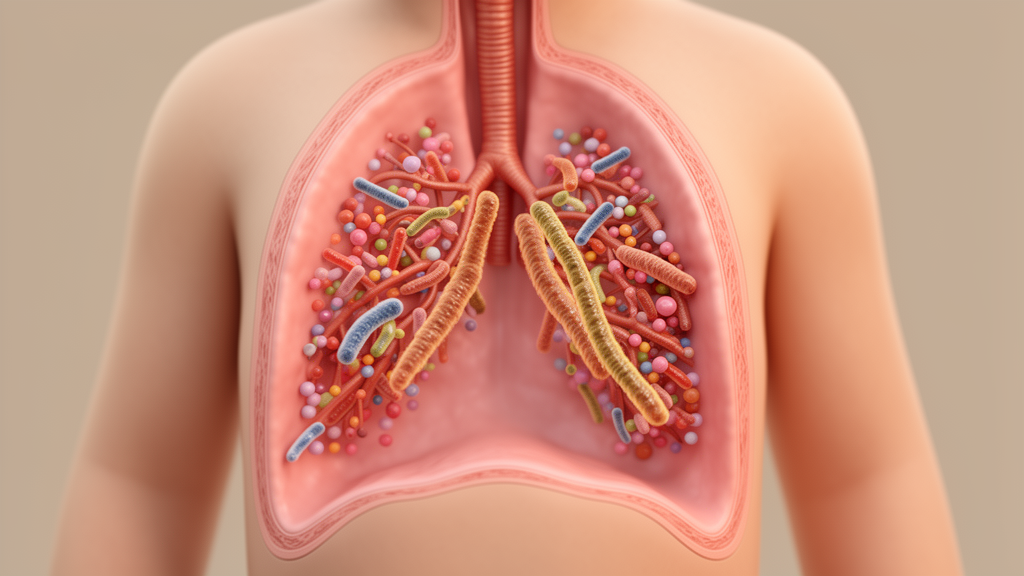
Children hospitalized with lobar pneumonia caused by Mycoplasma pneumoniae carry markedly different bacterial communities in their upper and lower airways, according to a new sequencing study published in BMC Pediatrics. The finding suggests that the pathogen does not simply add itself to an existing microbial community but actively restructures the ecology of the lung, and that samples from the nose and throat may poorly reflect what is happening at the site of disease. Researchers performed 16S rRNA gene sequencing on paired nasopharyngeal swab and bronchoalveolar lavage fluid samples from 40 children with lobar pneumonia, with 38 paired samples ultimately included in the analysis.
The cohort was stratified by infection status into an MP-positive group of 28 children and an MP-negative group of 12. Comparing these groups allowed the team to ask whether the airway microbiota of children with MP-associated lobar pneumonia differed from that of children with lobar pneumonia in which MP was not detected. The results showed distinct microbiota profiles at both the phylum and genus levels in children with MP-associated disease.
Alpha diversity analysis revealed reduced bacterial diversity in the lower airways of MP-positive children compared with MP-negative children, indicating a less varied community at the site of infection when the pathogen was present. Principal coordinate analysis demonstrated a clear separation between the bacterial communities of the upper and lower airways in MP-positive patients, with a statistical significance of q < 0.001. In contrast, no such segregation between respiratory sites was observed in MP-negative individuals, where the comparison yielded q = 0.102.
This asymmetry implies that the compartmentalization of airway microbiota, in which the lung maintains a community distinct from that of the nasopharynx, is a feature specifically associated with MP infection in this cohort. Beyond the spatial contrast, the overall composition of the microbial community differed significantly between MP-positive and MP-negative children in both the upper airway (q < 0.001) and the lower airway (q < 0.001). In other words, the presence of Mycoplasma pneumoniae was associated with a measurable shift in community structure at both respiratory sites, not only in the lung.
A key analytical step clarified the nature of this shift. When the researchers excluded Mycoplasma sequences from the data, the structural differences in the lower airway microbiota between the two groups persisted (q < 0.001), meaning the compositional changes were not merely an artifact of counting the pathogen itself. However, the differences in alpha diversity were no longer significant after this exclusion, indicating that the apparent reduction in lower airway diversity was driven largely by the abundance of Mycoplasma rather than by a broader loss of other bacterial species.
Taken together, these results suggest that MP infection primarily reshapes the composition of the lower airway microbial community rather than globally reducing diversity across the airways. The authors conclude that distinct, site-specific microbial signatures characterize pediatric MP-associated lobar pneumonia, and that the upper and lower respiratory tracts should be treated as ecologically separate compartments in this disease context. The study carries practical implications for diagnostics and research design.
The observed separation between sites in MP-positive children, but not in MP-negative children, suggests that such proxies may be unreliable precisely in the patients of greatest interest, and the authors emphasize that bronchoalveolar lavage fluid remains crucial for characterizing this site-specific pathology. As with any observational sequencing study, the findings describe associations within a single cohort of 40 children and do not establish causal mechanisms by which Mycoplasma pneumoniae restructures the airway microbiota. The relatively small MP-negative comparison group also limits the precision of between-group estimates.
Nevertheless, the work provides a detailed baseline description of how the microbial landscapes of the nose and lung diverge in pediatric lobar pneumonia, and it highlights the value of paired sampling from both sites when studying respiratory infections in children.
Subject of Research: Upper and lower airway microbiota profiles in children with Mycoplasma pneumoniae-associated lobar pneumonia
Article Title: Distinct upper and lower airway microbiota profiles in pediatric Mycoplasma pneumoniae-associated lobar pneumonia
Article References: Lv, F., Xu, M., Yang, L., Zheng, Y., Wen, S., Yu, G., Zhang, H., & Zhang, X. (2026). Distinct upper and lower airway microbiota profiles in pediatric Mycoplasma pneumoniae-associated lobar pneumonia. BMC Pediatrics. https://doi.org/10.1186/s12887-026-07922-z
Image Credits: AI Generated
DOI: 10.1186/s12887-026-07922-z
Keywords: Mycoplasma pneumoniae, lobar pneumonia, pediatrics, airway microbiota, 16S rRNA sequencing, bronchoalveolar lavage fluid, nasopharyngeal swab, alpha diversity, microbiome, respiratory infection, Distinct, upper
News Source: Morgan Morrow. (October 27, 2026). Mycoplasma pneumoniae reshapes lower airway microbiota in children with lobar pneumonia. Scienmag.