


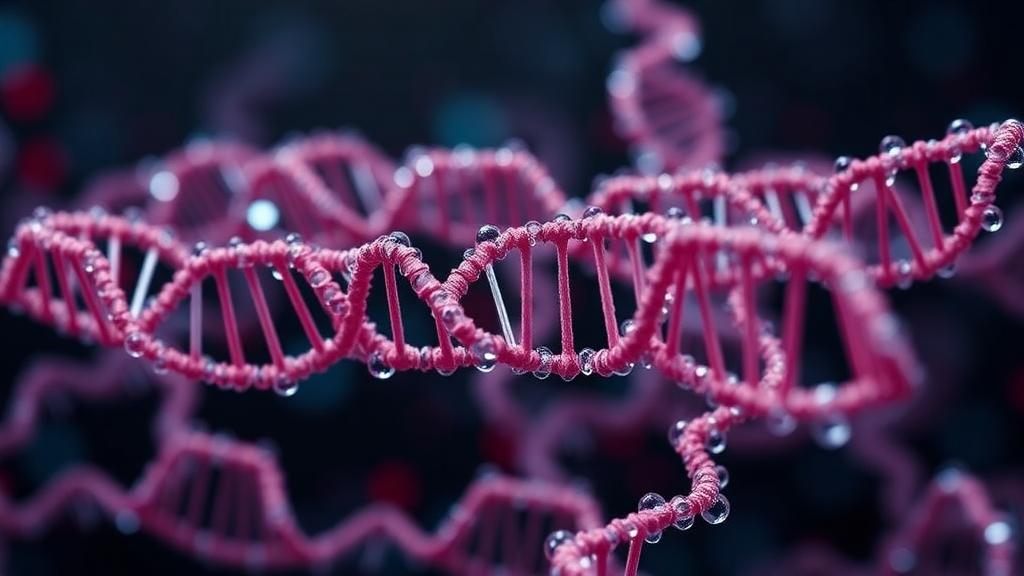
Synthetic DNA droplets form more readily and organize into more complex structures when the surrounding solution is crowded with large polymers, according to a study from Institute of Science Tokyo published in JACS Au. The researchers, led by Professor Masahiro Takinoue with graduate student Naoki C. Yoshida, Dr. Mayu Shono of The University of Tokyo, and Professor Kenichi Yoshikawa of Doshisha University, showed that macromolecular crowding can act as a design tool for controlling the size, interactions, and organization of liquid-like DNA condensates. The paper appeared online on July 27, 2026, and in Volume 6, Issue 8 of the journal on August 24, 2026.
The team worked with Y-shaped branched DNA nanostructures called DNA nanostars, which self-assemble into liquid droplets through short complementary single-stranded overhangs known as sticky ends. As nanostars bind one another via these sequences, they undergo liquid–liquid phase separation, producing a concentrated, droplet-like DNA phase. In experiments where the solution was cooled from 85 °C, droplets formed below 63 °C in the absence of crowding agents. When the researchers added 10% of the polymers polyethylene glycol (PEG), dextran, or Ficoll, droplets formed at markedly higher temperatures of 76, 65, and 67 °C, respectively, indicating that crowding both promotes droplet formation and stabilizes the condensates at elevated temperatures.
PEG with a high molecular weight of 7.5 kDa had the strongest effect and was selected for further experiments. The crowding agent could not drive assembly on its own: when added to nanostars lacking sticky ends, PEG produced no condensates, demonstrating that it requires the sticky-end-mediated interactions between nanostars to promote droplet formation. In living cells, biomolecules such as proteins and nucleic acids gather into concentrated regions called biomolecular condensates that regulate cellular processes, and the crowded interior of the cell can influence the properties of these droplets. The synthetic system was designed to mimic that crowded environment and probe how it affects condensate formation, stability, and organization.
The most striking result concerned organization rather than stability alone. The researchers created two types of nanostars whose sticky ends could not bind to each other. Under normal conditions, the two types formed separate droplets that did not mix or fuse. When PEG was added, the crowding effect pushed the droplets into contact without causing them to fuse. By tuning the PEG concentration, the ratio of the two nanostar types, and the salt concentration, the team controlled how the droplets interacted and arranged themselves, generating patterns that ranged from alternating, network-like structures to more complex architectures containing up to three distinct nanostar types.
“These findings reveal that macromolecular crowding is not merely a feature of the cellular environment but also serves as a powerful design parameter for engineering artificial DNA condensates,” Takinoue said in the release. He described the work as providing “a new design strategy for constructing sophisticated artificial cell architectures and molecular networks based on programmable self-organization.” The authors suggest that harnessing crowding could support the development of artificial cell tissues, molecular communication networks, molecular computing systems, and programmable micromachines in which function emerges from controlled self-organization of biomolecular components. The study was an experimental investigation of synthetic DNA systems rather than a demonstration in living cells, and the reported patterns and temperature thresholds apply to the nanostar and polymer formulations tested. The authors declared no competing financial interests.
Subject of Research: How macromolecular crowding controls the formation and organization of synthetic DNA droplets
Article Title: Macromolecular crowding could help build artificial cell systems
Article References: Macromolecular crowding could help build artificial cell systems. Original publication (Bibliographic details unavailable.)
Image Credits: AI Generated
DOI: Not provided
Keywords: DNA nanostars, macromolecular crowding, liquid-liquid phase separation, biomolecular condensates, polyethylene glycol, synthetic biology, artificial cells, self-organization, JACS Au, Institute of Science Tokyo, DNA droplets, molecular crowding agents
News Source: Drew Townsend. (October 29, 2026). Crowded molecular environments steer synthetic DNA droplet self-assembly. Scienmag.



