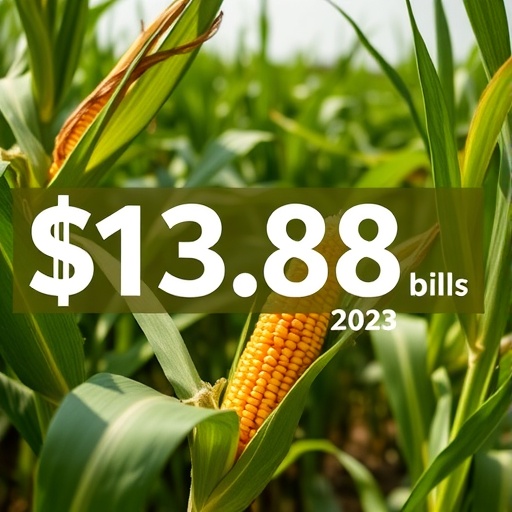
An extensive new study analyzing corn disease impacts across the United States and Ontario, Canada has revealed staggering economic and agricultural losses from 2020 through 2023. Researchers, led by a collaboration of over 40 plant pathology experts, estimate that diseases have reduced corn yields by approximately 2.5 billion bushels during this four-year span. These yield deductions correspond to financial damages reaching nearly $13.8 billion USD, underscoring the profound vulnerabilities facing corn producers across North America’s vast agricultural landscapes.
This comprehensive analysis encompassed evaluations of disease impacts on corn cultivated across more than 375 million acres, spanning diverse climatic zones and agronomic practices between 2020 and 2023. The team assessed the yield losses attributed to 37 individual pathogens and pathogen groups, including losses linked to grain contamination from harmful mycotoxins. Among the myriad causal agents, tar spot, Fusarium stalk rot, and infestations of plant-parasitic nematodes emerged as the primary drivers behind the greatest yield reductions during this interval.
Disease losses exhibited significant variability both geographically and temporally. For example, regions like Texas in 2023 faced minimal disease pressure with negligible yield loss, while Michigan in 2021 experienced an alarming 15.8% decrease in corn production attributable to disease. Averaged across all sites and years, corn diseases reduced yields by roughly 3%, translating to an economic loss estimated at $37.76 per acre annually. Importantly, these figures reflect direct yield reductions and do not account for the substantial additional costs incurred by farmers for disease management measures such as fungicide treatments and seed enhancements.
The collaborative research effort is unprecedented both in scale and scope, representing one of the most detailed evaluations of corn disease losses in recent years. By drawing on pooled expertise and data from an array of specialists distributed throughout 29 U.S. states and Ontario, the researchers gained a panoramic view of the shifting landscape of corn pathogens and their associated threats. This extensive geographic and temporal coverage allows for nuanced insights into regional disease dynamics and evolving pathogen pressures over time.
The study’s findings illuminate the complex interplay among diverse corn diseases, regulatory challenges, and the agricultural methods employed by growers. Tar spot, a fungal disease characterized by distinctive black lesions on leaves, was reaffirmed as a consistently emerging threat capable of severely impacting photosynthetic capacity and ultimately yield outcomes. Fusarium stalk rot, another leading cause of losses, compromises plant vascular tissue and heightens susceptibility to lodging, particularly under abiotic stress conditions. Furthermore, plant-parasitic nematodes disrupt root systems, impeding water and nutrient uptake critical for healthy corn development.
Disease monitoring and yield loss documentation across multiple growing seasons also provide essential empirical data that can inform targeted disease management strategies. By tracking how pathogen prevalence and impact vary over time and location, agronomists and plant breeders can prioritize resources toward combating the most damaging diseases. This approach is integral to optimizing the deployment of disease-resistant crop hybrids and tailoring precision interventions to local epidemiological realities.
Beyond immediate yield loss quantifications, the study highlights broader economic repercussions and indirect effects within corn production systems. Recurrent disease outbreaks impose additional operational expenses, including enhanced scouting, fungicide applications, and integrated pest management adaptations. These cumulative costs contribute substantially to overall production budgets, exerting pressure on profit margins in an already economically volatile agricultural sector.
The research stands to inform multiple stakeholders across the agricultural value chain, including extension educators, commodity organizations, policy makers, and industry partners. By elucidating current disease pressures, regional vulnerabilities, and temporal trends, the study offers a vital knowledge base to guide research priorities, regulatory frameworks, and the design of new crop protection technologies. The findings also advocate for sustained investment in coordinated disease surveillance networks and integrated management programs that can dynamically respond to shifting pathogen threats.
Integral to this publication is its connection to the broader Crop Protection Network, a collaborative consortium that synthesizes disease loss data for various major field crops such as soybean, wheat, and cotton in addition to corn. Through platforms like the Field Crop Disease and Insect Loss Calculator, stakeholders gain real-time access to evolving disease loss estimates, facilitating informed decision-making and adaptive management strategies at the farm and regional levels.
This study builds upon prior multiyear assessments covering the intervals 2012–2015 and 2016–2019, showcasing the importance of longitudinal data accumulation in understanding disease evolution and impact patterns. By comparing successive time periods, researchers can detect emerging disease trends, novel pathogen introductions, or the efficacy of implemented management regimes, thus advancing the resilience and sustainability of corn production systems.
In summary, the recent analysis presents a sobering yet crucial appraisal of the burden imposed by corn diseases on North American agriculture. The pronounced yield losses and vast economic damages documented for 2020–2023 underscore the critical necessity for integrated disease management, continued research innovation, and collaborative response frameworks. Through sustained vigilance and adaptive strategies, corn producers can better navigate the evolving pathogen landscape, safeguarding both yield stability and economic viability in future growing seasons.
Subject of Research: Corn yield losses due to diseases and their economic impact in the United States and Ontario, Canada from 2020 to 2023
Article Title: Corn Yield Loss Estimates Due to Diseases in the United States and Ontario, Canada, from 2020 to 2023
News Publication Date: April 2, 2026
Web References:
https://doi.org/10.1094/PHP-07-25-0193-RS
https://cropprotectionnetwork.org/
https://loss.cropprotectionnetwork.org/
Keywords: Corn, maize, plant diseases, plant pathology, crop production, crop yields, agriculture, farming, crop protection, tar spot, Fusarium stalk rot, plant-parasitic nematodes
Tags: agricultural disease outbreak analysiscorn disease economic impactcorn disease management strategiescorn yield losses 2020-2023Fusarium stalk rot effectsmulti-year corn disease studymycotoxin contamination in grainNorth America corn agriculture lossesplant pathology corn diseasesplant-parasitic nematodes in cornregional variability in corn diseasestar spot corn damage