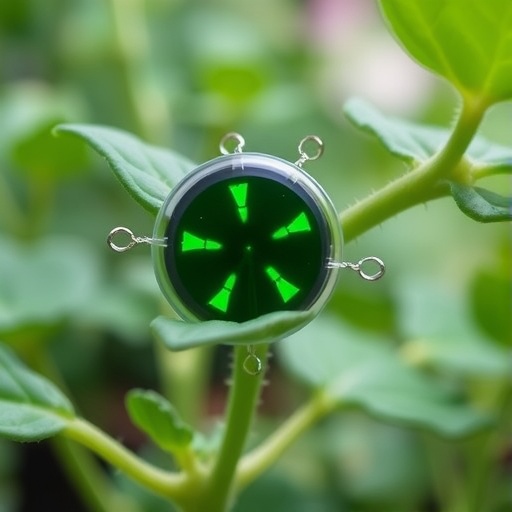
In a breakthrough that promises to transform agricultural monitoring and food safety, researchers at the São Carlos Institute of Physics of the University of São Paulo (IFSC-USP) in Brazil have unveiled a cutting-edge, biodegradable wearable sensor specifically designed for plants. This innovative device is capable of real-time, non-destructive detection of pesticides and other vital indicators of plant health, marking a significant leap in sustainable agricultural technology. Spearheaded by Paulo Augusto Raymundo-Pereira, the team has harnessed the potential of eco-friendly, plant-derived materials to overcome longstanding challenges inherent in conventional wearable sensors used in agriculture.
Traditional wearable sensors often rely on petroleum-based plastic polymers, which exhibit poor adaptability to the uneven, wavy, and dynamic surfaces typical of plants, especially leaves and stems. These materials also pose environmental concerns due to their non-biodegradable nature. Recognizing these limitations, Raymundo-Pereira’s group developed sensors based on cellulose acetate, a transparent bioplastic derived from cellulose—the most abundant natural polysaccharide on the planet. This material offers remarkable biocompatibility, thermal stability, and flexibility, making it ideally suited for conforming to the irregular geometries of plant surfaces.
The sensor fabrication process involves screen-printing carbon ink directly onto cellulose acetate substrates, producing miniaturized devices that can be seamlessly affixed to diverse plant organs including stems, bark, and leaves. This direct application capability is a notable advantage, as the acetate’s pliability ensures an intimate interface with the surface, thereby enhancing measurement accuracy. Moreover, the biodegradable nature of cellulose acetate addresses sustainability concerns by reducing plastic waste and facilitating sensor recycling through the recovery of carbon ink via controlled burning.
These dual-unit sensors deploy advanced electrochemical analytical techniques to detect three classes of common pesticides: diquat, carbendazim, and diphenylamine. Utilizing square-wave voltammetry (SWV) for diquat and differential pulse voltammetry (DPV) for the latter two, the sensors provide rapid and sensitive quantification within a mere three minutes and twenty-eight seconds. Each sensor is designed for single use and remarkably costs only 0.077 cents, making widespread deployment economically feasible for agricultural stakeholders.
A distinctive feature of the wearable sensor system lies in its operational interface: while the sensor is positioned directly on the plant, it measures pesticide levels via an aqueous medium created by applying a small droplet of water to naturally occurring surface depressions such as leaf centers or stem grooves. This aqueous environment is crucial for electrical conductivity, enabling precise electrochemical measurements at the electrode-liquid boundary. This innovative methodological approach ensures that monitoring is non-invasive, on-site, and fast, dramatically shortening the feedback loop between analysis and action.
Further enhancing usability, the sensor platform integrates wirelessly with a commercial portable potentiostat, transmitting pesticide concentration data in real-time via Bluetooth to smartphone applications. This wireless functionality empowers farmers, agronomists, and food safety inspectors with immediate access to critical information, facilitating swift intervention when pesticide residues surpass safety thresholds.
The developmental narrative behind this technology draws inspiration from wearable sensor research conducted at the University of California, San Diego, under Professor Joseph Wang. While earlier devices focused on human applications—such as monitoring sweat biomarkers—they generally employed non-biodegradable, petrochemical-based plastics. By contrast, the IFSC-USP team’s pioneering approach galvanized the translation of this technology for plant health monitoring using renewable, plant-derived components, thereby aligning with global calls for sustainable innovation in agriculture.
Beyond the intrinsic agricultural applications, the sensor’s versatility extends to human health and environmental monitoring. Experimental tests demonstrated the device’s capacity to detect pesticide residues in human saliva and tap water, showcasing its potential utility in public health analysis. Moreover, its sensitivity to bioactive chemicals paves the way for future adaptations to monitor biomarkers found in human urine or sweat, potentially serving as a low-cost diagnostic tool in clinical or epidemiological settings.
In practical trials, the sensors were affixed to apples and bell peppers treated with a standardized 1,000 μM agrochemical spray and allowed to dry, replicating real-world pesticide exposure scenarios. Subsequent analyses involved applying a phosphate buffer solution to the fruit surface and deploying the sensor for immediate detection. This protocol underscores the robustness and applicability of the technology in realistic agricultural and food safety contexts.
The environmental credentials of these sensors are reinforced by their sustainable lifecycle. Since the devices are single-use but biodegradable, they minimize environmental impact compared to traditional polymer-based sensors. Importantly, discarded sensors can be incinerated under controlled conditions to recover the carbon ink, enabling the production of new sensors, thus fostering a circular economy model within sensor manufacturing.
The research is a multidisciplinary achievement involving contributions from scientists at IFSC-USP and collaborators at the Federal University of Viçosa. The project has garnered support from the São Paulo Research Foundation (FAPESP), which provided funding through various fellowships and grants, reflecting the strategic importance of advancing agro-technological frontiers in Brazil, a nation with a substantial GDP linked to agriculture.
Patent applications for this technology have been lodged with the National Institute of Intellectual Property (INPI) in Brazil, signaling the team’s intent to protect and potentially commercialize the innovation. This move anticipates a future where biodegradable, efficient, and cost-effective wearable sensors become standard tools for farmers worldwide, promoting safer food production and environmental stewardship.
As global populations grow and demands on agricultural productivity intensify, timely and accurate monitoring of plant health and pesticide residues will become indispensable. The development of these biodegradable wearable sensors heralds a new era in precision agriculture, where sustainability, technological sophistication, and real-time data converge to enhance crop yields, ensure food safety, and mitigate environmental harm. This research not only sets a benchmark in sensor technology but also exemplifies how interdisciplinary scientific efforts can engender solutions tailored to some of humanity’s most pressing challenges.
Subject of Research: Biodegradable wearable sensors for plant health monitoring and pesticide detection
Article Title: Biodegradable wearable sensors for rapid non-destructive analysis of pesticides on plants and foods
News Publication Date: February 13, 2026
Web References: https://agencia.fapesp.br/37874 (related glove sensor article)
References: Biosensors and Bioelectronics: X, DOI: 10.1016/j.biosx.2026.100758
Image Credits: Paulo A. Raymundo-Pereira
Tags: biodegradable plant sensorscarbon ink printed sensorscellulose acetate bioplastic sensorseco-friendly wearable plant devicesenvironmental impact of agricultural sensorsflexible sensors for plantsminiaturized plant wearable devicesnon-destructive plant health monitoringplant-derived sensor materialsreal-time pesticide detectionsustainable agricultural technologyUniversity of São Paulo agricultural innovation