In the vast agricultural landscapes of the U.S. Midwest, tile drainage systems have become indispensable. These underground pipes efficiently remove excess water from soil, preventing crop damage and promoting robust plant growth by enhancing soil aeration. However, this well-established practice has a significant downside: the drainage water often carries with it phosphorus, a key nutrient that, when entering nearby waterways, fuels the growth of harmful algal blooms. These blooms not only disrupt aquatic ecosystems but also threaten water quality for human consumption and recreational use. Recognizing this pressing environmental challenge, researchers at the University of Illinois Urbana-Champaign have embarked on an innovative exploration to mitigate phosphorus pollution through the use of biochar.
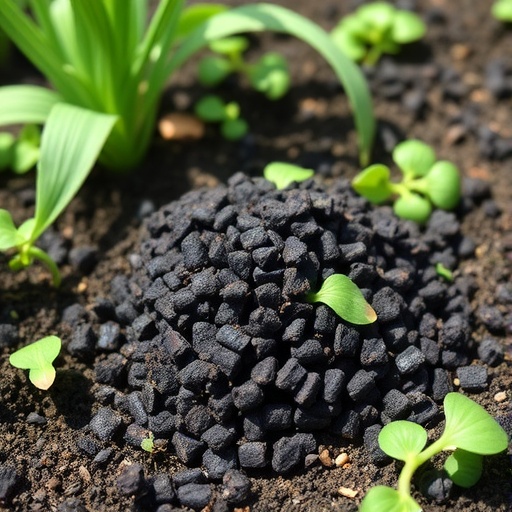
Biochar, a charcoal-like substance created by heating organic waste materials in a low-oxygen environment, has garnered attention for its potential in agricultural and environmental applications. Its porous structure and high carbon content give it a remarkable capacity to absorb and retain nutrients and pollutants. The recent study focuses on specially engineered “designer” biochar pellets crafted from a blend of sawdust, bentonite clay, and lime sludge. These materials are processed to form dense pellets with extensive surface area, theoretically capable of capturing phosphorus from agricultural drainage efficiently.
The researchers strategically positioned these biochar pellets at the outlets of tile drainage systems in a field situated in Central Illinois. Over the course of nearly a year, the pellets were exposed to real-world conditions—interacting with a complex and variable effluent mixture ranging from pure phosphate solutions to agricultural runoff containing cow manure and other organics. Following field exposure, the pellets were recovered and subjected to laboratory analyses to determine their phosphorus sorption and desorption performance characteristics.
Initial laboratory tests with pure phosphate solutions demonstrated promising results; the designer biochar pellets effectively absorbed phosphorus as anticipated. This behavior aligns with the physicochemical properties of biochar, which facilitate the attraction and binding of phosphate ions to its surface under controlled conditions. However, real agricultural effluents are far more chemically intricate. Rich in competing ions, microbial populations, and residual agrochemicals such as herbicides and pesticides, these waters present an inherently dynamic and reactive environment.
When exposed to agricultural wastewater, the biochar pellets exhibited less predictable phosphorus absorption and release patterns. The complex interactions among various ions and biological components altered sorption dynamics, leading to diminished effectiveness compared to idealized laboratory conditions. Moreover, environmental factors such as rainfall and fluctuating ambient temperatures compounded these effects, underscoring the challenges of translating lab successes into field applications.
A particularly critical factor influencing phosphorus dynamics was the fluctuating pH within the systems. pH levels influence the surface charge of biochar pellets, the solubility of phosphate minerals, and the nature of competitive ion interactions. The biochar itself can modify pH, often increasing alkalinity, creating a feedback loop where sorption and desorption processes continuously evolve with environmental conditions. These observations highlight the importance of monitoring and understanding pH variations when employing biochar in agricultural runoff treatment.
To explore the pellets’ function in nutrient cycling, the study’s next phase involved incorporating both new and “spent” biochar pellets into a cornfield research plot. The aim was twofold: to determine the pellets’ capacity to capture phosphorus from soil water and to assess the release potential of phosphorus stored within previously used pellets. Remarkably, higher soil pH levels correlated with increased phosphorus precipitation, facilitating enhanced phosphate removal from the soil solution. However, the diverse soil chemistry required careful consideration of existing nutrient levels prior to pellet application.
These findings raise intriguing questions about the dualistic role of biochar pellets in agricultural ecosystems. While designed to sequester excess phosphorus from runoff, the pellets simultaneously offer a slow-release nutrient amendment, potentially reducing the need for synthetic phosphorus fertilizers. Nonetheless, the complexity of soil systems demands thorough pre-application soil testing to ensure balanced nutrient management and to avoid unintended phosphorus surpluses.
Dr. Agnes Millimouno, lead author and doctoral candidate, emphasized the critical need for long-term field studies to fully comprehend the practical efficacy and environmental impacts of designer biochar pellets. Such research should span diverse soil types and climatic conditions, elucidating the nuanced mechanisms governing biochar-phosphorus interactions and informing sustainable agricultural practices.
As agricultural landscapes grapple with nutrient management challenges, innovative materials like biochar offer a tantalizing avenue for harmonizing productivity with environmental stewardship. Achieving this balance requires a systems-level understanding that integrates soil chemistry, hydrology, microbial ecology, and agronomic management into coherent phosphorus mitigation strategies.
This pioneering work, published in Water Environment Research, marks a significant step toward refining the use of biochar in real-world agricultural settings. By moving beyond laboratory simplifications to embrace the complexity of field environments, researchers are forging a path toward more effective and affordable nutrient pollution solutions—solutions that could ultimately safeguard freshwater resources while supporting sustainable food production.
Funding for this groundbreaking study was provided in part by the U.S. Department of Agriculture’s National Institute of Food and Agriculture Hatch Program, as well as the U.S. Environmental Protection Agency, underscoring the broader governmental commitment to addressing nutrient pollution through science-based innovation.
Subject of Research: Phosphorus sorption and desorption dynamics of designer biochar pellets in agricultural wastewater and soil environments.
Article Title: Evaluating Phosphorus Sorption and Desorption in Agricultural Wastewater Using Designer Biochar Pellets
News Publication Date: March 25, 2026
Web References:
https://onlinelibrary.wiley.com/doi/full/10.1002/wer.70349
References:
Millimouno, A., Guzman, J., et al. (2026). Evaluating Phosphorus Sorption and Desorption in Agricultural Wastewater Using Designer Biochar Pellets. Water Environment Research. https://doi.org/10.1002/wer.70349
Image Credits: College of Agricultural, Consumer and Environmental Sciences, University of Illinois Urbana-Champaign
Keywords: biochar, phosphorus pollution, tile drainage, agricultural wastewater, nutrient management, environmental chemistry, sustainable agriculture, soil pH, nutrient sorption, environmental engineering
Tags: agricultural nutrient runoff solutionsbiochar applications in agriculturebiochar for water quality improvementbiochar pellet manufacturing materialsdesigner biochar pellets for phosphorus removalengineered biochar for environmental remediationMidwest agricultural water managementmitigating phosphorus pollution in waterwaysphosphorus and harmful algal bloom preventionphosphorus management in tile drainage systemssustainable phosphorus capture techniquesUniversity of Illinois biochar research