In the ever-evolving landscape of microbial pathogenesis, the intricate mechanisms by which bacterial pathogens manipulate host cells remain a captivating frontier of scientific research. A groundbreaking study published in Nature Communications now sheds unprecedented light on the fine-tuned temporal control of bacterial secreted effectors—key molecules deployed by pathogens to hijack host cellular machinery. Researchers Zhang, Guo, Adhikari, and colleagues have introduced a pioneering technique that directly modulates ubiquitin-mediated degradation at an unprecedented minute-scale resolution, offering novel insights into the dynamic interplay between pathogen effectors and host systems.
Understanding the precise dynamics of bacterial effector proteins has long presented formidable challenges. These effectors are secreted through specialized secretion systems, rapidly entering host cells to subvert immune defenses and remodel intracellular environments favorable to infection. However, the transient nature of effector-host interactions and the swift post-translational modifications they undergo have made it difficult to capture their functional chronology in real-time. By ingeniously harnessing the ubiquitin-proteasome system—the central cellular pathway for targeted protein degradation—the team devised an innovative tool that enables researchers to control effector lifespans within living cells with remarkable temporal precision.
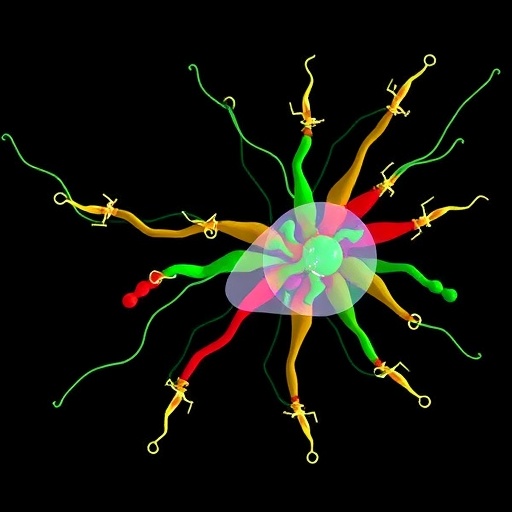
The ubiquitin system tags proteins with ubiquitin molecules, marking them for degradation by the proteasome complex. By engineering bacterial effectors fused with controllable ubiquitin signals, the authors achieved inducible degradation triggered within minutes. This approach allowed them to switch effector activity on and off dynamically, thereby observing how varying effector presence impacts host cellular pathways sequentially. The result is a temporally resolved map of effector function far more detailed than previously attainable with static genetic knockouts or traditional overexpression methods.
Central to the study was the use of bacterial effectors from model pathogens whose roles in host subversion are well-documented but not fully temporally dissected. By applying their minute-scale degradation system, the researchers uncovered novel phases of effector action, including early rapid host cytoskeletal rearrangements, followed by delayed immune signaling modulation. These findings indicate a sophisticated temporal orchestration whereby bacteria deploy effectors in a choreographed manner to outmaneuver host defenses—initially establishing footholds and subsequently dampening immune responses to ensure infection persistence.
Technically, the team employed an engineered ubiquitin variant linked to a degron domain responsive to a small-molecule inducer. Upon addition of this inducer, the modified ubiquitin signal enhanced proteasomal recognition and accelerated effector degradation. This rapid inducibility contrasts with conventional methods of protein depletion, which often require hours to days for significant effects to manifest. The technique’s precision facilitates kinetic studies correlating effector presence with phenotypic host outcomes, thereby elucidating causal relationships that were previously speculative.
Moreover, the approach proved broadly adaptable, functioning across diverse bacterial effectors and host cell types, underscoring its versatility. The researchers conducted extensive validation experiments demonstrating that the inducible degradation does not perturb unrelated host processes, ensuring the specificity and reliability of observed dynamics. This level of control and specificity marks a substantial advance for the microbiology community, enabling dissection of complex infection timelines with unparalleled clarity.
Beyond fundamental microbiology, the implications of this technology stretch into antimicrobial therapeutic development. By mapping the minute-to-minute dynamics of effector functions, drug discovery efforts can target critical windows of vulnerability where bacterial virulence factors are indispensable. Temporally precise inhibition strategies may be designed to complement existing antibiotic regimens, potentially overcoming resistance mechanisms that arise from redundant or compensatory bacterial tactics.
The mechanistic revelations afforded by this research extend further into host-pathogen coevolution studies. Understanding how pathogens temporally regulate effectors offers clues about evolutionary pressures shaping bacterial infection strategies. It also highlights potential countermeasures evolved by hosts—such as timed activation of immune defenses—to neutralize bacterial manipulations at specific infection stages. Thus, the study not only clarifies molecular interactions but also enhances our comprehension of evolutionary biology in the context of infectious diseases.
In essence, the elegant melding of protein degradation biology with bacterial pathogenesis research exemplifies the power of innovative molecular tools to unravel complex biological phenomena. This minute-scale control system stands poised to become a standard method for probing transient protein functions across various biological disciplines beyond microbiology, including cancer biology and neurobiology, where temporally regulated protein dynamics play pivotal roles.
Importantly, this research highlights the critical significance of temporal resolution in understanding biological systems. Static snapshots of protein presence or function, while informative, often miss the subtle timing nuances that dictate cellular outcomes. By enabling real-time toggling of effector proteins, the presented methodology empowers scientists to dissect the causality and sequence of molecular events governing infection processes with refined granularity.
Looking ahead, the technology invites integration with live-cell imaging and systems biology approaches to build comprehensive spatiotemporal models of infection. Such models may accelerate hypothesis-driven experimentation and predictive modeling, ultimately yielding new paradigms in infectious disease biology. Furthermore, adapted versions of this system may facilitate tissue-specific or organism-level studies, broadening its impact across biomedical research.
The study by Zhang, Guo, Adhikari, and collaborators fundamentally redefines our capacity to explore microbial virulence mechanisms. It propels forward an exciting era where manipulating protein degradation pathways with minute-scale precision unlocks deeper understanding of host-pathogen interactions and paves pathways towards innovative therapeutic interventions. As infectious diseases remain a global health challenge, such cutting-edge tools will be indispensable for unveiling vulnerabilities in bacterial armamentaria and devising effective counterstrategies.
In conclusion, the minute-scale control of ubiquitin-mediated degradation developed in this landmark study represents a transformative advancement in the toolkit for microbial pathogenesis research. By revealing the complex temporal dynamics of secreted bacterial effectors, this technology empowers researchers to explore infection biology with unprecedented precision. The insights gained promise to shape novel therapeutic approaches, enrich evolutionary understanding, and inspire future innovations in controlling infectious diseases worldwide.
Subject of Research: Dynamics and temporal control of bacterial secreted effectors via ubiquitin-mediated degradation.
Article Title: Minute-scale control of ubiquitin-mediated degradation reveals dynamics of bacterial secreted effector-functions.
Article References:
Zhang, H., Guo, Y., Adhikari, B. et al. Minute-scale control of ubiquitin-mediated degradation reveals dynamics of bacterial secreted effector-functions. Nat Commun 17, 4420 (2026). https://doi.org/10.1038/s41467-026-73213-x
Image Credits: AI Generated
DOI: https://doi.org/10.1038/s41467-026-73213-x
Tags: bacterial effector proteinsbacterial secretion systemsintracellular bacterial infection mechanismsmicrobial pathogenesis researchminute-scale temporal controlpathogen-host interaction dynamicspost-translational modifications in bacteriaprotein degradation pathwaysreal-time effector protein monitoringtargeted protein degradation toolsubiquitin-mediated degradationubiquitin-proteasome system