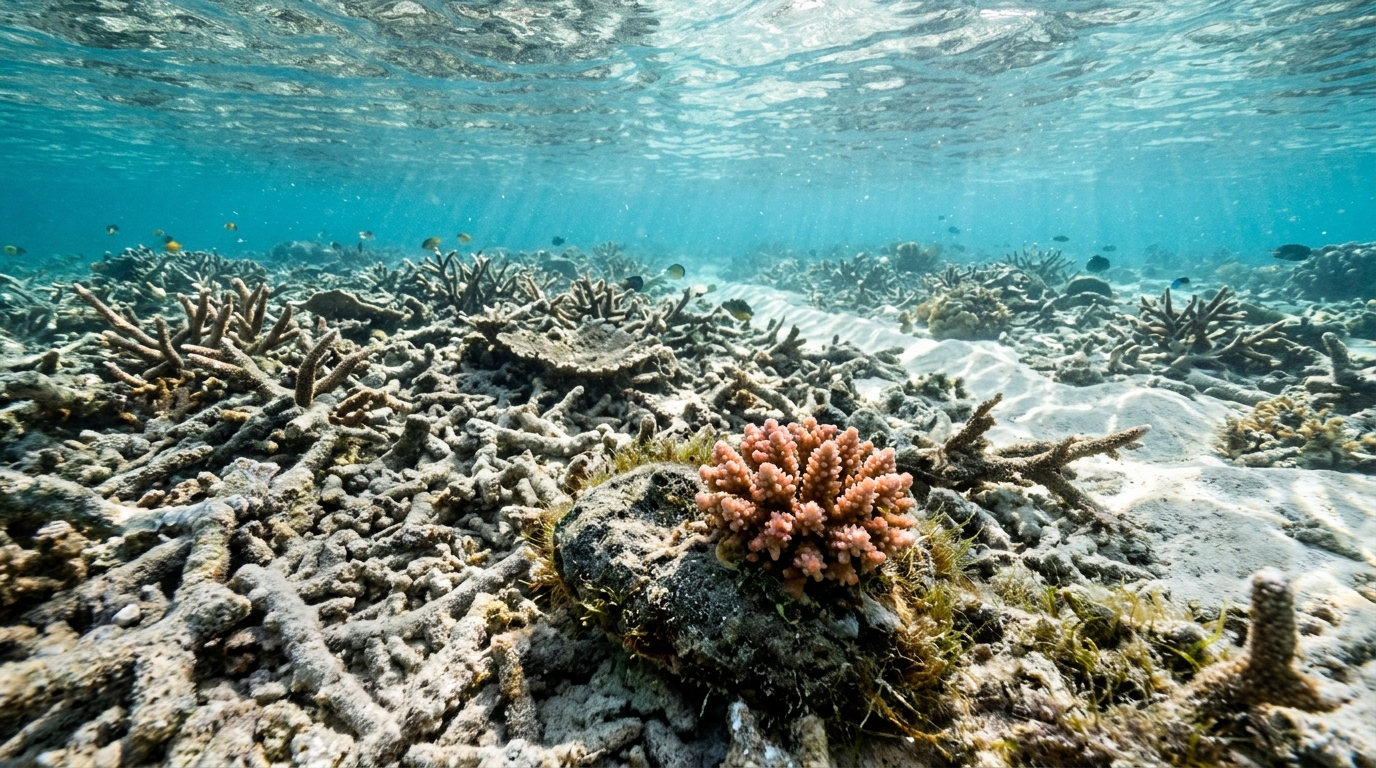
Coral rubble beds have long been blamed for blocking reef recovery because loose fragments tumble in waves and currents, crushing or smothering young corals. A new field experiment on the southern Great Barrier Reef shows that even when rubble is completely immobilised, settlement of coral larvae still falls far below the levels seen on stable reef substrate, meaning that instability is only part of the story. The study, published in the journal Coral Reefs, deployed recruitment tiles made from rubble fragments fixed to mesh across three habitats and followed the fate of coral settlers for a full year.
The loose rubble pieces averaged 7.6 centimetres in length and about 1 centimetre in diameter, while interlocked pieces averaged 15.9 centimetres in length and 1.7 centimetres in diameter, with larger void spaces between them creating a more structurally complex bed.
To remove the influence of rubble mobility, the team built 160 tiles: 40 per substrate, each consisting of a 180 by 180 millimetre stainless steel mesh onto which cleaned, bleached and sun-dried rubble pieces were cable-tied in pairs. At each substrate, 20 tiles were placed flush with the benthos and 20 were raised 20 centimetres above it. The elevated tiles served as a proxy for larval supply, allowing the researchers to check whether differences in settlement on the seafloor reflected genuine habitat effects rather than simply fewer larvae arriving. The tiles were deployed in September 2021, roughly a month before the coral spawning event, so they could condition and develop a biofilm.
After four months, the pattern was clear. Settlement on the benthic tiles was 2.7-fold higher in the interlocked rubble than in the loose rubble at Heron Reef, a statistically significant difference. At Wistari Reef, settlement on benthic tiles was 1.5-fold higher on the hard carbonate reef than on the interlocked rubble. Across both rubble habitats, settlement was consistently greater on the elevated tiles, roughly four times higher than on benthic tiles in loose rubble and more than twice as high in interlocked rubble. Yet settlement occurred in every habitat, and elevated tiles showed comparable settlement across rubble habitats when data from the two sites were pooled, indicating that larval supply was not the limiting factor.
Instead, the authors conclude that environmental and ecological factors intrinsic to each substrate, rather than substrate stability alone, drove the observed declines. The direction of the pattern was consistent at both sites: settlement was always lower in the less structurally stable substrate, pointing to a bottleneck during the earliest life stages.
Post-settlement mortality proved to be the great leveller. More than 90 percent of the coral settlers recorded at four months were gone by 12 months, across all substrates and tile heights at both reefs. With losses that severe, the number of surviving recruits at one year evened out across all substrates, although there was a non-significant trend towards slightly more recruits on interlocked than loose rubble at Heron Reef. The authors note that early post-settlement mortality is inherently high during the first weeks to months after settlement, one of the most sensitive stages in a coral’s life history, so some of the observed loss reflects a naturally high baseline rather than habitat-specific effects alone.
The team also measured sedimentation and mapped the encrusting communities on the rubble. Community analysis showed that the effect of encrusters on settlement depended strongly on habitat. Settlement increased with crustose coralline algae cover only in the loose rubble bed, increased with bare space in both rubble beds but not on hard carbonate, and declined with increasing competitor cover in both rubble types, with the steepest reduction in the loose rubble.
Competition, however, appears to have played a limited role overall. Rubble on benthic tiles was dominated by competitors such as ascidians, bryozoans and sponges regardless of substrate, and the elevated tiles, which had less available settlement space and more competitors, consistently attracted more settlers than the benthic tiles. The authors suggest that the specific type of competitor may matter more than total cover, noting that some sponges compete with corals while others facilitate their growth.
From a restoration standpoint, the findings are cautiously encouraging. Stabilising rubble did not immediately level settlement rates among substrates, but recruitment on stabilised rubble became comparable between rubble and hard carbonate habitats over time, especially where the rubble was interlocked. The authors argue that rubble stabilisation can support longer-term coral recovery even where settlement is initially low, by allowing surviving settlers to persist and transition into recruits, while managers should also address the environmental constraints that suppress settlement in rubble-dominated systems. Because the study was restricted to the southern Great Barrier Reef, the authors note that broader application will require further work, and they call for more rigorous quantification of sediment dynamics, competitive interactions and fine-scale flow regimes to identify the unresolved drivers of reduced settlement in rubble beds.
Subject of Research: Experimental study of coral settlement and recruitment on stabilised rubble tiles across loose rubble, interlocked rubble and hard reef habitats on the southern Great Barrier Reef
Article Title: Instability is not the only driver of rubble impacts on coral settlement and recruitment
Article References: Paewai-Huggins, R., Kenyon, T. M., & Mumby, P. J. (2026). Instability is not the only driver of rubble impacts on coral settlement and recruitment. Coral Reefs. https://doi.org/10.1007/s00338-026-02970-4
Image Credits: AI Generated
DOI: 10.1007/s00338-026-02970-4
Keywords: coral reefs, rubble beds, coral settlement, coral recruitment, Great Barrier Reef, post-settlement mortality, rubble stabilisation, reef restoration, sedimentation, structural complexity, larval supply, Heron Reef
News Source: Drew Townsend. (November 5, 2026). Coral rubble mobility is not the only barrier to reef recovery, study finds. Scienmag.