• HOME
  • NEWS
  • EXPLORE
    • CAREER
      • Companies
      • Jobs
    • EVENTS
    • iGEM
      • News
      • Team
    • PHOTOS
    • VIDEO
    • WIKI
  • BLOG
  • COMMUNITY
    • FACEBOOK
    • INSTAGRAM
    • TWITTER
Saturday, May 16, 2026
BIOENGINEER.ORG
No Result
View All Result
  • Login
  • HOME
  • NEWS
  • EXPLORE
    • CAREER
      • Companies
      • Jobs
        • Lecturer
        • PhD Studentship
        • Postdoc
        • Research Assistant
    • EVENTS
    • iGEM
      • News
      • Team
    • PHOTOS
    • VIDEO
    • WIKI
  • BLOG
  • COMMUNITY
    • FACEBOOK
    • INSTAGRAM
    • TWITTER
  • HOME
  • NEWS
  • EXPLORE
    • CAREER
      • Companies
      • Jobs
        • Lecturer
        • PhD Studentship
        • Postdoc
        • Research Assistant
    • EVENTS
    • iGEM
      • News
      • Team
    • PHOTOS
    • VIDEO
    • WIKI
  • BLOG
  • COMMUNITY
    • FACEBOOK
    • INSTAGRAM
    • TWITTER
No Result
View All Result
Bioengineer.org
No Result
View All Result
Home NEWS Science News Chemistry

Composite to replace cast iron in harsh maritime environments

Bioengineer by Bioengineer
December 11, 2019
in Chemistry
Reading Time: 3 mins read
0
IMAGE
Share on FacebookShare on TwitterShare on LinkedinShare on RedditShare on Telegram

Inside the giant engines in the world’s largest ships are huge heat exchangers made of cast iron; for the first time, a new project is looking for an inexpensive composite substitute for the classical iron components, which can cost vast sums to maintain
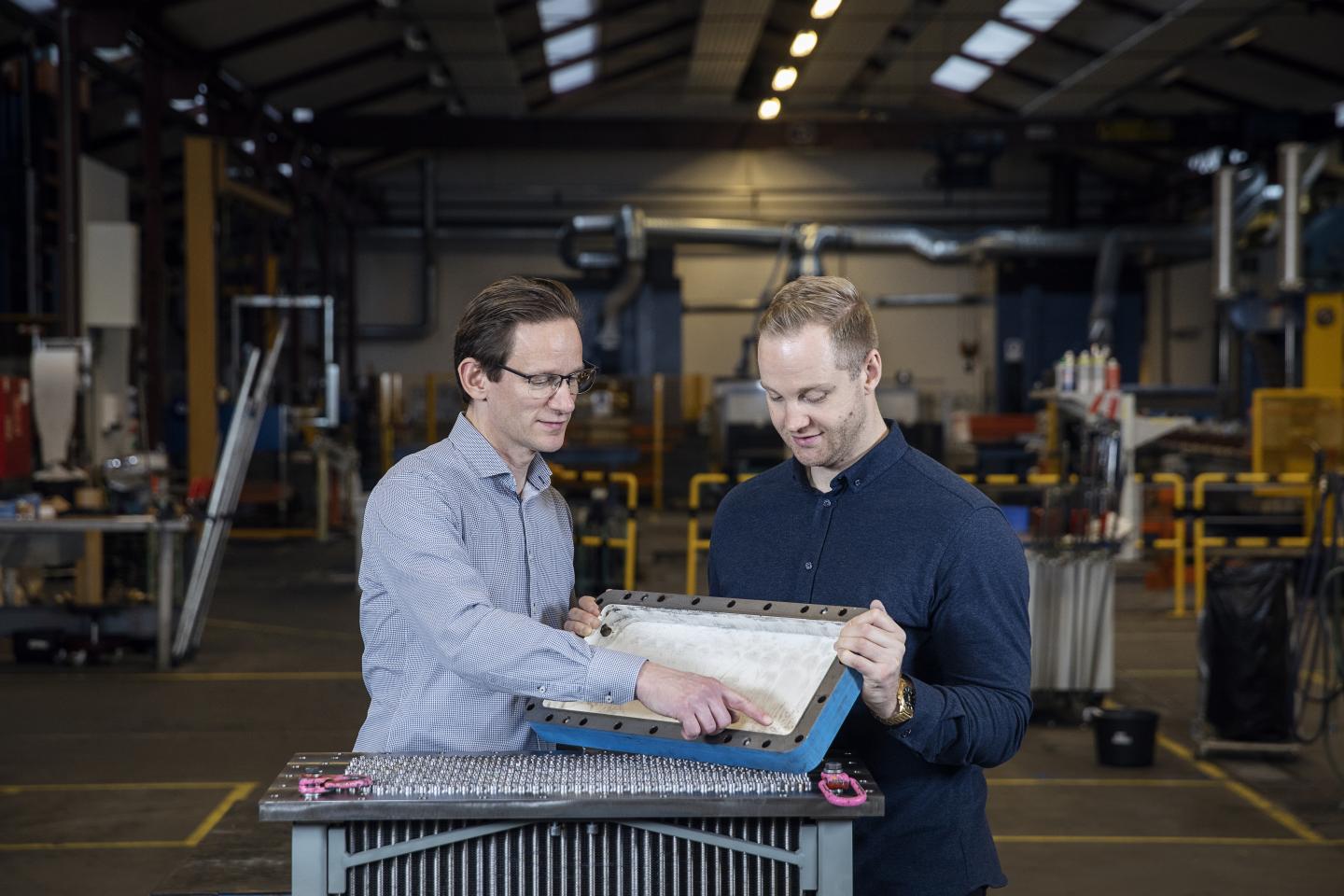
IMAGE

Credit: Anders Trærup


Inside the massive engines in the world’s largest ships are huge heat exchangers made of cast iron. For the first time, a new research project is looking for an inexpensive composite substitute for the classical iron components, which can cost vast sums to maintain.

Danish Vestas Aircoil and the Department of Engineering at Aarhus University have joined forces to find an alternative to the extremely heavy heat exchanger constructions, which for decades have been a central component in huge, turbocharged marine engines.

The aim is to reduce the weight of end plates on heat exchangers which, on the largest engines, can be several metres high and weigh hundreds of kilos. This is the first time anyone has tried to replace the classical cast iron plates.

“We’re going into unexplored territory. Of course, today there’s many alternatives to cast iron, but these are very expensive metal alloys. This is the first time anyone has tried to find a cheaper or corresponding composite solution, but it’s not easy, because the conditions are so harsh,” says Simon Heide-Jørgensen, industrial postdoc on the project, which is being supported by Innovation Fund Denmark and goes by the name of comMEC (Durability of COMposite end plate for Marine Engine Cooler).

He continues:

“The material we’re looking for must be able to withstand water, salt water, vibrations, high pressure and high temperatures. Not only for a short period of time, but for many years to come. And it should also be a good match in terms of the price of the current solution we’ve been using for so many years.”

There is plenty of financial incentive to find an alternative to cast iron. Today, a leak in the system means the engine has to be stopped and the plates have to be opened to find the fault. But the plates are so heavy that they require specialised personnel and tools. Which can be time-consuming and costly. At the same time, the ship is still costing thousands of dollars every day in downtime.

“It’s ridiculously expensive, so we’re working on finding a solution to make it much easier to handle the plates. We hope to be able to reduce their weight significantly,” says Simon Heide-Jørgensen.

Furthermore, cast iron does not work very well with salt water, so today, to avoid rusting, the entire system is treated with expensive chemicals.

“The main objective of the project is to find a proof of concept for a new material and design for an end plate that can withstand everything, and we want to predict the impact on the plate of long-term exposure to the harsh conditions. From here, the plan is to take the material forward, and hopefully in the long run create a lighter and stronger construction that doesn’t need the chemical treatment,” he says.

###

The ComMEC project is being headed by Associate Professor Michal Budzik from the Department of Engineering, Aarhus University and R&D Manager Claus Hessler Ibsen from Vestas Aircoil.

Media Contact
Simon Heide-Jørgesen
[email protected]
0045-60-18-03-52

Tags: Chemistry/Physics/Materials SciencesIndustrial Engineering/ChemistryMaterialsMechanical EngineeringResearch/DevelopmentTechnology/Engineering/Computer Science
Share12Tweet8Share2ShareShareShare2

Related Posts

New Drexel Study Reveals Key to Keeping Students on Track in Physics Learning — Chemistry

New Drexel Study Reveals Key to Keeping Students on Track in Physics Learning

May 15, 2026
Reversible Glue Technology Powers Up with Electric Activation — Chemistry

Reversible Glue Technology Powers Up with Electric Activation

May 15, 2026

Sweet as Honey: Unveiling a New Heat Transport Regime in Ultrathin Semiconductors

May 15, 2026

High-Precision Boltzmann Luminescent Nanothermometry Achieved Through Predictive Rules

May 15, 2026
Please login to join discussion

POPULAR NEWS

  • Research Indicates Potential Connection Between Prenatal Medication Exposure and Elevated Autism Risk

    843 shares
    Share 337 Tweet 211
  • New Study Reveals Plants Can Detect the Sound of Rain

    730 shares
    Share 291 Tweet 182
  • Salmonella Haem Blocks Macrophages, Boosts Infection

    62 shares
    Share 25 Tweet 16
  • Breastmilk Balances E. coli and Beneficial Bacteria in Infant Gut Microbiomes

    58 shares
    Share 23 Tweet 15

About

We bring you the latest biotechnology news from best research centers and universities around the world. Check our website.

Follow us

Recent News

Post-Neonatal Epilepsy in Newborns Study Revealed

Loneliness Forecasts Parkinsonism Decline: Long-Term Study

New Kitasatospora Species and Synonym Proposed

Subscribe to Blog via Email

Enter your email address to subscribe to this blog and receive notifications of new posts by email.

Join 82 other subscribers
  • Contact Us

Bioengineer.org © Copyright 2023 All Rights Reserved.

Welcome Back!

Login to your account below

Forgotten Password?

Retrieve your password

Please enter your username or email address to reset your password.

Log In
No Result
View All Result
  • Homepages
    • Home Page 1
    • Home Page 2
  • News
  • National
  • Business
  • Health
  • Lifestyle
  • Science

Bioengineer.org © Copyright 2023 All Rights Reserved.