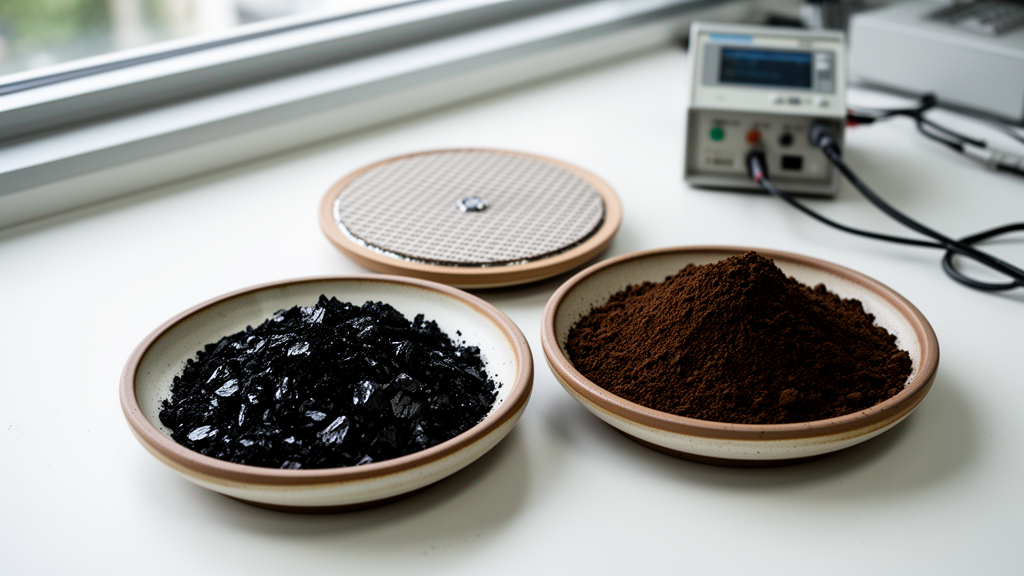
Waste shells from coconuts and kluwak nuts can be turned into carbon electrodes for electrical double-layer capacitors, and a new study shows the two biomasses perform very differently. Researchers converted both materials into activated carbon and then into partially reduced graphene oxide, testing how microwave treatment conditions shaped the resulting electrodes.
The team first produced activated carbon from each shell type. The activated carbon was then oxidized to graphite oxide using a modified Hummer’s method, and the graphite oxide was reduced in ethylene glycol through microwave-assisted solvothermal treatment to yield partially reduced graphene oxide, abbreviated p-rGO.
The novelty of the work lies in using kluwak shell as an alternative carbon precursor and systematically comparing its electrochemical performance with coconut shell-derived materials under controlled microwave conditions. For coconut shell-derived p-rGO, microwave power was varied at 100, 180, and 300 watts, while for kluwak shell-derived p-rGO, irradiation times of 15, 30, and 45 minutes were applied.
Structural characterization showed that increasing microwave intensity reduced the interlayer spacing and enhanced pore development, indicating improved reduction and structural ordering of the carbon material.
Electrochemical testing used three complementary techniques: cyclic voltammetry, galvanostatic charge-discharge, and electrochemical impedance spectroscopy. Together these measurements demonstrated superior performance for the coconut shell-derived materials across the tested conditions.
The numbers highlight the gap between the two precursors. Coconut shell activated carbon reached a specific capacitance of 130.83 farads per gram, and its p-rGO counterpart reached 103.58 farads per gram, with electrical conductivities of 0.78 and 0.30 siemens per meter respectively at 300 watts of microwave power.
Kluwak shell-derived materials lagged far behind. After 45 minutes of irradiation, kluwak shell activated carbon and p-rGO exhibited specific capacitances of only 1.39 and 3.73 farads per gram, with conductivities of 0.063 and 0.157 siemens per meter respectively. The results demonstrated a strong correlation between electrical conductivity and electrochemical performance, with the more conductive coconut-derived carbons storing substantially more charge.
Overall, the study concluded that coconut shell was the more favorable precursor for supercapacitor electrodes, while kluwak shell remained a promising sustainable alternative for biomass-derived carbon electrodes. Because both feedstocks are agricultural wastes, the approach points toward low-cost, sustainable electrode materials for energy storage devices, with precursor choice and microwave processing conditions as key levers for performance.
Subject of Research: Converting coconut shell and kluwak shell waste into activated carbon and partially reduced graphene oxide electrodes for electrical double-layer capacitors
Article Title: Biomass-derived carbon from coconut shell and kluwak shell for electrical double-layer capacitor applications
Article References: Susanti, D., Rindiani, N. A., Mubarok, R., Purwaningsih, H., Bahfie, F., Nurdiansah, H., Pramata, A. D., Pradesar, Y., Rohmanuddin, T. N., Fajarin, R., Rakhmawati, Y. W., Sagadevan, S., & Kusuma, G. E. (2026). Biomass-derived carbon from coconut shell and kluwak shell for electrical double-layer capacitor applications. BMC Chemistry. https://doi.org/10.1186/s13065-026-01947-2
Image Credits: AI Generated
DOI: 10.1186/s13065-026-01947-2
Keywords: supercapacitor, electrical double-layer capacitor, biomass-derived carbon, coconut shell, kluwak shell, activated carbon, reduced graphene oxide, microwave-assisted reduction, specific capacitance, electrical conductivity, cyclic voltammetry, sustainable materials
News Source: Bethany Barker. (October 29, 2026). Coconut Shell Carbon Outperforms Kluwak Shell in Supercapacitor Electrodes. Scienmag.