Researchers at Kobe University and their collaborators have developed a polymer membrane that lets singly charged ions pass through rapidly while blocking multiply charged ions, whether positive or negative. By engineering interconnected water-filled channels at the angstrom scale, the team demonstrated efficient lithium enrichment from magnesium-rich brines and high-purity salt recovery from simulated seawater, opening new possibilities for sustainable resource recovery.
Lithium is essential for rechargeable batteries used in electric vehicles and renewable energy storage, but recovering it from natural salt-lake brines remains difficult because those solutions often contain large amounts of magnesium and other dissolved salts. Similar challenges arise in seawater treatment, where valuable salts must be separated from complex mixtures of dissolved ions.
Membrane-based separation offers a promising alternative to conventional chemical treatment, but existing membranes face a fundamental trade-off between ion transport efficiency and selectivity. Enlarging membrane channels helps ions move through but lets unwanted ions pass, while narrowing channels improves separation at the cost of transport speed. Conventional ion-exchange membranes also generally favor either positively or negatively charged ions, making efficient discrimination between singly and multiply charged ions in both cationic and anionic systems a long-standing challenge.
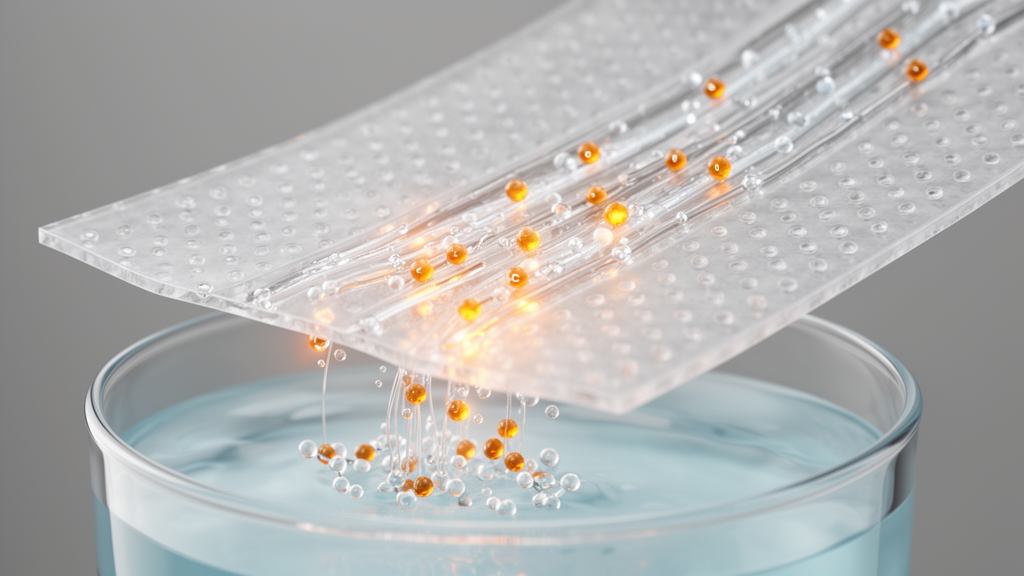
To overcome these limitations, Kobe University membrane engineering researchers Lin Yuqing, Matsuyama Hideto and their colleagues built a new class of ion-exchange membranes based on Tröger’s base-derived porous organic polymers. By combining specially designed molecular building blocks, they constructed a rigid, three-dimensional polymer network containing interconnected pores roughly 0.5 to 0.7 nanometers wide. They then introduced charged functional groups that promote the formation of continuous water-filled pathways, known as hydration channels, while maintaining the membrane’s structural stability. Unlike conventional approaches that mainly adjust pore size or membrane charge, this strategy simultaneously controls pore structure, connectivity and the local chemical environment through which ions move.
“The key is not simply to make membrane pores smaller, but to control how water molecules organize and connect within them,” explains Lin. “By engineering these hydrated pathways, we can facilitate the movement of singly charged ions while creating strong barriers against multiply charged ions.”
Experiments and molecular simulations revealed that the membrane’s selectivity arises from several mechanisms working together. Singly charged ions can partially reorganize their surrounding water molecules and move through the narrow channels with relatively low resistance. Multiply charged ions face substantially higher transport barriers because of stronger hydration, spatial confinement and electrostatic interactions. Positively charged magnesium ions are hindered by confinement and electrostatic repulsion, while negatively charged sulfate ions can become strongly associated with charged sites inside the membrane, restricting their movement. This ability to discriminate between singly and multiply charged ions in both cationic and anionic systems is a distinctive feature of the membrane.
To demonstrate practical potential, the researchers applied the membrane to a three-stage electrodialysis process for lithium recovery from magnesium-rich salt-lake brine. Electrodialysis uses an electric field to drive dissolved ions through selective membranes, allowing valuable ions to be separated and concentrated. The magnesium-to-lithium ratio fell progressively from approximately 40 in the initial brine to just 0.08 after three stages, an almost 500-fold reduction. The lithium-enriched solution was then converted into crystalline lithium carbonate with a purity of 99.5%. The membrane maintained stable separation performance during more than 400 hours of continuous electrodialysis operation.
Beyond lithium recovery, the same membrane selectively enriched sodium chloride from simulated seawater. After treatment, sodium and chloride accounted for 99.4% of the measured ion mass in the enriched solution, highlighting the versatility of a design that can separate different ion mixtures rather than being limited to a single application.
“The ability to combine rapid ion transport with precise selectivity is an important step forward in membrane separation technology,” says Matsuyama. “This approach offers new opportunities for recovering valuable resources from complex aqueous solutions.”
The findings show how molecular-level control of water-filled channels can help overcome the longstanding trade-off between transport efficiency and selectivity. Further development will focus on evaluating the membrane with actual industrial and natural water sources, improving large-scale fabrication and integrating the technology into practical separation systems. Beyond lithium extraction and salt purification, the approach could contribute to future membrane technologies for resource recovery, wastewater treatment and other electrochemical separation processes.
Subject of Research: Angstrom-scale water channels in polymer membranes for selective ion separation, lithium recovery and salt purification
Article Title: Angstrom-scale water channels help membranes recover lithium and purify salt
Article References: Angstrom-scale water channels help membranes recover lithium and purify salt. Original publication (Bibliographic details unavailable.)
Image Credits: AI Generated
DOI: Not provided
Keywords: lithium recovery, polymer membrane, electrodialysis, ion separation, hydration channels, porous organic polymers, magnesium-rich brine, seawater desalination, lithium carbonate, membrane technology, resource recovery, Kobe University
News Source: Neil Sanderson. (October 29, 2026). New Polymer Membrane With Angstrom Water Channels Extracts Lithium From Brine. Scienmag.