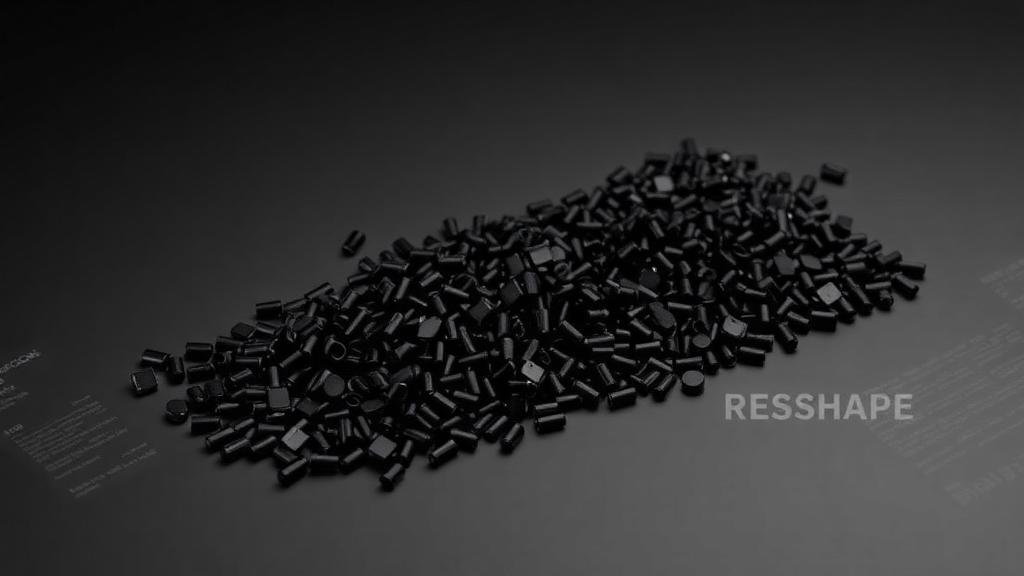
In a study published in Discover Polymers, Muleta Tiki Lemi, Hirpa G. Lemu, and Endalkachew Mosisa Gutema fabricated composite filaments containing 1.5, 2.5, and 3.5 weight percent acetylene-grade carbon black, 50 percent compressed, with particles averaging 75 ± 2 nm, and then printed and tested standardized specimens. Their central result is nuanced rather than dramatic: at 2.5 weight percent carbon black, the composite matched the mechanical performance of pure polylactic acid, reaching a Young’s modulus of 3.9 GPa and an average tensile strength of 39.46 MPa, comparable with the 40.85 MPa measured for the neat polymer, while every carbon-black-loaded sample showed reduced strain at failure.
The choice of polylactic acid as the matrix was deliberate. It is a semi-crystalline thermoplastic produced from renewable feedstocks such as corn starch or sugarcane, with a melting point between 145 and 160 °C and a glass transition between 45 and 60 °C, and it resists fats, moisture, alcohols, and UV radiation. Its weaknesses are equally well documented: low elongation at break, limited impact resistance, and moderate heat resistance. Carbon black was selected because it is a conductive, cost-effective inorganic filler known to enhance rigidity, thermal stability, and dimensional stability, and because prior work has shown that adding 1 to 5 weight percent can improve polylactic acid crystallinity, tensile strength, and heat resistance. The team’s stated motivation, however, extends beyond stiffness: carbon black imparts electrical conductivity, and the group is targeting potential textile printing applications in which a biodegradable, conductive filament would be valuable.
Sample preparation began with Ingeo 4043D polylactic acid granules shredded to 0.1–2.0 mm and manually blended with the carbon black loadings in a stainless steel container. Filaments of 1.75 ± 0.05 mm diameter were then produced on a 3Devo Precision 450 single-screw extruder with four heating zones and a screw speed of 3.5 rpm. Extrusion temperature proved critical: below 190 °C the melt clogged the nozzle and produced heterogeneous filament, while above 260 °C the material flowed too quickly to hold diameter and risked thermal degradation of the polymer. The researchers settled on 190 °C for pure polylactic acid and 250, 255, and 260 °C for the 1.5, 2.5, and 3.5 weight percent composites respectively. Loadings above 3.5 weight percent were attempted but abandoned as unprocessable with the 0.4 mm nozzle used throughout the study.
Tensile specimens were printed to the ASTM D638 Type 1 specification on an Original Prusa MK4S with an enclosed, temperature-controlled build chamber. Pure polylactic acid was printed at a 190 °C nozzle temperature and 40 mm/s, while the composites required 240 °C and 30 mm/s, reflecting the increase in melt viscosity and thermal conductivity that carbon black introduces. All specimens used a 60 °C platform, 0.4 mm layer thickness, a 45° infill pattern, and 100 percent infill. Five identical samples were printed and tested for each composition on an Instron universal testing machine with a 2.5 kN load cell and a crosshead speed of 5 mm/min, with strain measured by extensometer in the elastic regime, and average values were computed from the five replicates.
The tensile data revealed a non-monotonic pattern. The 1.5 weight percent composite was the weakest of all tested samples in elastic modulus, maximum force, and tensile strength, which the authors attribute to insufficient and non-uniform dispersion of carbon black at low filler content, where the concentration may fall below the percolation threshold needed to form an effective reinforcing network. At 2.5 weight percent, the modulus peaked at 3.9 GPa, an exceptional value the authors link to improved dispersion and partial formation of a reinforcing filler network that restricts polymer chain mobility and improves load transfer. Notably, the printed pure polylactic acid showed a Young’s modulus of 2.9 GPa, well below the manufacturer’s datasheet value of 3.6 GPa for the raw granules, a gap consistent with the known reduction in mechanical performance that layer-by-layer printing imposes relative to molded material.
Ductility moved in the opposite direction. The strain at failure for every carbon-black-reinforced sample was lower than that of pure polylactic acid at 0.84 percent, with the lowest value, 0.52 percent, registered for the 2.5 weight percent composite. The authors explain this embrittlement by the hindrance that rigid filler particles pose to molecular chain alignment, which is only achievable when matrix continuity is preserved, together with void formation between printed layers and stress concentrations wherever poorly bonded particles sit in the matrix. The composites became harder and more brittle as loading rose, and the authors caution that no clear trend as a function of weight percent emerged overall, with porosity from the printing process and molecular weight loss during extrusion and printing both cited as contributing factors.
Hardness told a cleaner story. Measured with a Shore D durometer according to ISO 48-4 on printed specimens of 26 × 13 × 3.2 mm at 100 percent infill, hardness increased proportionally with carbon black content. The 3.5 weight percent composite exhibited the highest average hardness at 81.40 N, while pure polylactic acid registered the lowest at 73.71 N, an effect attributed to the increased filler surface area within the matrix. Variability, however, was composition-dependent: the 1.5 weight percent samples showed a noticeably higher standard deviation of 2.3, which the researchers connect to non-uniform filler dispersion and localized agglomeration arising from the manual mixing step. The authors also note that durometer hardness alone is not a reliable predictor of strength, abrasion, or wear resistance and should not be used as the sole basis for design specifications.
Scanning electron microscopy of tensile fracture surfaces, performed on a Zeiss Gemini SUPRA 35VP at 15 kV with gold-coated samples at 200× and 500× magnification, added the microstructural context. The 1.5 weight percent fracture surfaces contained tensile cracks, delamination, and voids consistent with their weak mechanical showing, and fibers misaligned to the load direction were visible. The pure polylactic acid surfaces were not defect-free either, showing triangle-shaped hollow spaces at fiber ends, so the observed defects cannot be attributed solely to the carbon black. Across all four compositions, no significant microstructural differences were detected, which the authors ascribe to the difficulty of achieving homogeneous carbon black distribution at the filament preparation stage in the absence of plasticizers or more sophisticated mixing.
The authors are candid that part of the underperformance likely stems from their processing choices. Manual blending cannot guarantee complete dispersion, and they cite work suggesting that careful particle size selection and double-stage extrusion could improve homogeneity enough to allow higher carbon black loadings without sacrificing mechanical performance. Their conclusion is that 2.5 weight percent is the practical optimum in this system, delivering mechanical properties equivalent to pure polylactic acid while the embedded conductive filler adds functional value that pure polymer cannot offer. Electrical conductivity itself was not measured in this study and remains the subject of continuing work, as do thermal characterization of the composites and dispersion improvements using double extrusion or dispersing agents. For now, the study establishes a processing window and a composition benchmark for biodegradable, potentially conductive filaments aimed at applications such as printed textiles.
Subject of Research: Mechanical and microstructural characterization of 3D printed polylactic acid composites with varying carbon black loadings
Article Title: Characterization of 3D printed polylactic acid composites with varying carbon black concentrations manufactured by material extrusion process
Article References: Lemi, M. T., Lemu, H. G., & Gutema, E. M. (2026). Characterization of 3D printed polylactic acid composites with varying carbon black concentrations manufactured by material extrusion process. Discover Polymers, 3(1), Article 15. https://doi.org/10.1007/s44347-026-00054-8
Image Credits: AI Generated
DOI: 10.1007/s44347-026-00054-8
Keywords: 3D printing, polylactic acid, carbon black, material extrusion, composites, tensile strength, hardness, Shore D, SEM, biodegradable polymers, filament extrusion, electrical conductivity
News Source: Denise Maddox. (October 29, 2026). Carbon Black Loads Reshape 3D Printed Bioplastic Strength and Hardness. Scienmag.