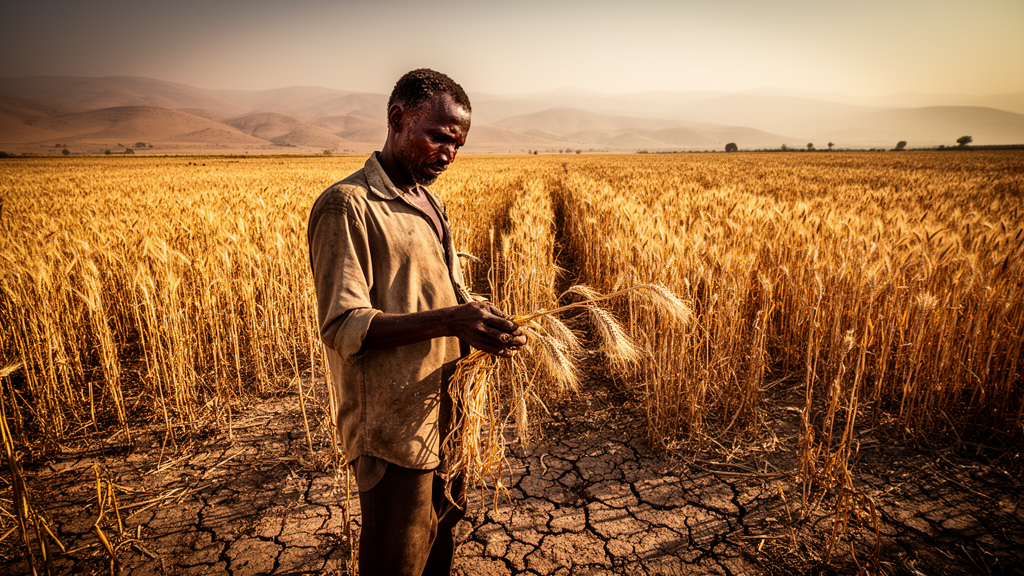
Rain-fed wheat in Ethiopia’s Upper Blue Nile Basin faces a steep decline in viability under high-emission climate scenarios, according to a new modeling study published in Ecological Processes. Using the FAO Global Agro-Ecological Zones framework driven by bias-corrected CMIP6 climate projections, researchers mapped how climate-related production constraints, multi-cropping potential and attainable yield ceilings for wheat could evolve from the 2020s through the 2080s under two Shared Socioeconomic Pathways, SSP3-7.0 and SSP5-8.5. The results point to a basin that becomes progressively divided: southern lowlands slide toward severe climatic marginality, while northern highlands retain conditions capable of sustaining high yields.
Wheat is a critical crop for Ethiopia, supplying roughly 14 percent of national caloric intake and occupying about 1.7 million hectares of rain-fed land, with a further 0.4 million hectares irrigated, based on statistics from 2020 to 2022. The Upper Blue Nile Basin alone contributes more than 45 percent of national wheat production, yet the average rain-fed yield of 2.8 tonnes per hectare sits well below the attainable potential estimated by the study. Terminal drought and extreme heat during flowering already account for an estimated 35 to 50 percent of annual yield variability, and acidic soils impair nutrient uptake across more than 40 percent of the basin’s croplands.
The study’s central metric is the climate-related constraints index, a composite measure from the GAEZ framework that ranges from 0 to 10,000 and captures the combined limiting effects of thermal and moisture stress. Values below 5,000 signal severe limitations corresponding to potential yield reductions exceeding 50 percent. During the historical baseline of 1981 to 2010, southern and southeastern parts of the basin already showed such vulnerability, while northern and central zones remained comparatively stable. Under future scenarios, these constraints intensify and spread.
By the 2080s under SSP5-8.5, approximately 35 percent of the total basin area transitions into a zone of acute vulnerability, with constraint values dropping near 4,000, implying potential yield losses from climate stress alone exceeding 50 percent. In contrast, the northern highlands consistently maintain constraint scores above 7,000, confirming their role as climatic refugia. The researchers define the southern UBNB as the area below 9.5 degrees north latitude, encompassing the Didessa, Guder and upper Gibe catchments, while the northern highlands lie above 11 degrees north and above 2,000 meters elevation.
A parallel analysis of agro-climatic constraints, which add pests, diseases and field workability to the climate stress picture, revealed that these patterns track the climate index almost exactly. Pixel-level correlation between the two layers exceeded 0.93 across all periods and scenarios, and the climate index explained roughly 89 percent of the variance in the broader constraint measure. This indicates that within the model’s parameterization, climatic stress dominates and pest effects are secondary, though the authors caution that the composite index does not allow the separate contributions of heat versus moisture stress to be quantified.
Multi-cropping potential, a key avenue for intensifying food production on limited land, contracts substantially in the projections. Historically, single cropping covered 70.8 percent of the basin, double cropping 26.2 percent and triple cropping 3.0 percent. Under SSP5-8.5, double-cropping area falls from 26.2 percent historically to 10.9 percent by the 2080s, a 58.4 percent reduction, while single cropping expands to 87.9 percent of the basin. Under the less severe SSP3-7.0 pathway, double cropping declines by 37.8 percent over the century. The contraction is attributed to increased rainfall variability and shortened growing periods, and the authors note this is a biophysical assessment that does not account for socio-economic feasibility.
The yield modeling produced what the authors describe as a critical inversion: the warm, high-radiation western lowlands show the highest theoretical yield potential but become the least suitable areas once water and heat limitations are applied. In the baseline period, attainable yields ranged from 750 kilograms per hectare under low-input assumptions to over 9,055 kilograms per hectare under high-input systems, with the highest values concentrated in the north-central highlands. Under SSP5-8.5, high-input yields in these resilient highland areas remain above 9,000 kilograms per hectare, but the extent of such refugia contracts dramatically, from 26.1 percent of the basin historically to just 2.2 percent by the 2080s.
Meanwhile, the area with attainable yields below 3,000 kilograms per hectare, a threshold marking increasing marginality relative to the national average of 2,800 kilograms per hectare, expands from 1.2 percent historically to 23.4 percent of the basin by the 2080s under SSP5-8.5, a roughly 19-fold increase. The centroid of high-yield areas migrates northward by approximately 55 kilometers, and the mean attainable yield on currently cultivated wheat lands declines from 4,850 to 3,220 kilograms per hectare, a 33.6 percent reduction. Under SSP3-7.0, the marginal area still expands to 18.7 percent by the 2080s.
The authors emphasize several limitations when interpreting these figures. The climate input data operate at a coarse 0.5-degree resolution that averages out local variability and may obscure micro-refugia or pockets of acute vulnerability. The five-model ensemble mean may not capture the full range of possible outcomes, particularly for rainfall extremes. The GAEZ model represents pests and diseases only through a generic recovery factor rather than explicit life-cycle simulation, and the simulated yields represent attainable ceilings under optimal management rather than predictions of what farmers will actually harvest. Field-scale validation was not possible due to data scarcity, and comparison with district-level statistics is planned for subsequent work.
Despite these caveats, the study offers a spatially explicit blueprint for adaptation. In vulnerable southern lowlands where constraint values fall below the critical threshold, the authors suggest policymakers could consider supporting a transition toward heat- and drought-tolerant crops such as sorghum and millet, though they stress that socio-economic feasibility requires local assessment. In the highland refugia, they propose prioritizing climate-resilient, fast-maturing wheat varieties combined with water conservation measures including terracing, conservation tillage and water harvesting. The authors frame these as adaptation directions derived from biophysical modeling, noting that implementation would require integrated evaluation of market access, farmer preferences and institutional support to safeguard wheat production in a region central to Ethiopia’s food security.
Subject of Research: Projected climate constraints and attainable yields for rain-fed wheat in Ethiopia's Upper Blue Nile Basin
Article Title: Climate constraints and maximum attainable yield of rain-fed wheat in the Upper Blue Nile Basin under climate change
Article References: Demissew, W. L., Zeleke, T. T., Ture, K., & Mengistu, D. K. (2026). Climate constraints and maximum attainable yield of rain-fed wheat in the Upper Blue Nile Basin under climate change. Ecological Processes, 15(1), Article 86. https://doi.org/10.1186/s13717-026-00746-w
Image Credits: AI Generated
DOI: 10.1186/s13717-026-00746-w
Keywords: Ethiopia, Upper Blue Nile Basin, rain-fed wheat, climate change, GAEZ, CMIP6, SSP5-8.5, yield projections, multi-cropping, food security, adaptation, agro-climatic modeling
News Source: Alan Morgan. (October 30, 2026). Climate Stress Could Cut Ethiopian Wheat Yields by Half by the 2080s. Scienmag.