


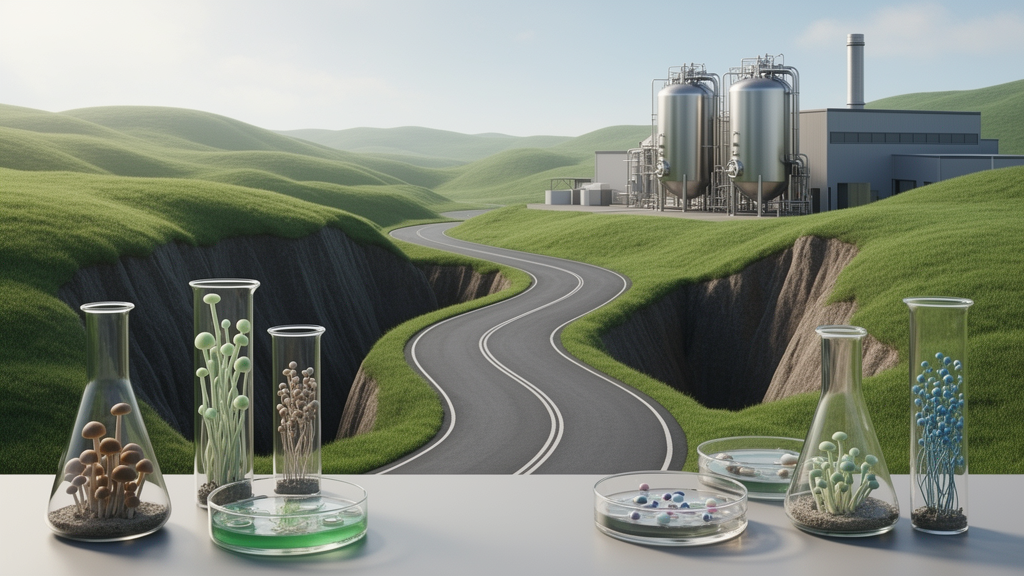
Filamentous fungi have quietly built the modern fermentation industry. For more than a hundred years they have served as production hosts for proteins, enzymes, certain drugs and platform chemicals such as citric acid, which is produced by Aspergillus niger and ranks, after ethanol, as the largest volumetric biotech product in the world. Yet according to a new editorial in the journal Fungal Biology and Biotechnology, the field now stands at a crossroads: despite a wave of start-ups, large investments and celebrated media stories, many fungal biotech solutions still fail to reach the market, and the authors argue that two distinct bottlenecks—two so-called valleys of death—stand between laboratory discovery and commercial reality.
The editorial, written by Yvonne Nygård and Vera Meyer, takes stock of where fungal biotechnology stands today and asks where tomorrow’s fungal biotechnology could take us. The authors note that during the past decades the importance of fungal biotechnology in advancing a bioeconomy and a circular economy has been emphasized in scientific literature, project proposals, awarded grants and social media. Filamentous fungi have been proven to provide sustainable solutions for a wide range of industrial applications, from bioremediation and medicine to the production of food, feed, materials, chemicals and energy. But the number of start-ups in the fungal biotechnology space has steadily increased in recent years even as some companies announce their stories have come to an end, prompting the authors to ask why more fungal biotech solutions have not yet been realized.
To answer that question, the authors borrow a framework from a recent policy paper published by the European Bio-based Industry Consortium, which emphasizes that Europe must accelerate the path from lab to factory by enabling biomanufacturing at scale along the value chain. According to that analysis, not one but two valleys of death hinder commercialization of bio-based innovations. The first refers to translating laboratory innovation into a proof-of-concept prototype, with key challenges relating to technology development, scaling up and financing. The second refers to transforming initial prototypes into commercially viable products, with key challenges relating to market penetration, regulatory approvals, a sustainable supply of biomass and financing. In the context of fungal biotechnology, the editorial identifies major hurdles within the first valley as limited genetic and molecular knowledge of the fungal production host, lengthy strain development and challenges in scale-up caused by unpredictable fungal macromorphologies.
On the technical side, the authors describe a field whose genetic toolbox has expanded dramatically but unevenly. Advancements in genome engineering using modern synthetic biology tools such as CRISPR with Cas9 or Cas12a, together with increasing amounts of available sequence data, have led to more fungal species being explored, and more than 23,000 fungal genomes are now available in online databases. This has shortened the still long time needed for genetic engineering of fungi. Synthetic toolkits for filamentous fungi have recently been reported and shared with the community, and many synthetic biology tools developed in more easily manipulatable model organisms, often yeast, are today rapidly translated to fungal systems. Cas ribonucleoparticles circumvent the need for expression of Cas and sgRNAs, bypassing the need to develop genetic tools for each new species.
Still, the editorial is candid about the remaining friction. Engineered fungi are typically achieved through protoplastation, but developing protocols for generating protoplasts and achieving efficient transformation of novel species or even strains can be very time consuming. Protoplast formation is followed manually under the microscope, and learning what a good protoplast looks like for a given strain demands many rounds of trials followed by long incubation times waiting for colonies to appear. Cryopreservation of protoplasts can be a great time saver, and other commonly used approaches include Agrobacterium-mediated transformation and electroporation, but the cellular mechanisms involved in transformation of fungi are yet to be elucidated. The multicellular morphology of filamentous fungi further challenges gene manipulation, and they possess only a limited number of plasmids and selectable markers, although the AMA1 plasmid has been shown to be stable in many different fungal species, providing a tool for assessing constructs across strains.
The synthetic biology toolbox of filamentous fungi is already quite vast, the authors conclude—the challenge is the efficiency and reliability of these tools, which still often leaves room for improvement, and their transferability to fungi that have received less study but are potentially better suited for industrial applications. CRISPR activation has been demonstrated for activation of biosynthetic clusters, and CRISPR interference has been demonstrated for gene silencing in several fungal species; before the CRISPR era, RNA interference was used as a tool for silencing genes, often conditionally upon induction. Meanwhile, the kingdom of fungi is estimated to constitute millions of species, yet the number of fungal species studied and used for production purposes remains modest, and the number of groups working with filamentous fungi is, compared to many other fields, still rather small. Often, fungal start-ups prefer not to reveal their species employed.
The commercial landscape reflects this concentration. Traditionally, Trichoderma or Aspergillus species for protein production, Fusarium venenatum for food and single cell protein production, and Penicillium chrysogenum or Acremonium chrysogenum for antibiotics production have dominated. Solid state fermentation for obtaining mycelium for applications such as leatherlike materials, composites or packing materials is typically conducted with basidiomycetes such as Trametes versicolor, Pleurotus ostreatus, Ganoderma lucidum and Fomes fometarius, while leatherlike materials have also been obtained through submerged bioreactor cultivation of Trichoderma reesei. There are already a few commercial mycelium-material producers, but such materials struggle to compete with other, synthetic materials both in terms of properties and price. Nevertheless, the authors argue that many of the recognized challenges facing fungal materials can be addressed through genetic engineering of the fungal production host, optimizing the production processes, or combining the material with other biodegradable substances.
Scale-up remains the field’s stubborn problem. The relatively low number of species employed today may be due to vast domestication efforts having shaped the commercially employed fungi into cell factories amendable for genetic engineering and fit for large-scale production in bioreactors. The morphology of fungi, which typically form large clumps in submerged cultures, challenges their exploitation, and a more uniform growth pattern has in many cases been obtained by selection and various classical strain improvement technologies, including mutagenesis and adaptive laboratory evolution and combinations thereof—efforts that rely on selection of mutants with favorable features. While efforts for establishing fungal biofoundry platforms have been initiated, screening filamentous fungi in high throughput still remains challenging after two decades of research efforts by the community and cannot be considered yet as a routine method. Microfluidics, automation and artificial intelligence are expected to advance fungal biotechnology, but examples at higher technology readiness level remain scarce. Translating research results from small to even medium, let alone pilot or industrial scale is notably difficult, and access to pilot or demo facilities for technology validation remains a bottleneck within the first valley of death, although several fungal start-ups have built their own pilots that have enabled them to refine their technology, make prototypes of products or even produce small batches for commercial use.
The second valley of death is regulatory. The regulatory landscape for novel fungal products is complex and approval processes can be tedious, requiring rigorous safety assessments. In Europe, the Novel Food authorization by the European Food Safety Authority is required for food that had not been consumed to a significant degree by humans in the EU before 15 May 1997, while in the US the FDA regulates compounds to be used for food, feed and drug applications. Navigating these hurdles can be time-consuming and costly, posing challenges for start-ups and established companies alike. There is a clear demand for more transparent and rapid approval processes in the EU, with stakeholders such as EuropaBio calling for an improved regulatory approach for use of microorganisms in food and feed, environmental and agricultural applications, and consumer applications such as detergents and cosmetics. Because regulations for products used as food are more stringent than those for feed or materials, many companies choose to start commercialization of less regulated products such as fish feed or materials, and investors are hesitant to invest in technologies where the path to commercialization and timelines for approval are unknown.
There are signs of progress. A recent breakthrough came when EFSA issued a positive scientific opinion for Fermotein, a fungal biomass ingredient and the first fermented fungal biomass novel food in Europe, and Swedish rainbow trout raised on circular feed made of insects, mussels and mycoprotein sold out in no time. The authors also point to the new EU framework, published on December 4, 2025, that allows certain plants used for foods to be altered and sold using so-called New genomic techniques, which they expect will further support market entry of genetically modified fungal food products. Recent years have also marked several news reports on start-ups securing funding for full-sized commercial factories for production of fungal biomass for feed and food applications, and the authors hope to see many new mycoprotein-based products hitting the market in the coming years. These and globally many more examples, initiatives and frameworks, they write, can help unlock the full potential of fungi as enablers of a future sustainable bioeconomy—not only in the food sector but also in the materials sector and beyond.
Subject of Research: Barriers to commercializing filamentous fungal biotechnology for a circular bioeconomy
Article Title: How to get the most out of fungal biotechnology?
Article References: Nygård, Y., & Meyer, V. (2026). How to get the most out of fungal biotechnology?. Fungal Biology and Biotechnology, 13(1), Article 1. https://doi.org/10.1186/s40694-025-00207-7
Image Credits: AI Generated
DOI: 10.1186/s40694-025-00207-7
Keywords: fungal biotechnology, filamentous fungi, valleys of death, CRISPR, protoplast transformation, scale-up, mycoprotein, novel food regulation, EFSA, bioeconomy, mycelium materials, strain engineering
News Source: Gregory Coleman. (October 30, 2026). Fungal biotechnology faces two valleys of death on the road from lab to factory. Scienmag.



