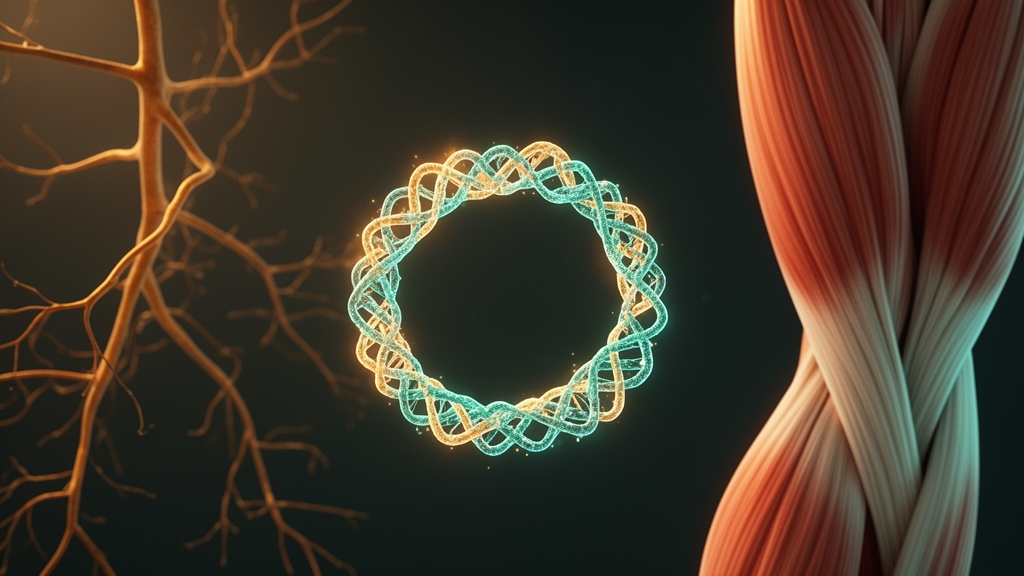
Circular RNAs, a class of single-stranded molecules whose covalently closed loop structure makes them unusually stable, are gaining attention as regulators of gene expression, and a mini review published in the journal Amino Acids now focuses on one of them: circSMOX. The review, authored by Marianna Nicoletta Rossi, Lavinia Attili and Manuela Cervelli and published on 18 September 2026, gathers what is currently known about this circular RNA in muscle and neuronal physiology and disease.
CircRNAs influence gene expression through several routes, according to the review. Many act as molecular sponges that sequester microRNAs, others bind specific RNA-binding proteins, and some affect transcription or post-transcriptional control. A subset can even be translated into short peptides. These molecules are particularly abundant in the nervous system and in skeletal muscle, where they contribute to processes such as neural development, synaptic function, neuronal plasticity, muscle formation and tissue homeostasis. Disruptions in circRNA expression patterns have been linked to neurodegenerative conditions, muscle-wasting disorders and other disease states.
Among the known circular RNAs, circSMOX is formed from exons 2 and 3 of the murine SMOX gene. The review describes it as dynamically expressed during brain and muscle development and as increased in models of ischemia, spinal cord damage and muscle atrophy. During C2C12 myogenic differentiation, a widely used cell model of muscle cell formation, circSMOX expression parallels that of the linear SMOX transcript.
The picture changes in disease settings. In dexamethasone-induced atrophy and in two amyotrophic lateral sclerosis mouse models, SOD1G93A and hFUS+/+, which exhibit progressive muscle atrophy, circSMOX is significantly upregulated. This contrast between developmental and atrophic contexts is one of the observations the review highlights as a basis for further mechanistic work.
Subcellular localization and abundance also distinguish circSMOX from its linear counterpart. The review notes that circSMOX is mainly localized in the cytoplasm and is less abundant than the linear isoform. Functionally, it acts as a sponge for miR-340-5p, thereby influencing neuroinflammatory pathways, a role that connects the molecule to inflammatory signaling relevant in neural tissue.
The authors are careful to frame the current state of knowledge. Despite these insights, the precise molecular mechanisms of circSMOX remain to be fully clarified, and the identification of a human ortholog will be important to broaden its therapeutic potential. Because the molecule has so far been characterized in murine systems and cell models, translating these findings toward human biology depends on establishing whether an equivalent circular RNA exists in people.
As a mini review, the article does not report new experimental results but consolidates existing evidence on circSMOX’s expression patterns, localization and proposed mechanism of action. It situates the molecule within the broader landscape of circular RNAs, whose tissue- and stage-specific expression patterns are increasingly recognized as important in gene regulation, particularly in nerve and muscle where many of these stable loop-shaped transcripts accumulate.
For researchers studying neurodegeneration and muscle wasting, circSMOX offers a concrete example of how a single circular RNA can be tied to both normal development and pathological atrophy in the same tissues. The open-access review, published in Amino Acids, is intended as a stepping stone toward clarifying the mechanisms that remain unresolved and toward determining whether the murine findings can be extended to human disease.
Subject of Research: The circular RNA circSMOX and its roles in muscle and neuronal physiology and disease
Article Title: CircSMOX in muscle and neuronal physiology and disease
Article References: Rossi, M. N., Attili, L., & Cervelli, M. (2026). CircSMOX in muscle and neuronal physiology and disease. Amino Acids. https://doi.org/10.1007/s00726-026-03549-7
Image Credits: AI Generated
DOI: 10.1007/s00726-026-03549-7
Keywords: circSMOX, circular RNA, SMOX gene, muscle atrophy, amyotrophic lateral sclerosis, miR-340-5p, neuroinflammation, gene expression, myogenic differentiation, neurodegeneration, skeletal muscle, mini review
News Source: Diana Fleming. (October 28, 2026). Circular RNA circSMOX Emerges as a Player in Muscle and Nerve Disease. Scienmag.